


As Turkish President Recep Tayyip Erdogan seeks re-election in June, it's worth asking who in the international community would like him to win and who wouldn't. After all, this election won't have just local importance — it will have geopolitical implications as well.
The Turkish President, one might assume, doesn't enjoy the most cordial of relations with a number of leaders around the world.
Some European leaders are wary of him, particularly of his policies that they see as provocative and opportunistic on a range of issues, from the standoff with Greece to his encouragement of migration to Europe. The US administration and Congress might be worried about a new Erdogan term, too, given how much of a thorn he has been in the side of Nato, despite Turkey being a member of the security alliance.
The Iranian regime is wary of Mr Erdogan, particularly of his regional ambitions that rival its own, with both countries vying for dominance in the Mena region. Tehran doesn't want Ankara to expand at its expense across the region.
A number of Arab leaders also lack faith in Mr Erdogan, due in part to his historic links with the Muslim Brotherhood. Some Arab nations have improved relations with Ankara in recent months, yet the latter's regional ambitions worry them just like they concern Iran. Israel, meanwhile, has been at the receiving end of Mr Erdogan’s impulses, and it views him to be a permanent friend of Hamas and a saboteur of its ambitions from Syria to Sudan.
Both Iraq and Syria share at least one concern with Turkey, which relates to their sovereignty and territorial integrity. Much of this stems from the fact that among the Kurdish populations living across all three borders, there are those seeking greater autonomy for themselves, leading Ankara to conduct cross-border military operations.
This leaves Russia, which appears to be one of the countries that will want Mr Erdogan to win. President Vladimir Putin has staked Russia’s relations with Turkey on Mr Erdogan personally, given how much he needs him owing to the Ukraine war and the resulting western sanctions.
-

Saudi King Salman walks with Turkish President Recep Tayyip Erdogan at Al Salam Palace in Jeddah, Saudi Arabia. All photos: SPA -
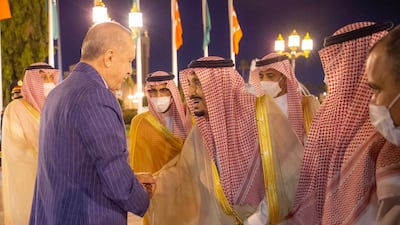
King Salman welcomes Mr Erdogan to Al Salam Palace. -
King Salman welcomed Mr Erdogan and a high-level delegation to the palace in Jeddah. -
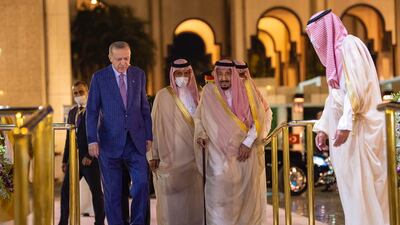
King Salman held a welcome ceremony and iftar for Mr Erdogan and his delegation. -
King Salman and Mr Erdogan at Al Salam Palace. -
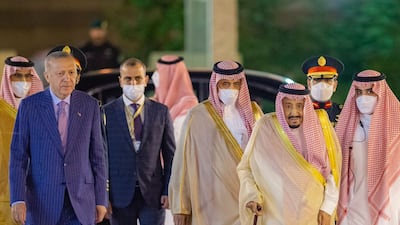
Mr Erdogan thanked King Salman for his welcome as he looked to strengthen ties between his country and the kingdom. -
King Salman welcomes Mr Erdogan to Jeddah on the start of his two-day visit. -
King Salman and Mr Erdogan share coffee as they speak at Al Salam Palace. -
King Salman in discussion with Mr Erdogan. -
Mr Erdogan expressed his happiness to visit Saudi Arabia and to meet King Salman and Crown Prince Mohammed bin Salman. -
Saudi Crown Prince Mohammed bin Salman at Al Salam Palace. -
Crown Prince Mohammed bin Salman welcomes Mr Erdogan at the Jeddah palace. -
Dignitaries at the reception for Mr Erdogan included leading members of the Saudi royal family.


For Moscow, there are also political and economic implications. Indeed, the fate of the Russian economy is tied closely to that of Turkey. Today, it relies a great deal on sanctions-busting trade with Turkey, including oil exports, tanker transit, technology transfer, and other activities affected by American and European sanctions. Since the Ukraine war began, trade between Russia and Turkey has doubled.
Mr Erdogan's decision not to antagonise Moscow frustrates its western allies, who seek to isolate the latter.
The US is threatening to impose secondary sanctions on Turkey, including blocking banking transactions, which could be devastating for its economy. Mr Erdogan appears confident it will not happen. But even if it does, he could find a way to use it to his benefit in the election by accusing the Washington of trying to damage the country.
The Biden administration is said to be unhappy about a recent meeting held by the defence ministers of Turkey, Russia and Syria in Moscow, triggering a campaign against normalisation of relations with Syria's Assad regime. However, its real anger was directed at Mr Erdogan.
The Turkish President has resolved that rapprochement with Damascus would be crucial to his re-election bid, as he seeks a deal to exit the corner he had backed himself into, when he had threatened to launch military operations in Syria against Kurdish forces there, to establish a buffer zone along the Turkish border. Mr Erdogan has realised the extent of the possible fallout of such an offensive for his electoral chances and has thus sought an off ramp.

I am given to understand that Mr Erdogan has sought guarantees from Moscow that Russia and Syria will not cause further problems to Ankara, which would precipitate Turkish operations inside Syrian territory. He also sought guarantees to maintain the status quo for the next six months until the election. Mr Erdogan can then present these guarantees as a triumph of his policies, which might give him leverage in the election.
Mr Erdogan’s role as an intermediary between the Russian and Ukrainian leaderships is also crucial for Moscow, but even more important is his ability to rub fellow Nato members the wrong way.
Turkey’s membership of the alliance has often been a source of tension for the other member states, particularly because Mr Erdogan gradually moved previously secular Turkey in a more Islamist direction. It also didn't help that Ankara cut arms deals with Russia, exposing Nato security to potential risks, for which Washington imposed sanctions on it.
Further, Turkey hasn’t been part of the otherwise widespread consensus within Nato on the Ukraine war. While this has caused anxiety in the West, Mr Erdogan has played an important role, brokering a grains deal between Russia and Ukraine, in a move that has been welcomed globally as it boosted global food security. Mr Erdogan has also engaged in attempts to mediate between the leaders of the two countries.
The Turkish President is today a player in the regional landscape, especially in Syria, as well as the global geopolitical landscape. Which means, a change in leadership in Ankara would almost certainly amount to a change in global geopolitics.
The question is: Which way will the Turkish people vote?

