


I’m old enough to have excitedly watched the grainy TV images of the first Moon landings by Apollo 11 in 1969. I can never look at the Moon without recalling this heroic exploit. It was achieved only 12 years after the first object, Sputnik-1, was launched into orbit. Had that momentum been maintained, there would surely have been footprints on Mars a decade or two later. That’s what many of our generation expected. However, in the 1960s there was a “space race” – a contest in superpower rivalry between the US and the Soviet Union, when Nasa absorbed up to 4 per cent of the US federal budget. Once that race was won, there was no motivation for continuing this huge expenditure.
To today’s young people, these exploits – still the “apogee” of human spaceflight – are ancient history. Yet, space technology has burgeoned. We depend on satellites every day, for communication, weather forecasting surveillance, and satnav. Robotic probes to other planets have beamed back pictures of varied and distinctive worlds; several have landed on Mars. And telescopes in space have revolutionised our knowledge of the cosmos.
The successful launch this month of Nasa’s Artemis 1 rocket – at the third attempt – signals the start of a new programme to send astronauts to the Moon this decade – and perhaps eventually to Mars. And there may be parallel developments from China.
-
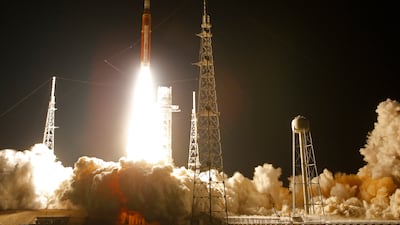
Nasa's Artemis 1 Moon rocket lifts off from Cape Canaveral, Florida. Reuters -
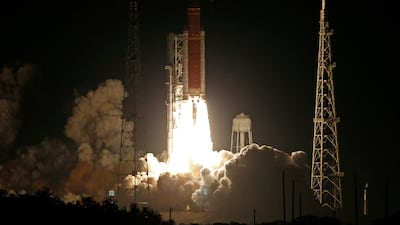
The unmanned Space Launch System (SLS) rocket with the Orion crew capsule attached launched from complex 39B. Reuters -
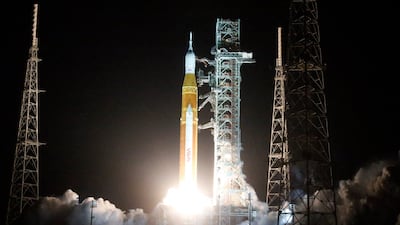
This was the third attempt by Nasa to launch the rocket. Reuters -
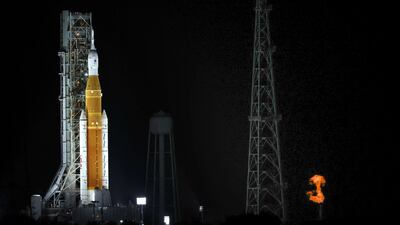
Artemis 1 ready for launch at Florida's Kennedy Space Centre on November 16, 2022. Getty Images / AFP -
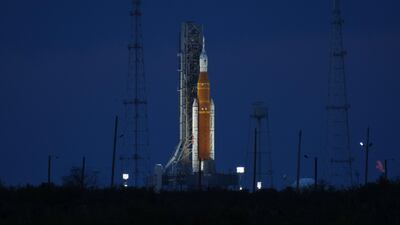
Previous attempts were failed owing to hydrogen leaks. Two hurricanes delayed other attempts. Getty Images / AFP -

The Artemis 1 mission is an uncrewed test flight around the Moon and will test the Space Launch System rocket's performance. Getty Images / AFP -
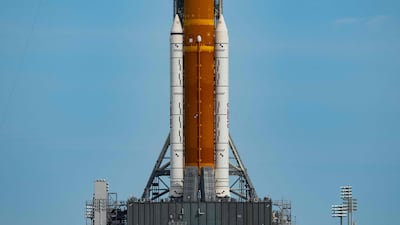
The Artemis I lunar rocket sits on launch pad 39B at NASA's Kennedy Space Center in Cape Canaveral, Florida, on November 15, 2022. AFP -

Black vultures circle the area as the Artemis I lunar rocket sits on launch pad 39B at NASA's Kennedy Space Center in Cape Canaveral, Florida, on November 15, 2022. AFP


Artemis 1 is actually not very different from the Saturn V rockets that launched the Apollo astronauts. Like its predecessors, its booster combines liquid hydrogen and oxygen to create enormous lifting power before falling into the ocean. Planned launches by the SpaceX “starship” launcher, similar in size, should be far cheaper because the rocket can be recovered and reused.
Artemis 1 is intended to be followed within two years by a mission that will take astronauts to orbit around the Moon. The third launch, later this decade, will allow astronauts to return to the lunar surface – after a more than 50-year gap.
But it’s good that robotic lunar exploration – far more cost-effective – is being pursued by other nations. And, in particular, that the UAE’s Rashid rover will soon be on its way. The mission, whose launch has been scheduled on Wednesday from Cape Canaveral in Florida, will be one of great interest to all of us, particularly as its objective is to study the geology of the Moon. I am also told that thousands of high-resolution images will be captured of the surrounding areas, which will not only make for interesting viewing but also deepen our understanding about the Moon.
Many, in fact, query the case for sending humans. The romance of human spaceflight is undimmed, but there is an important difference between the Apollo era and the mid-2020s; the amazing improvement in our ability to create, launch, and guide robot explorers and fabricators. These are exemplified by the suite of rovers on Mars, where Perseverance, Nasa’s latest prospector, can drive itself through rocky terrain with only limited guidance from Earth. Furthermore, improvements in sensors and in AI will enable robotic rovers, within 10 or 20 years, to do geology on the Moon and Mars. Similarly, engineering projects – such as astronomers’ dream of constructing a large radio telescope on the far side of the Moon, free of interference from Earth, or assembling solar energy collectors in space – no longer require human intervention, but could instead proceed robotically. The same is true for the mining of rare minerals. Instead of astronauts who require an enclosed and well-furnished environment from which to emerge for construction purposes, robotic fabricators can remain permanently at their work site.
Astronauts require far more “maintenance” than robots, simply because their journeys and operations require air, water, food, living space, and protection against harmful radiation, especially from solar storms. Moreover, safety and reliability standards must be more stringent, and therefore more expensive, when human lives are at stake.
Already substantial for any trip to the Moon, the cost differences between human and robotic journeys would grow much larger for any long-term stay. A voyage to Mars, hundreds of times longer than one to the Moon, would not only expose astronauts to far greater risks but also make emergency support far less feasible.
Even astronaut enthusiasts accept that almost two decades could elapse before the first crewed trip to Mars. In that time, advances in AI will close the current gap between robots’ capabilities and those that we possess. Moreover, robots could explore the outer solar system with little additional expense, since journeys of several years present little more challenge to a robot than the six-month voyage to Mars.
The scientific trade-offs plainly favour robots. But some would highlight other motives that justify space voyages by humans – at least to the Moon, if not to Mars.

Close to the Moon’s south pole, the “Peaks of Eternal Light”, on the walls of the Shackleton Crater, which never fall into shadow as the Moon rotates, provide the best location for a lunar colony that relies on solar power. If this happens, let’s hope it is achieved internationally, via co-operation and not via conflict. We would not want the US, China and Russia to create separate colonies – far better if they could co-operate. Involvement of nations in Europe, and in the Middle East – led maybe by the UAE – would be benign and a deeply positive symbol of international collaboration.
For many, the compelling case for human spaceflight is “inspirational”: how can we expect children to lift their eyes to the stars, or their spirits to the heavens, without suggesting that they may themselves travel into space someday?
And some would regard as even more compelling the argument that “humans are explorers – always have been, always will be”. Strong segments of our society remain enthusiastic about supporting ever-greater journeys of exploration, and it’s encouraging that the UAE is embarking on this inspirational challenge.

