Dr Bilal Wahab is the Nathan and Esther K Wagner fellow at The Washington Institute
November 27, 2022
Corruption and political dysfunction have belittled Iraqi sovereignty. Iran and Turkey have recently carried out simultaneous drone and missile attacks deep inside Iraqi Kurdistan. These assaults have caused casualties, stunted business and angered the Iraqi public. Further, such acts of aggression by its neighbours embarrass the Iraqi state and delegitimise its leaders who are in turn unwilling and unable to stand up for their country.
In attacking Iraq, Iran and Turkey are targeting their domestic audience. The Iranian regime is engulfed in countrywide anti-regime protests that were sparked by the murder of Mahsa Amini, a Kurdish woman, in September. Iran has sought to blame the protests on its Kurdish population. To deflect from events that invite a sense of deja vu of the 1979 revolution, the regime is attacking camps of Iranian opposition Kurdish groups that have been in Iraq for decades. Concurrently, Turkey has started a new military operation against the Kurdistan Workers' Party (PKK) in Iraq and the US-backed Syrian Democratic Forces militants in Syria accusing them of carrying out a recent terror attack in Istanbul. Akin to Iran, the Turkish government seeks to generate a boost of nationalism ahead of the 2023 elections.
Iran and Turkey are pushing against an open door in Iraq. Its military and political defences are down. Its response to such attacks has been feeble and feckless, amounting to little more than issuing statements. It had demonstrated a sliver of diplomatic heft when it filed a complaint against Turkey at the UN Security Council for killing nine civilians at a tourist resort in July. However, Baghdad has not dared take such action against Iran.
When Iran in March hit the home of a Kurdish energy executive in Erbil with a dozen ballistic missiles on unsubstantiated allegations that it was an Israeli base, many Iraqi leaders toed the Iranian line. Similarly, at the closed parliamentary session held on November 22 to discuss attacks on Kurdistan, several Iraqi representatives blamed Kurdistan Regional Government (KRG) and justified Iran’s actions. Neither the Iraqi government nor the KRG have taken the proverbial grievance airing measures of summoning Tehran’s ambassador and consul general or recalling their representatives in Tehran. In fact, as if out of sheer chutzpah, following its attacks inside Iraq, Iran called on the Security Council to shut down Iranian Kurdish groups in Iraq.
Kurdish groups in Iraq are being targeted by Turkey and Iran. AFP
Such Iraqi weakness and lack of agency is embarrassing but not surprising. The rot in its corrupt and corrupting clientelist political system has escalated into a national security threat, beyond mere red tape or economic waste. Doing away with meritocracy in favour of sectarian patronage in the military had gutted its capacity and led to the loss of a third of the country to ISIS in 2014.
In jockeying for power at home, many Iraqi political factions find in Iran or Turkey a patron and protector. Iran abuses its sectarian affinity and geographic proximity to Iraqi and Kurdish factions. As a state, however, Iran has systematically invested in keeping Iraq weak and dependent.
Pro-Iran militias challenge the authority of the Iraqi state and carry out Iran’s bidding in the region, as manifest in their attacks on Gulf states. Iran’s influence inside the Iraqi government, coupled with direct and indirect attacks on Iraq’s energy and power infrastructure, keeps Iraq hooked on Iranian overpriced electricity and gas imports. Another liability is Iraq’s food security, which is also reliant on imports from Turkey and Iran. Together, Iran and Turkey are drying up Iraqi rivers. Although they seldom agree, Iran and Turkey welcome this irresolute Iraq. The October protests of 2019 were in part a nationalist backlash against such regional abuses and Iraqi acquiescence.
The presence of the PKK and various Iranian Kurdish groups in Iraqi Kurdistan go back decades but they make opportune excuses for fresh strikes by Turkey and Iran. Given its extreme vulnerability, the KRG is also a convenient target – it can neither deter attacks, nor defend itself or count on Iraq for support. The concerted Iranian and Turkish strikes have not even broken the influential cleric Moqtada Al Sadr's silence. The worst is yet to come should Iran carry out its threat of a cross-border military incursion joined by militias on the Iraqi side.
However, like their Shiite and Sunni political partners in the Iraqi government, the two ruling Kurdish parties have invested in weakening the Iraqi state, and seek out Iran and Turkey as patrons and protectors. KRG leaders become Iraqis selectively, when under attack, for example. With the use of violence, Iran and Turkey are seeking to change the Kurdish calculus – to see the presence of the PKK and the various Iranian Kurdish opposition groups as liabilities, not leverage.
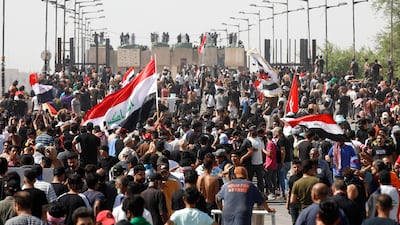
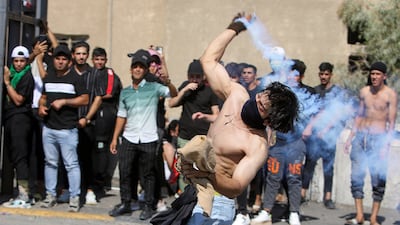
Protesters wave the Iraqi national flag as they attend a protest in Tahrir Square, Baghdad. AFP
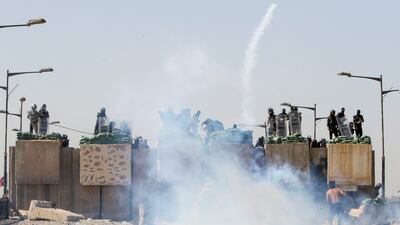
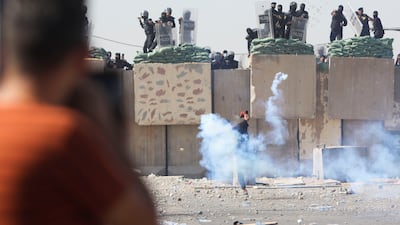
Anti-riot police, standing on barricades, disperse protesters with tear gas, in Baghdad. Reuters
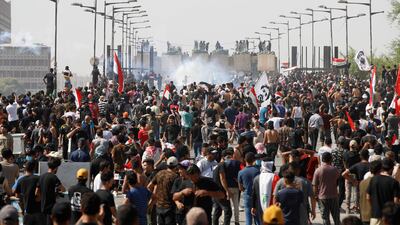
Tear gas rises as demonstrators gather in Tahrir Square in the centre of Baghdad. AFP
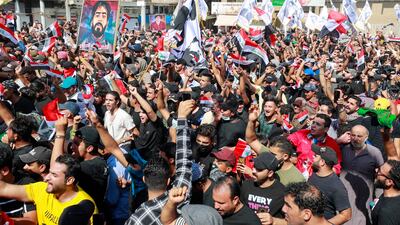
People were marking three years since anti-government protests swept through major cities in central and southern Iraq. AFP
A protester hurls a tear gas canister. Reuters
Anti-riot police clash with protesters. Reuters
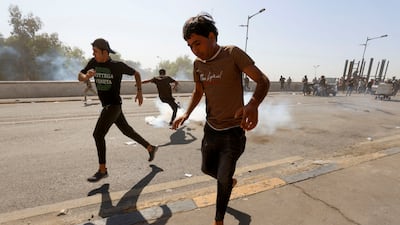
Fleeing from tear gas. Reuters
A protester affected by tear gas is carried away. Reuters
Although the recent violent breach of Iraqi sovereignty does not target the US, it goes against the Biden administration’s efforts to de-escalate tensions in the Middle East and to focus on the challenges posed by the great powers. Iran and Turkey’s attacks both abuse and challenge this US stance, however. The US did condemn the Iranian attacks in particular, but the KRG has higher expectations, especially for greater air defence. However, to be heeded, such a request would have to come through Baghdad, which is unlikely. Per its strategic agreement with the Iraq, the US military mission there is narrowed to an advisory role and free from defence obligations. American hardware or not, Iraq seems to lack the political will to pursue procuring air defence systems.
The concurrent Iranian and Turkish attacks will test new Iraqi Prime Minister Mohammed Shia Al Sudani and his ability to stand up for his country's sovereignty. Foreign policy and national security are not Mr Al Sudani’s strongest suits. But his domestic agenda focused on fighting corruption and mending Erbil-Baghdad ties is well-placed as building blocks for a state more able at standing up for itself. The scale and depth of corruption in the elite and state have resulted in a series of unpatriotic allegiances that cripple Iraq against national security threats. In the interim, better KRG-Baghdad security co-ordination could secure the country’s borders and deny the neighbours further excuses. Only a clean and orderly house would enable Iraq to convincingly rally regional and international support for its sovereignty.

The insured employee may still file an ILOE claim even if a labour dispute is ongoing post termination, but the insurer may suspend or reject payment, until the courts resolve the dispute, especially if the reason for termination is contested. The outcome of the labour court proceedings can directly affect eligibility.
- Abdullah Ishnaneh, Partner, BSA Law
The specs: 2018 Jaguar F-Type Convertible
Price, base / as tested: Dh283,080 / Dh318,465
Engine: 2.0-litre inline four-cylinder
Transmission: Eight-speed automatic
Power: 295hp @ 5,500rpm
Torque: 400Nm @ 1,500rpm
Fuel economy, combined: 7.2L / 100km
LA LIGA FIXTURES
Saturday (All UAE kick-off times)
Valencia v Atletico Madrid (midnight)
Mallorca v Alaves (4pm)
Barcelona v Getafe (7pm)
Villarreal v Levante (9.30pm)
Sunday
Granada v Real Volladolid (midnight)
Sevilla v Espanyol (3pm)
Leganes v Real Betis (5pm)
Eibar v Real Sociedad (7pm)
Athletic Bilbao v Osasuna (9.30pm)
Monday
Real Madrid v Celta Vigo (midnight)
How to apply for a drone permit
Individuals must register on UAE Drone app or website using their UAE Pass
Add all their personal details, including name, nationality, passport number, Emiratis ID, email and phone number
Upload the training certificate from a centre accredited by the GCAA
Submit their request
What are the regulations?
Fly it within visual line of sight
Never over populated areas
Ensure maximum flying height of 400 feet (122 metres) above ground level is not crossed
Users must avoid flying over restricted areas listed on the UAE Drone app
Only fly the drone during the day, and never at night
Moustafa Rashid Nada (KSA) beat Imad Al Howayeck (LEB)
Split points decision
Welterweight
Gimbat Ismailov (RUS) beat Mohammed Al Khatib (JOR)
TKO round 1
Flyweight (women)
Lucie Bertaud (FRA) beat Kelig Pinson (BEL)
Unanimous points decision
Lightweight
Alexandru Chitoran (ROU) beat Regelo Enumerables Jr (PHI)
TKO round 1
Catchweight 100kg
Marc Vleiger (NED) beat Mohamed Ali (EGY)
Rear neck choke round 1
Featherweight
James Bishop (NZ) beat Mark Valerio (PHI)
TKO round 2
Welterweight
Abdelghani Saber (EGY) beat Gerson Carvalho (BRA)
TKO round 1
Middleweight
Bakhtiyar Abbasov (AZE) beat Igor Litoshik (BLR)
Unanimous points decision
Bantamweight
Fabio Mello (BRA) beat Mark Alcoba (PHI)
Unanimous points decision
Welterweight
Ahmed Labban (LEB) v Magomedsultan Magomedsultanov (RUS)
TKO round 1
Bantamweight
Trent Girdham (AUS) beat Jayson Margallo (PHI)
TKO round 3
Lightweight
Usman Nurmagomedov (RUS) beat Roman Golovinov (UKR)
TKO round 1
Middleweight
Tarek Suleiman (SYR) beat Steve Kennedy (AUS)
Submission round 2
Lightweight
Dan Moret (USA) v Anton Kuivanen (FIN)
TKO round 2
The bio
Job: Coder, website designer and chief executive, Trinet solutions
School: Year 8 pupil at Elite English School in Abu Hail, Deira
Role Models: Mark Zuckerberg and Elon Musk
Dream City: San Francisco
Hometown: Dubai
City of birth: Thiruvilla, Kerala
Libya's Gold
UN Panel of Experts found regime secretly sold a fifth of the country's gold reserves.
The panel’s 2017 report followed a trail to West Africa where large sums of cash and gold were hidden by Abdullah Al Senussi, Qaddafi’s former intelligence chief, in 2011.
Cases filled with cash that was said to amount to $560m in 100 dollar notes, that was kept by a group of Libyans in Ouagadougou, Burkina Faso.
A second stash was said to have been held in Accra, Ghana, inside boxes at the local offices of an international human rights organisation based in France.
The specs: 2018 Volkswagen Teramont
Price, base / as tested Dh137,000 / Dh189,950
Engine 3.6-litre V6
Gearbox Eight-speed automatic
Power 280hp @ 6,200rpm
Torque 360Nm @ 2,750rpm
Fuel economy, combined 11.7L / 100km
UAE jiu-jitsu squad
Men: Hamad Nawad and Khalid Al Balushi (56kg), Omar Al Fadhli and Saeed Al Mazroui (62kg), Taleb Al Kirbi and Humaid Al Kaabi (69kg), Mohammed Al Qubaisi and Saud Al Hammadi (70kg), Khalfan Belhol and Mohammad Haitham Radhi (85kg), Faisal Al Ketbi and Zayed Al Kaabi (94kg)
Women: Wadima Al Yafei and Mahra Al Hanaei (49kg), Bashayer Al Matrooshi and Hessa Al Shamsi (62kg)
Justin Thomas and Tiger Woods (US) beat Marc Leishman and Joaquin Niemann (International) 4 and 3.
Adam Hadwin and Sungjae Im (International) beat Xander Schauffele and Patrick Cantlay (US) 2 up.
Adam Scott and Byeong Hun An (International) beat Bryson DeChambeau and Tony Finau (US) 2 and 1.
Hideki Matsuyama and C.T. Pan (International) beat Webb Simpson and Patrick Reed (US) 1 up.
Abraham Ancer and Louis Oosthuizen (International) beat Dustin Johnson and Gary Woodland (US) 4 and 3.
UPI facts
More than 2.2 million Indian tourists arrived in UAE in 2023 More than 3.5 million Indians reside in UAE Indian tourists can make purchases in UAE using rupee accounts in India through QR-code-based UPI real-time payment systems Indian residents in UAE can use their non-resident NRO and NRE accounts held in Indian banks linked to a UAE mobile number for UPI transactions
Estijaba – 8001717 – number to call to request coronavirus testing
Ministry of Health and Prevention – 80011111
Dubai Health Authority – 800342 – The number to book a free video or voice consultation with a doctor or connect to a local health centre
Emirates airline – 600555555
Etihad Airways – 600555666
Ambulance – 998
Knowledge and Human Development Authority – 8005432 ext. 4 for Covid-19 queries
BUNDESLIGA FIXTURES
(All games 4-3pm kick UAE time) Bayern Munich v Augsburg, Borussia Dortmund v Bayer Leverkusen, Hoffenheim v Hertha Berlin, Wolfsburg v Mainz , Eintracht Frankfurt v Freiburg, Union Berlin v RB Leipzig, Cologne v Schalke , Werder Bremen v Borussia Monchengladbach, Stuttgart v Arminia Bielefeld
UK’s AI plan
AI ambassadors such as MIT economist Simon Johnson, Monzo cofounder Tom Blomfield and Google DeepMind’s Raia Hadsell
£10bn AI growth zone in South Wales to create 5,000 jobs
£100m of government support for startups building AI hardware products
Mercer, the investment consulting arm of US services company Marsh & McLennan, expects its wealth division to at least double its assets under management (AUM) in the Middle East as wealth in the region continues to grow despite economic headwinds, a company official said.
Mercer Wealth, which globally has $160 billion in AUM, plans to boost its AUM in the region to $2-$3bn in the next 2-3 years from the present $1bn, said Yasir AbuShaban, a Dubai-based principal with Mercer Wealth.
“Within the next two to three years, we are looking at reaching $2 to $3 billion as a conservative estimate and we do see an opportunity to do so,” said Mr AbuShaban.
Mercer does not directly make investments, but allocates clients’ money they have discretion to, to professional asset managers. They also provide advice to clients.
“We have buying power. We can negotiate on their (client’s) behalf with asset managers to provide them lower fees than they otherwise would have to get on their own,” he added.
Mercer Wealth’s clients include sovereign wealth funds, family offices, and insurance companies among others.
From its office in Dubai, Mercer also looks after Africa, India and Turkey, where they also see opportunity for growth.
Wealth creation in Middle East and Africa (MEA) grew 8.5 per cent to $8.1 trillion last year from $7.5tn in 2015, higher than last year’s global average of 6 per cent and the second-highest growth in a region after Asia-Pacific which grew 9.9 per cent, according to consultancy Boston Consulting Group (BCG). In the region, where wealth grew just 1.9 per cent in 2015 compared with 2014, a pickup in oil prices has helped in wealth generation.
BCG is forecasting MEA wealth will rise to $12tn by 2021, growing at an annual average of 8 per cent.
Drivers of wealth generation in the region will be split evenly between new wealth creation and growth of performance of existing assets, according to BCG.
Another general trend in the region is clients’ looking for a comprehensive approach to investing, according to Mr AbuShaban.
“Institutional investors or some of the families are seeing a slowdown in the available capital they have to invest and in that sense they are looking at optimizing the way they manage their portfolios and making sure they are not investing haphazardly and different parts of their investment are working together,” said Mr AbuShaban.
Some clients also have a higher appetite for risk, given the low interest-rate environment that does not provide enough yield for some institutional investors. These clients are keen to invest in illiquid assets, such as private equity and infrastructure.
“What we have seen is a desire for higher returns in what has been a low-return environment specifically in various fixed income or bonds,” he said.
“In this environment, we have seen a de facto increase in the risk that clients are taking in things like illiquid investments, private equity investments, infrastructure and private debt, those kind of investments were higher illiquidity results in incrementally higher returns.”
The Abu Dhabi Investment Authority, one of the largest sovereign wealth funds, said in its 2016 report that has gradually increased its exposure in direct private equity and private credit transactions, mainly in Asian markets and especially in China and India. The authority’s private equity department focused on structured equities owing to “their defensive characteristics.”