


If the US midterms confirmed anything, it is that Donald Trump is not very good at winning elections.
The former president, who lost the popular vote in 2016, lost control of the House of Representatives in 2018 and lost everything in 2020, once again showed that his toxic brand of politics is not what most Americans want.
Tuesday’s elections should have been a straightforward proposition for the Republicans. Americans are fed up with soaring petrol prices, persistent inflation and with President Joe Biden, whose popularity remains stuck at about 40 per cent or a little higher.
Just as Barack Obama saw his Democratic Party suffer a “shellacking” in the 2010 midterms, Mr Biden was primed to experience a similar wipeout — or so the Republicans had us believe.
But instead of seeing their predicted “red wave” crash across the country, the Grand Old Party was left staring at a whole lot of dry land on Wednesday morning.
True, they look poised to secure a narrow victory in the House of Representatives. But with Senate control still to be determined and the Democrats securing big wins in Pennsylvania, the Republicans cannot claim a popular mandate.
In short, they had a wretched night, notching marginal gains in what should have been an easy sweep.
The postmortems, already under way, must focus on Mr Trump and the disastrous role his non-stop intervention in races across the country played.
While he had some wins, such as in Ohio, where his chosen candidate JD Vance won the Senate race, the midterms generally served as a rebuke to the former president, his divisive style and his baseless claims about the 2020 election being “stolen” from him.
-
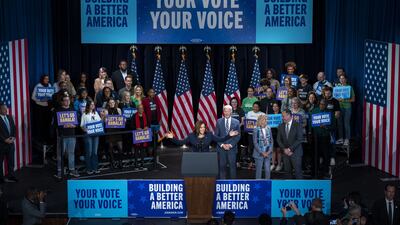
US Vice President Kamala Harris speaks at a Democrat rally in Washington, as President Joe Biden and their spouses Jill Biden and Doug Emhoff listen. Bloomberg -
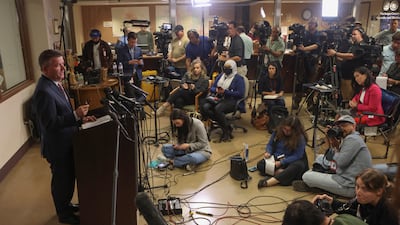
Bill Gates, chairman of the Maricopa County Board of Supervisors, speaks at the Maricopa County Tabulation and Election Centre in Phoenix, Arizona. Former astronaut and Democratic candidate Mark Kelly defeated his Republican rival in Arizona's senate race. Reuters -

Maricopa County recorder Stephen Richer, left, opens mail-in ballots at the Maricopa County Tabulation and Election Centre in Phoenix, Arizona. Ballots were being counted in Maricopa County three days after voters went to the polls for the midterm election in Arizona. AFP -
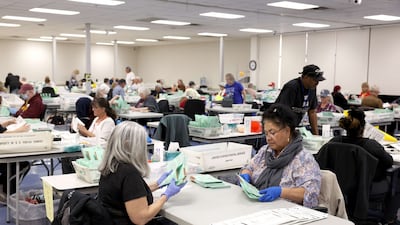
Election workers open mail-in ballots at the Maricopa County Tabulation and Election Centre in Phoenix, Arizona. AFP -
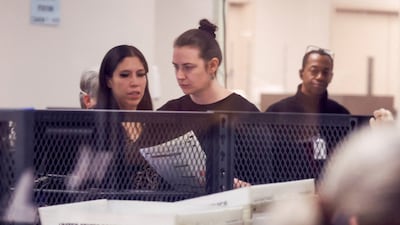
Staff scan ballots for the US midterm elections at the Maricopa County Tabulation and Election Centre in Phoenix, Arizona. Reuters -
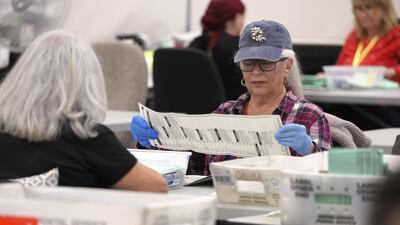
Election workers open mail-in ballots at the Maricopa County Tabulation and Election Centre in Phoenix, Arizona. AFP -
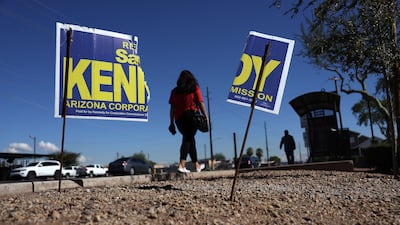
In a divided America, a political campaign sign sits abandoned at the roadside in Phoenix, Arizona, two days after the midterms. AFP -
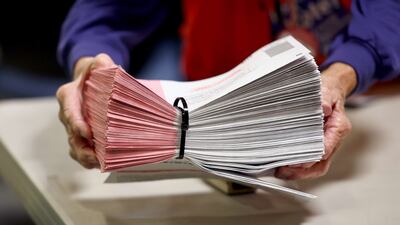
Ballots are processed in Las Vegas. Getty Images -
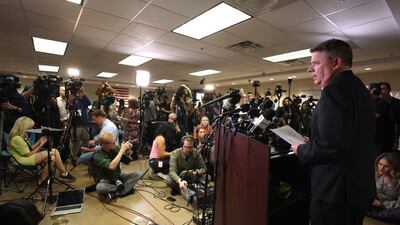
Election officials give a press conference in Maricopa County, Arizona, where ballots were still being counted two days after the midterms. AFP -
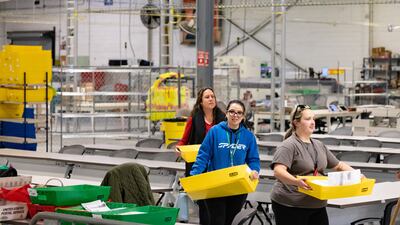
Ballots are carried to be scanned in Philadelphia. Reuters -
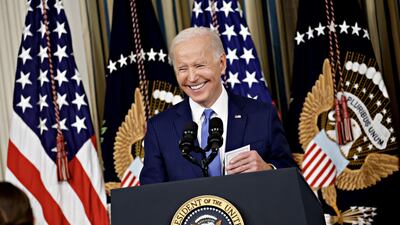
Mr Biden was all smiles during a news conference in the White House. Bloomberg -
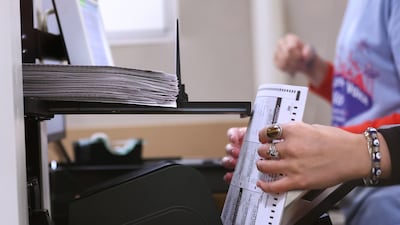
An election worker sorts ballots in Las Vegas. AFP -
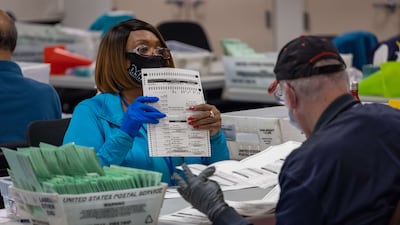
Election workers sort ballots at the Maricopa County Tabulation and Election Centre. AFP -
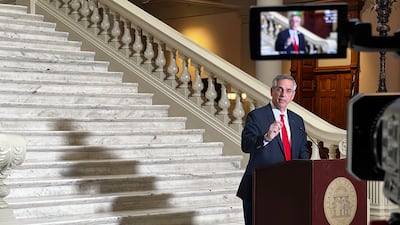
Georgia Secretary of State Brad Raffensperger holds a news conference in Atlanta. AP -
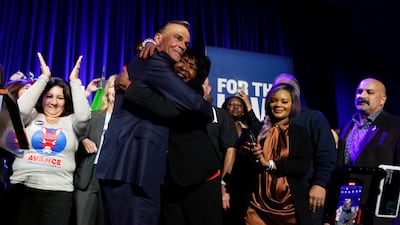
Los Angeles mayoral candidate Rick Caruso gets a hug on stage at his election night headquarters in Los Angeles. AP -
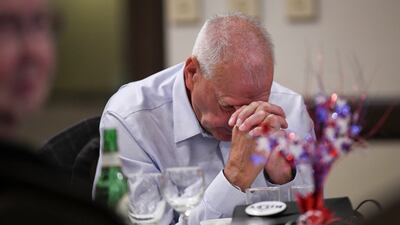
Paul Riley, father of Josh Riley, bows his head as election results come in at his son's election party in Binghamton, New York. Josh Riley, the Democratic candidate, ran against Republican Marc Molinaro. AP -
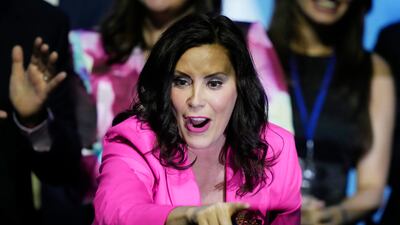
Michigan Democratic Governor Gretchen Whitmer speaks during election night in Detroit. AP -
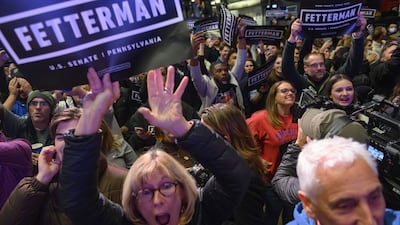
Supporters cheer during an election night event for Democratic Senate candidate John Fetterman in Pittsburgh, Pennsylvania. Mr Fetterman defeated Republican Senate candidate Dr Mehmet Oz. AFP -
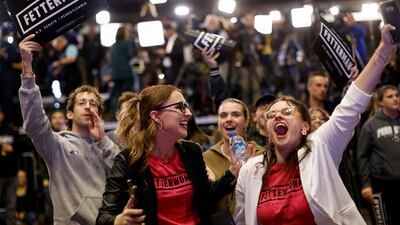
Supporters watch news of a projected victory for Democratic candidate for Pennsylvania governor, Josh Shapiro, in Pittsburgh, Pennsylvania. Reuters -
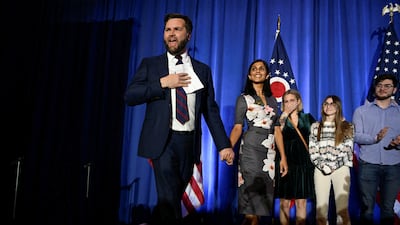
Republican J D Vance arrives with his wife Usha to declare victory in the Senatorial race in Columbus, Ohio. Reuters -
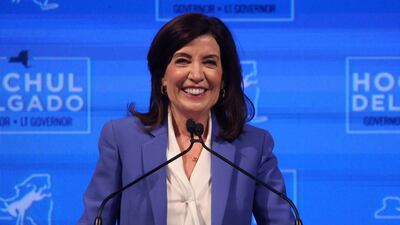
New York Governor Kathy Hochul attends an event to celebrate her victory in the US midterm elections. Reuters -
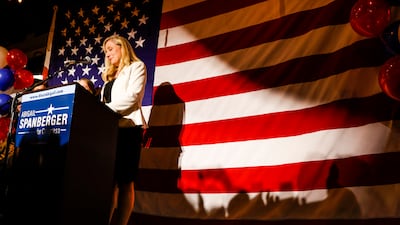
Representative Abigail Spanberger, of the Democratic party, speaks to supporters after her re-election, in Fredericksburg, Virginia. AP -
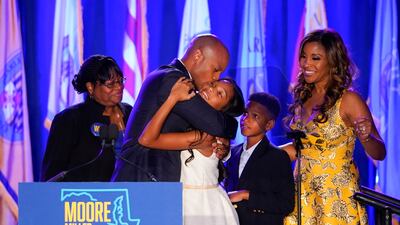
Democrat Wes Moore, second from left, hugs his daughter, Mia, centre, as his mother, Joy Thomas Moore, left, son, Jamie, second from right, and wife, Dawn, look on, after he was declared the winner of the Maryland race for governor. AP -
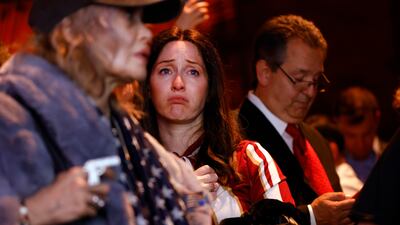
A supporter of Republican candidate Lee Zeldin reacts as media outlets predict results, in the race for governor, in favour of Democratic incumbent Kathy Hochul. AP -
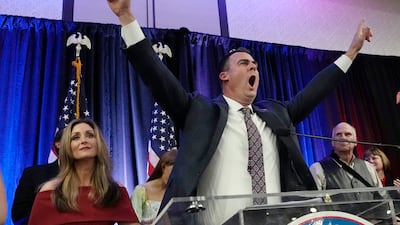
Oklahoma Governor Kevin Stitt celebrates his re-election, at a Republican Party watch party in Oklahoma City. AP -

Democratic candidate for governor of Georgia Stacey Abrams speaks during her 2022 US midterm elections night party in Atlanta, Georgia. Her rival Brian Kemp won. Reuters -

A woman arrives before Florida's Republican Governor Ron DeSantis speaks to supporters during an election night party in Tampa. AP -
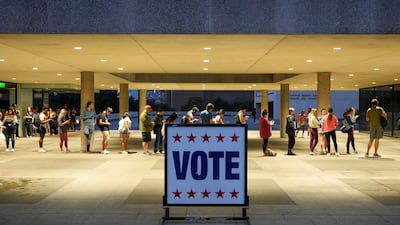
Voters wait in line at a polling station at the Lyndon B. Johnson School of Public Affairs in Austin, Texas. AP -
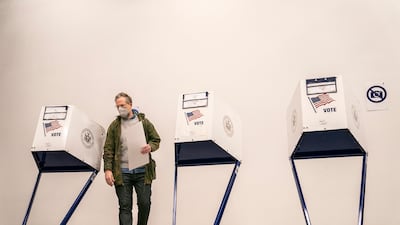
A voter goes to cast their vote after filling out their ballot at a polling station inside The Shed arts centre in Manhattan. AP -
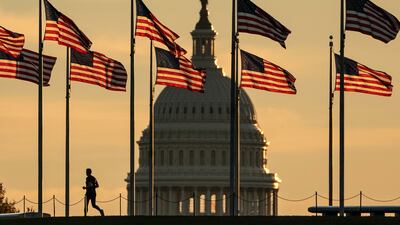
A jogger runs past the Capitol Building in Washington. The US midterm elections are held every four years at the midpoint of each presidential term. EPA -
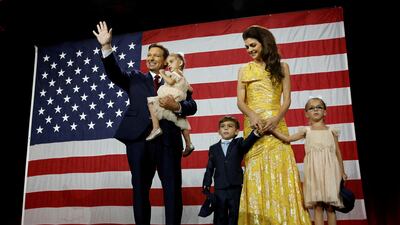
Florida's Republican Governor Ron DeSantis waves from the stage next to his wife Casey and children during his midterm elections party in Tampa. Reuters -

A man in costume arrives for a Republican party 'Save America' rally before the US midterm elections, in Miami, Florida. AFP -
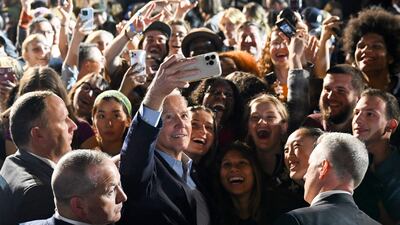
US President Joe Biden, centre, poses for a selfie with supporters during a rally for Democratic candidates, including New York Governor Kathy Hochul, at Sarah Lawrence College in Bronxville, New York. AFP -
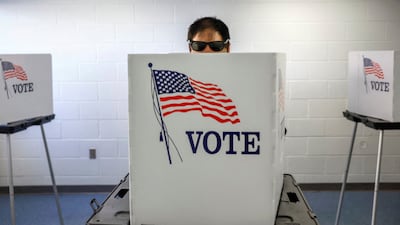
A man marks his ballot during early voting in Lansing, Michigan. Reuters -
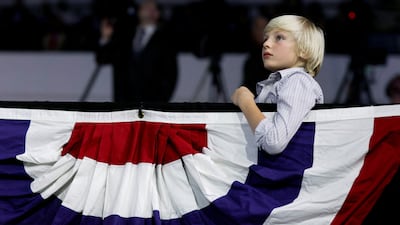
A child attends a rally held by US President Joe Biden with Democratic nominee for Maryland Governor Wes Moore, Senator Chris Van Hollen and other Maryland Democrats, at Bowie State University. Reuters -
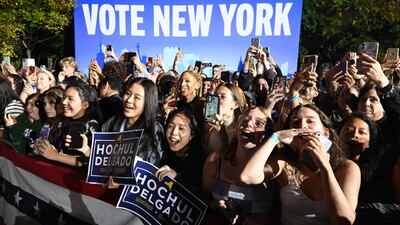
Supporters cheer during a rally for Democratic candidates at Sarah Lawrence College in Bronxville, New York. AFP -
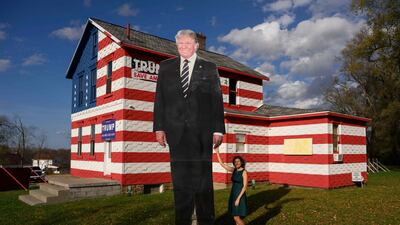
State Representative Leslie Rossi poses by a giant cutout of former US President Donald Trump in front of the "Trump House", which she owns and created in 2016, in Youngstown, Pennsylvania. AFP -

Republican candidate for US Senate for Arizona Blake Masters speaks at a rally in Queen Creek, Arizona. EPA -
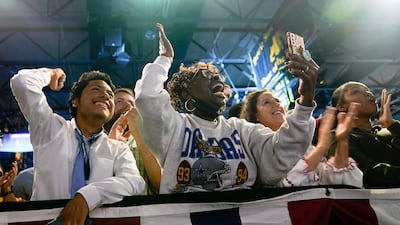
People in the crowd cheer during a campaign rally at Bowie State University in Maryland, which was attended President Joe Biden, the first lady, Jill Biden, Maryland Democratic gubernatorial candidate Wes Moore and Senator Chris Van Hollen. AP -

Republican candidate for Arizona governor Kari Lake arrives for a campaign stop, in Phoenix. Reuters -
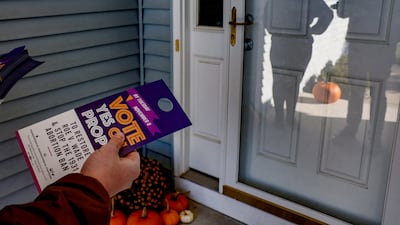
Morgan Koetje and Nickolas Lentz from Reproductive Freedom for All, canvass a neighborhood in support of Proposal 3, a ballot measure that would codify the right to an abortion, one day before the midterm election in Dewitt, Michigan. Reuters -
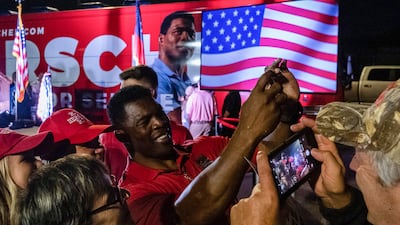
Republican candidate for US Senate Herschel Walker takes a picture with supporters in Kennesaw, Georgia during a "Unite Georgia Bus Stop" campaign rally on the eve of the midterm elections. AFP -

Republican Senate candidate Val Demings speaks to supporters in Wilton Manors, Florida. AP -

Senate hopeful Mehmet Oz addresses campaign rally in Pennsburg, Pennsylvania. AP -
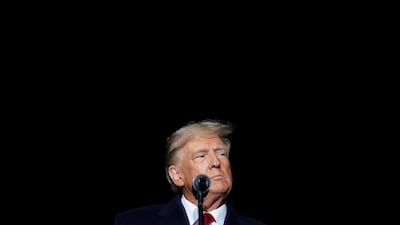
Former president Donald Trump speaks at a rally in support of the campaign of Ohio Senate candidate JD Vance, at Dayton International Airport. AP -
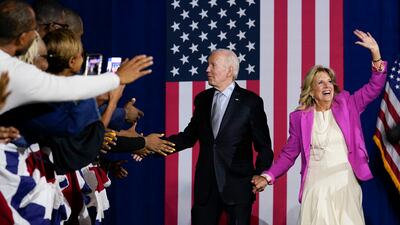
President Joe Biden and first lady Jill Biden arrive for the rally at Bowie State University, in Maryland. AP -
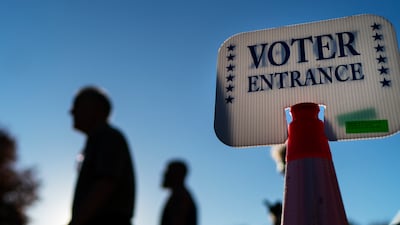
Voters pass by a sign outside a polling site in Warwick, Rhode Island after casting their ballots on the last day of early voting before the midterm election. AP -
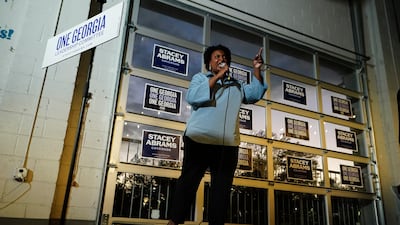
Democratic candidate for Georgia governor Stacey Abrams speaks to volunteers during an election eve phone and text bank party in Atlanta. AP -
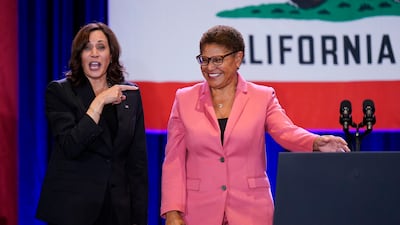
US Vice President Kamala Harris, left, points to Los Angeles mayoral candidate Representative Karen Bass, after speaking at a rally in Los Angeles. AP


In Michigan, a clear majority of voters countered Mr Trump’s war on democracy by approving a measure making it easier for people to vote. The Trump-backed gubernatorial candidate lost, as did his pick for secretary of state.
In Pennsylvania, Democrats secured the governorship after the Republicans fielded an election-denying candidate supported by Mr Trump. In Arizona, Mr Trump's pick for governor, Kari Lake, was trailing Democratic candidate Katie Hobbs.
The list goes on, but notably also includes an easy victory for Georgia Republican Brian Kemp, who kept his governorship after he distanced himself from Mr Trump and his election lies.
Another Republican rewarded for his disloyalty to Mr Trump was Florida Governor Ron DeSantis, who won re-election in a landslide. The 44-year-old leader has cut a clear path away from the former president and is preparing for a probable White House run in 2024.
On election day, Mr Trump released a four-page memo touting all his achievements in the run-up to the midterms.

Instead of reflecting on the Republican Party’s relatively poor showing, Mr Trump on Wednesday boasted of “174 wins and nine losses” on his Truth Social media platform and blasted the “Fake News Media” and the Democrats for playing down the “amazing job” his candidates had done.
This vainglorious lack of insight poses a real risk for the Republicans. The self-appointed kingmaker can't accept that his supposed Midas touch has turned into a fetid finger.
Mr Trump has all but declared he will be making another run for the presidency in 2024, teasing a big announcement for November 15.
His grip over the Republican Party is such that he might win the nomination, but Tuesday’s elections underscore just how many Americans have grown weary of Mr Trump's desperation to remain in the limelight.
It's not clear whether the Republican Party writ large will read the tea leaves.
But The New York Post, owned by Rupert Murdoch, whose Fox News continues to support Mr Trump, appears ready to choose a new king, proclaiming Mr DeSantis as “DeFuture”.


