


Sitting in a Bahrain television news studio, I was waiting to discuss the arrival of His Holiness Pope Francis on another peace-making visit to the Middle East. He came to Abu Dhabi a few years ago and one of the great achievements of this Pope has been repeatedly to try to bring about much better understanding between Christian and Muslim religious leaders. But I was thinking whether the Bahrain trip would really make a difference. Does such a trip – inspired by King Hamad of Bahrain and including a meeting with the Grand Imam of Al Azhar, Dr Ahmed Al Tayeb – really turn people away from religious intolerance, extremism and violence? Would the leader of the world’s 1.3 billion Catholics coming to Bahrain change some hard hearts? Bahraini friends reminded me that their islands have always been a crossroads of trade and culture. There were splendid scenes when the motorcade brought the humble Fiat "Popemobile" to the royal palace protected by Bahrain’s cavalry. There was a gun salute; a Papal mass; meetings with dignitaries and the blessing of children – all as I expected.
But what I did not expect was the warmth between the King, the Grand Imam and the Pope. In fact, warmth is not the right word. Friendship is. I have been to enough diplomatic meetings to know when leaders put on an act. They smile for the cameras because it is politically convenient. This was different. The three leaders greeted each other not merely as protocol demands, but as genuine friendship insists, with warm embraces, even though their speeches were challenging.
I sat with a Saudi-born Muslim journalist, an American rabbi and an evangelical Christian minister listening to a King from an Arab nation proudly insisting that the leaders were "united by the message of monotheism" and stood together in the tradition of Abraham.

"Peace is our only path" King Hamad said, as he demanded the end to the conflict in Ukraine. The Pope called for an end to the conflict in Yemen. The Grand Imam told us that the reason humans were all different was because God wants us to be different, but He also wants our diversity to be our human strength. We should therefore celebrate our differences by living together in harmony. King Hamad suggested that we would not always agree but that we could still find a "consensus" for peace. And each leader insisted – in the words of the Bahrain Declaration of 2017 – that we have the right to worship as we wish, but also not to worship, because "compelled religion cannot bring a person into a meaningful relationship with God."
Some of my scepticism began to melt. The Pope’s mission has been to build, or rebuild, good relations between Christians and Muslims. He was among friends in Bahrain, friends who happen to worship differently but who respect each other's traditions. This was not talk about "diversity". It was diversity brought alive, with concrete plans to take this message to a wider audience. All three leaders emphasised that ignorance is the root of extremism and intolerance.
Education, therefore, is a significant part of the cure. So is meeting "the Other," people of other faiths. I was struck by a conversation I had with a young Bahraini woman who was learning Hebrew, the language of Israel. "It’s easier than you think," she told me, because "it is quite similar to Arabic." Thank you, I thought, for educating me out of my ignorance.
So – will it make a difference? The world’s news media sent journalists to this four-day series of events. The National covered the meetings in detail. So did many others. But we live in an attention-poor world. War, famines, climate change, migration, economic dislocation fill us with fear – and fill up news broadcasts. The challenge is therefore not just for political and religious leaders. It is for you and me.
The Pope said that Bahrain’s name came from the idea of "two seas" – sweet fresh water that we can drink; salty water that is unpalatable. He suggested that tolerance and peace are like the sweet water, although some still choose the more bitter and salty path.
I am not a Catholic, and I have also spent a long time in areas of conflict from Lebanon to Nicaragua, Northern Ireland to the wars of Saddam Hussein. But I left Bahrain thinking that the meeting of these three leaders is a significant moment. It encourages those of us who wish to seek solutions rather than those who wish to create problems.
It reminds us that meeting "the Other," the stranger, the person who believes in something different, can be the beginning of a different kind of understanding, friendship even in hard times. One conversation stays with me, with the mother of a four-year-old boy whom the Pope picked up in his arms. The child will remember that moment for the rest of his life. Did the Pope’s trip make a difference? It did to me, and I will remember it too.
-

This handout photo released by the Vatican Media shows Pope Francis presiding over an open-air mass at Bahrain National Stadium in Riffa, near the capital Manama. AFP -
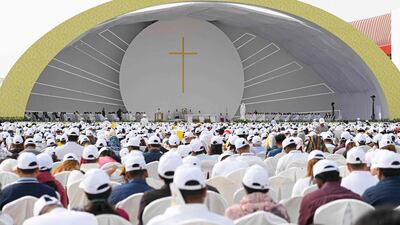
This handout photo released by the Vatican Media shows worshippers attending a mass held by Pope Francis at Bahrain National Stadium in Riffa, near the capital Manama. AFP -

This handout photo released by the Vatican Media shows Pope Francis presiding over an open-air mass at Bahrain National Stadium in Riffa, near the capital Manama. AFP -
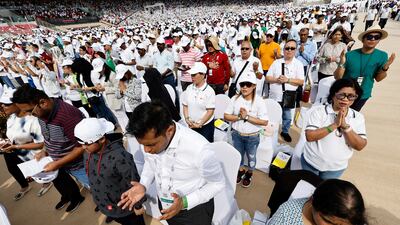
People attend a holy mass presided by Pope Francis at Bahrain National Stadium in Riffa, Bahrain. Reuters -
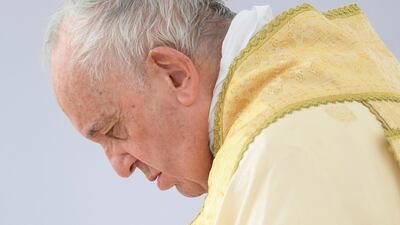
Pope Francis presides over a holy mass at Bahrain National Stadium during his apostolic journey, in Riffa, Bahrain. Reuters -
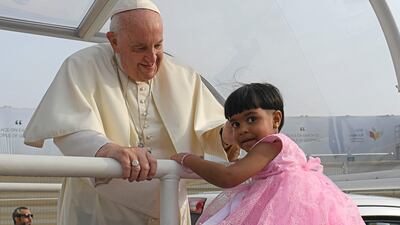
This handout photo released by the Vatican Media shows Pope Francis blessing a child as he arrives to celebrate mass at Bahrain National Stadium in Riffa, near the capital Manama. AFP -

Pope Francis arrives to celebrate mass at Bahrain National Stadium in Riffa, near the capital Manama. AFP -

People attend a holy mass presided by Pope Francis at Bahrain National Stadium in Riffa, Bahrain. Reuters -

Pope Francis blesses a child as he attends a holy mass at Bahrain National Stadium during his apostolic journey, in Riffa, Bahrain. Reuters -

Pope Francis celebrates mass at Bahrain National Stadium in Riffa, Bahrain. AP Photo -
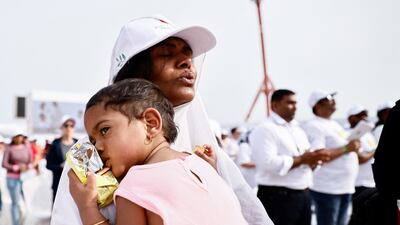
A woman sings while Pope Francis presides over a holy mass at Bahrain National Stadium during his apostolic journey, in Riffa, Bahrain. Reuters -
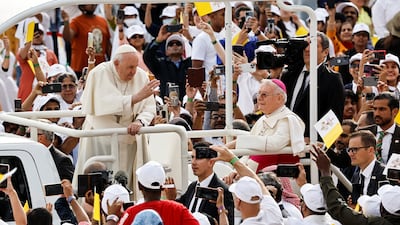
Pope Francis greets people as he attends a holy mass at Bahrain National Stadium during his apostolic journey, in Riffa, Bahrain. Reuters -
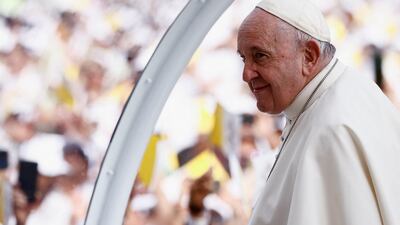
Pope Francis attends a holy mass at Bahrain National Stadium during his apostolic journey, in Riffa, Bahrain. Reuters -

Pope Francis blesses a boy as he attends a holy mass at Bahrain National Stadium during his apostolic journey, in Riffa, Bahrain. Reuters -

Pope Francis arrives to celebrate mass at Bahrain National Stadium in Riffa, Bahrain. AP Photo -
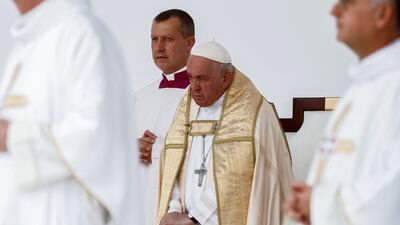
Pope Francis presides over a holy mass at Bahrain National Stadium during his apostolic journey, in Riffa, Bahrain. Reuters -
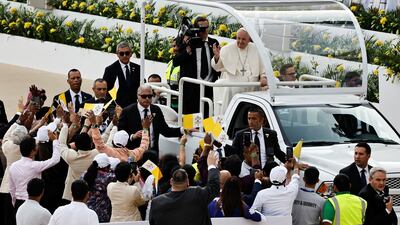
Pope Francis greets people as he attends a holy mass at Bahrain National Stadium during his apostolic journey, in Riffa, Bahrain. Reuters -

Pope Francis arrives to celebrate mass at Bahrain National Stadium in Riffa, Bahrain, on Saturday, November 5. AP Photo / Alessandra Tarantino -
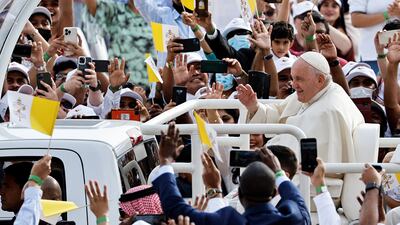
Pope Francis greets people. Reuters / Hamad I Mohammed -
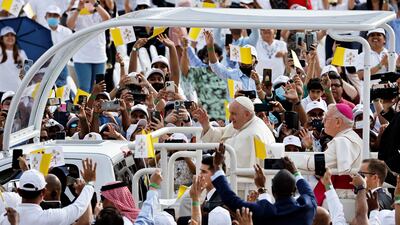
Pope Francis greets people. Reuters / Hamad I Mohammed -
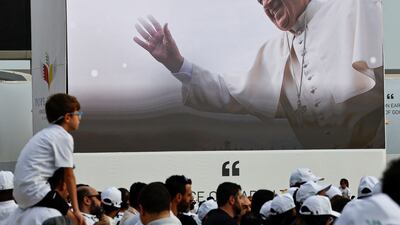
Worshippers gather to celebrate mass at Bahrain National Stadium. Reuters -
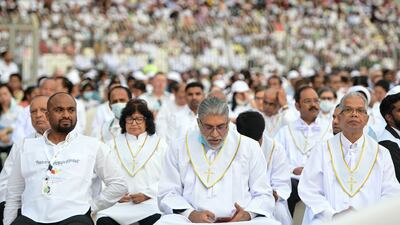
Eucharistic ministers will give holy communion for the early morning Papal mass. Khushnum Bhandari / The National -
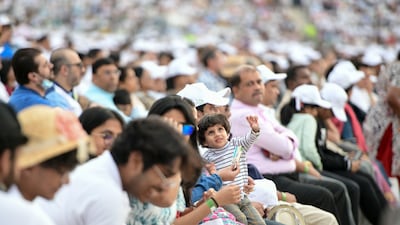
Thousands of different age groups attended the mass. Khushnum Bhandari / The National -
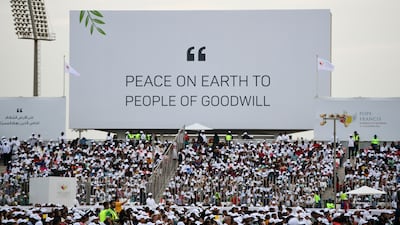
Crowds gather. Khushnum Bhandari / The National -
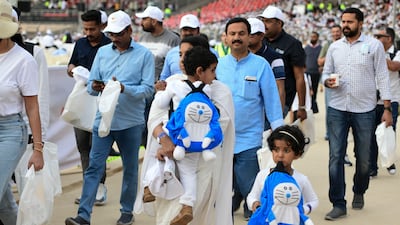
Thousands of different age groups gather for the early morning mass. Khushnum Bhandari / The National -
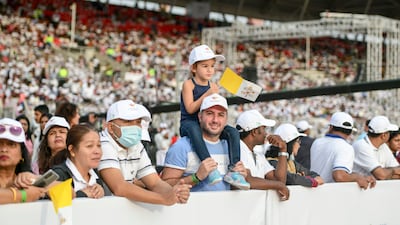
Families attend the early morning mass. Khushnum Bhandari / The National -
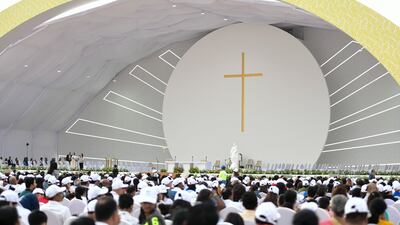
Crowds gather at Bahrain National Stadium. Khushnum Bhandari / The National -
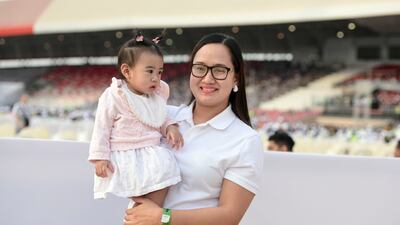
Maria Patawaran, 35 with daughter Samantha, 1. Khushnum Bhandari / The National -

Eucharistic volunteers excited for the early morning Papal mass. Khushnum Bhandari / The National -

Biju John, 55 with wife Caroline John, 52. Khushnum Bhandari / The National -

Crowds gather at Bahrain National Stadium. Khushnum Bhandari / The National -

From left, Steffi Cherian, 30 and Jaista Wilson, 32. Khushnum Bhandari / The National -

People wait for the mass to begin. Khushnum Bhandari / The National -

Errol Pereira, 50. Khushnum Bhandari / The National -

Thousands wait for the mass to begin. Khushnum Bhandari / The National -

Families attend the early morning mass. Khushnum Bhandari / The National -
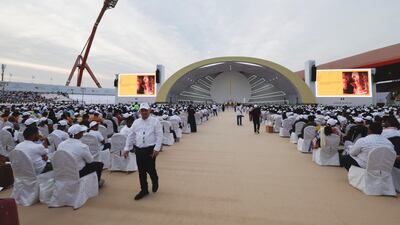
The main stage at Bahrain National Stadium. Hamad I Mohammed / Reuters -
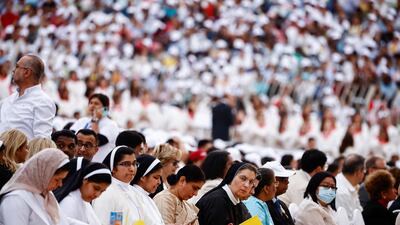
The occasion is a landmark moment for Bahrain's 80,000 Catholics and for Christianity in the Gulf. Yara Nardi / Reuters -
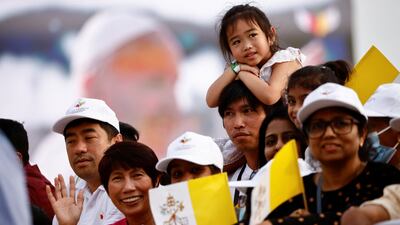
Bahrain's Catholics include expats from the Philippines and southern India, along with native Arabs. Yara Nardi / Reuters -

The faithful wave Vatican flags as they arrive hours ahead of the Pope's appearance. Hussein Malla / AP -

Clergy members gather ahead of the holy Mass at Bahrain National Stadium. Hamad I Mohammed / Reuters -
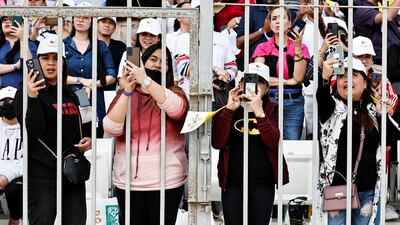
The stadium has the capacity for around 28,000 people, making the event one of the largest of its kind in the Gulf to date. Hamad I Mohammed / Reuters -

The faithful started out their journey in the early hours of the morning to be in place about two hours before the 8.30am start time. Yara Nardi / Reuters -
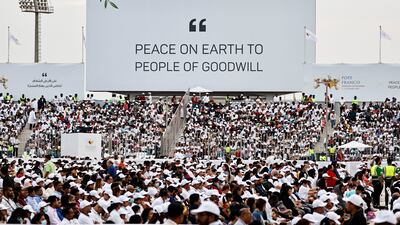
People gather to attend holy Mass at Bahrain National Stadium. Reuters -
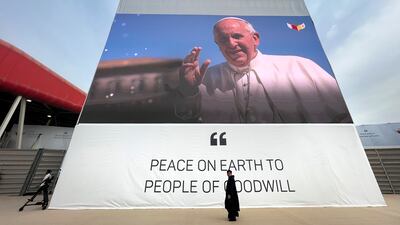
A priest passes under a giant poster of Pope Francis in Bahrain. AP Photo -

Attendees providing themselves with shade during early morning Papal mass at Bahrain National Stadium, Bahrain. Khushnum Bhandari / The National -
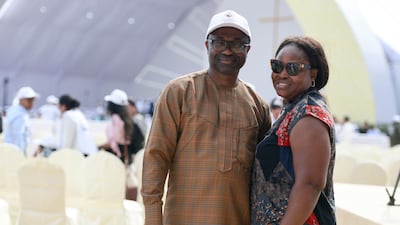
Endurance Ighodalo, 47 and Bridget Ighodalo, 46 who reside in Kingdom of Saudi Arabia during the early morning Papal mass at Bahrain National Stadium, Bahrain. Khushnum Bhandari / The National -

Crowds cheer as Pope Francis arrives for the early morning Papal mass at Bahrain National Stadium, Bahrain. Khushnum Bhandari / The National -
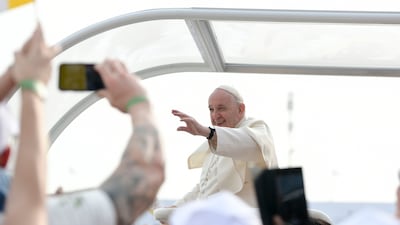
Pope Francis arrives for the early morning Papal mass at Bahrain National Stadium, Bahrain. Khushnum Bhandari / The National -

Pope Francis arrives for the early morning Papal mass at Bahrain National Stadium, Bahrain. Khushnum Bhandari / The National -

Crowds cheer as Pope Francis arrives for the early morning Papal mass at Bahrain National Stadium, Bahrain. Khushnum Bhandari / The National -

Attendees providing themselves with shade during early morning Papal mass at Bahrain National Stadium, Bahrain. Khushnum Bhandari / The National -

Attendees pray along to the hymns during early morning Papal mass at Bahrain National Stadium, Bahrain. Khushnum Bhandari / The National -

Attendees pray along to the hymns during early morning Papal mass at Bahrain National Stadium, Bahrain. Khushnum Bhandari / The National



