



Friday's attack on US House Speaker Nancy Pelosi's husband is an unsurprising turn in the implosion of civil discourse in American life.
David Depape allegedly broke through the back doors at the Pelosis' San Francisco home, tussled with Paul Pelosi, 82, and then struck him repeatedly with a hammer, fracturing his skull and causing injuries to one arm and his hands.
Mr Depape was reportedly yelling: “Where is Nancy?”
The assault, which police say was an attempted murder, is the latest in a series of attacks on US politicians and judges, and serves as a warning that political violence is becoming the norm in America.
Figures from the US Capitol Police show that threats made against politicians have drastically increased in the past five years, with nearly 10,000 threats investigated in 2021 alone.
Recent polling underscores this: a nationwide study in July found that 12.2 per cent of respondents were willing to commit political violence “to threaten or intimidate a person”, 10.4 per cent “to injure a person”, and 7.1 per cent “to kill a person”.
To be clear, most Americans do not support political violence, but that leaves 23 million people across this vast and well-armed land who do.
A CBS News poll last month found that nearly two thirds of Americans think political violence will increase.
In June, police arrested an armed man who had made threats against Brett Kavanaugh near the conservative US Supreme Court justice's home.
This month, three men in Michigan were found guilty of taking part in a conspiracy to kidnap Democratic Governor Gretchen Whitmer.
Right-wing pundits point out that political violence is bipartisan, such as the threat on Justice Kavanaugh after the Supreme Court voted to eliminate federal abortion laws.
But this is a scourge being driven by fantasists including the former president, Donald Trump.
His lies about widespread election fraud in the wake of his 2020 defeat have been embraced by the conservative mainstream and helped fuel the deadly January 6, 2021 attack on the Capitol that led to the deaths of at least five people.

The States United Democracy Centre said 22 people who denied the result of the 2020 election are running for governor in the November 8 mid-terms elections. Many will win.
And 11 election deniers are running for the position of secretary of state, whose function it is to oversee elections. QAnon adherents are openly supporting several of these candidates.
America risks sliding into a post-democracy dystopia, where the only election results can be Republican triumphs or else denials that they lost fairly. For anyone who needs reminding, QAnon believes that the Democrats are feasting on children and worshipping Satan.
It would be laughable if it was not so dangerous. In 2016, my local pizza restaurant was shot up by a man who decided he would try to rescue children that he had heard were being trafficked through the basement.
It was all absurd, of course, but that did not stop the attacker driving hundreds of miles to Washington from North Carolina with an assault rifle.
The US has long branded itself as a beacon for democratic values, but election deniers are headed to key positions of power, including possibly the presidency if Mr Trump runs in 2024, which he is expected to do.
-
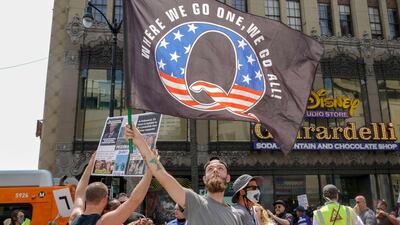
Demonstrators from the conspiracy theorist group QAnon protest against child trafficking on Hollywood Boulevard in Los Angeles, California on August 22, 2020. AFP -
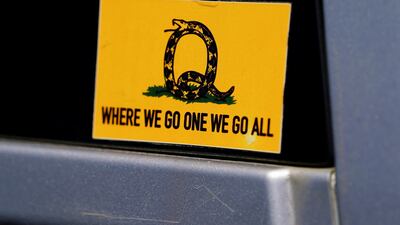
A sticker with the QAnon slogan is seen on a truck that participated in a convoy in Adairsville, Georgia, on September 5, 2020. The movement has moved from the US political fringe into the global mainstream during the coronavirus pandemic, with its influence seen at anti-lockdown and anti-mask rallies from Los Angeles, to London and Melbourne. Reuters -

QAnon conspiracy theory messages on the back of a pickup truck as supporters of US President Donald Trump gather near his campaign event in Macon, Georgia, on October 16, 2020. Reuters -

QAnon demonstrators protest during a rally to re-open California and against stay-at-home directives in San Diego, California. on May 01, 2020. AFP -

A car painted with QAnon references at a campaign rally for US President Donald Trump in Prescott, Arizona on October 19, 2020. AFP -
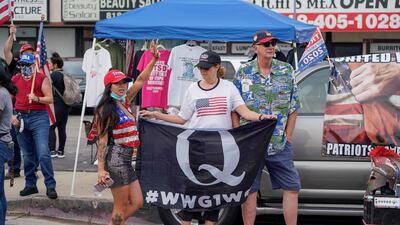
A Trump supporter waves a QAnon flag towards passing cars and counter-protesters standing across the road in Tujunga, Los Angeles on August 21, 2020. AFP -
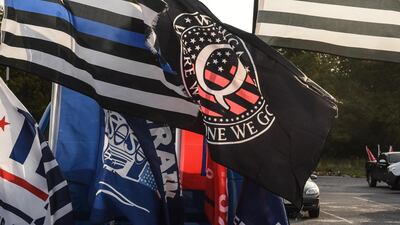
A flag for the QAnon conspiracy theory is flown with other right wing flags during a pro-Trump rally on October 11, 2020 in Ronkonkoma, New York on October 11, 2020. AFP -

A Q-Anon sticker on a car parked at a Trump campaign rally in Prescott, Arizona on October 19, 2020. AFP


Elon Musk, Twitter's new owner, a self-declared “free speech absolutist”, has vowed the platform will not become a “free-for-all hellscape”, but election lies and hate speech are likely to proliferate further as he seeks to “free” the platform.
Mr Musk himself on Sunday tweeted an anti-LGBT conspiracy theory about what happened the night Mr Pelosi was attacked.
What is so lamentable about the reaction to Friday's assault is that it could not even unify the very lawmakers who could themselves also become targets.
Senator Rand Paul condemned the attack but not without getting a dig in over comments Ms Pelosi's daughter made about his own assault in 2017, when a neighbour attacked him during a dispute over their yards.
“Unlike Nancy Pelosi's daughter, who celebrated my assault, I condemn this attack and wish Mr Pelosi a speedy recovery,” wrote the Kentucky senator.
Mike Loychik, a state politician in Ohio, said he hoped Mr Pelosi makes a full recovery, but only after trolling Ms Pelosi for the Democrats' perceived weakness to tackle crime.
“I hope San Francisco dispatched their very best social worker to respond to the brutal assault of Nancy Pelosi’s husband,” he wrote on Twitter.
President Joe Biden called the attack on Mr Pelosi “despicable”.
“There’s too much violence, political violence. Too much hatred. Too much vitriol,” Mr Biden said in Philadelphia.
“Enough is enough. Every good person of good conscience needs to clearly and unambiguously stand up against the violence.”
But in a country with more guns than people, a non-existent or ragged safety net that often fails mentally ill people, and a deep polarisation that has led to open talk of the risk of a new civil war, it would be naive not to believe that political violence in the US will only get worse.
-
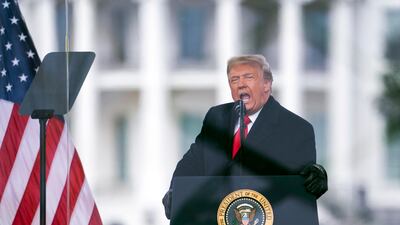
Donald Trump, the president at the time, speaks during a rally protesting the electoral college certification of Joe Biden as president in Washington on January 6, 2021. AP -
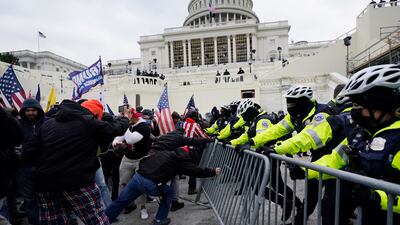
A mob loyal to Mr Trump tries to break through a police barrier at the Capitol. AP -
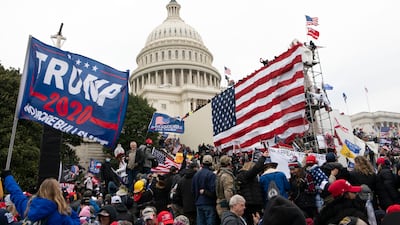
The mob waves pro-Trump flags in front of the Capitol building. AP -
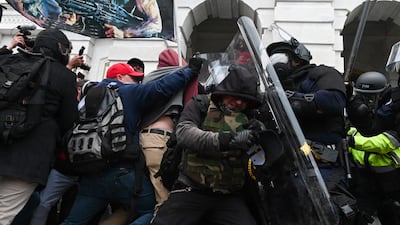
Riot police push back a crowd of rioters at the Capitol building. AFP -
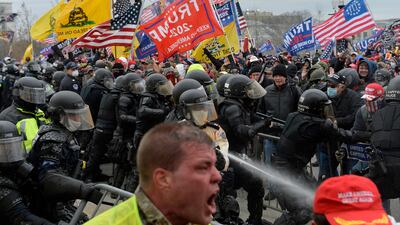
Trump supporters clash with police and security forces as people try to storm the US Capitol building. AFP -
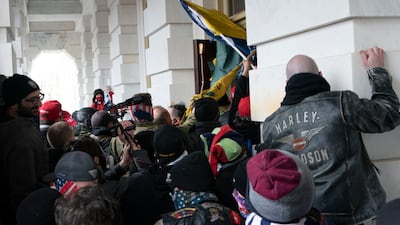
Insurrectionists loyal to Mr Trump try to open a door of the US Capitol building as they riot in Washington. AP -
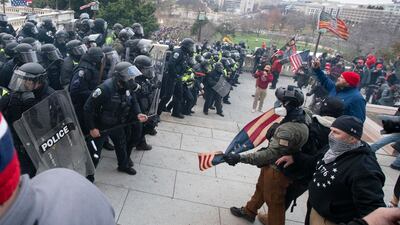
US Capitol Police push back rioters trying to enter the US Capitol. AP -
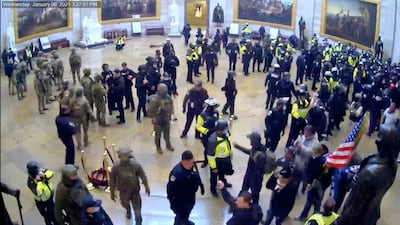
Police and rioters confront each other in the Rotunda of the Capitol. US Capitol Police via AP -
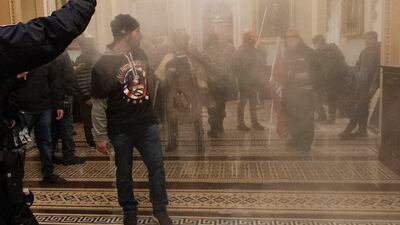
Smoke fills the hallway outside the Senate chamber of the Capitol. AP -
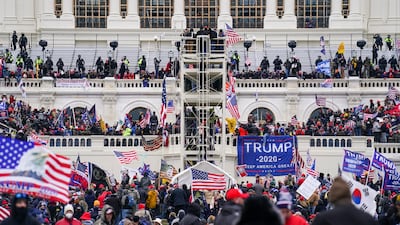
Insurrectionists loyal to Mr Trump breach the Capitol in Washington. AP -

Trump supporters, including Doug Jensen, centre, confront US Capitol Police in the hallway outside the Senate chamber at the Capitol. AP -
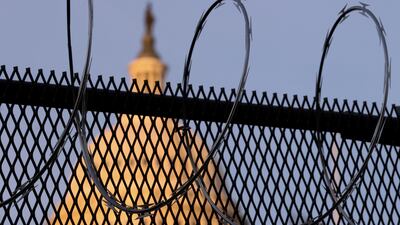
Newly installed razor wire tops the fence surrounding the US Capitol following the January 6 riot. Reuters -
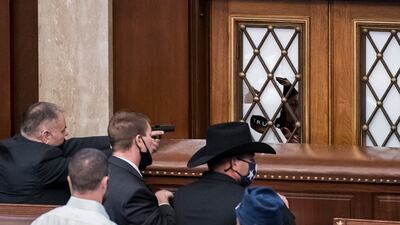
Security agents and members of Congress barricade the door to the House chamber as the violent mob breaches the Capitol. AP -
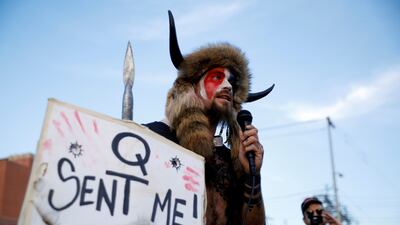
Rioter Jacob Chansley holds a sign referencing QAnon as supporters of Mr Trump gather to protest the early results of the 2020 presidential election. Reuters



