



Next week marks a month since the Kanjuruhan Stadium disaster in Indonesia, which is now one of the deadliest football stadium tragedies in the sport’s history. The death toll rose to 135 last week, after two more supporters died from injuries. Hundreds more are still recovering after sustaining injuries at the stadium. Fifa president Gianni Infantino has called the disaster one of the sport’s darkest days.
Shockingly, it was the second large-scale disaster in world football this year, following the Yaounde Olembe Stadium crush in Cameroon, during which eight people died and 38 supporters were injured.
The twin tragedies of Cameroon and Indonesia, join a long list of at least 14 football stadium disasters from the past 40 years. Hillsborough, Heysel and Valley Parade will be catastrophes instantly familiar to British football supporters, particularly those who followed the sport in the 1980s, just as the needless loss of life in Bastia 30 years ago when a temporary stand collapsed at a cup match leading to the loss of 19 lives, will never be forgotten in France. For Egypt, it was Port Said 10 years ago, where 74 people died after a match between Al Ahly and Al Masry. Twenty one years ago, tragedies in Ghana and South Africa cast equally long shadows over the sport. Needless loss of life binds all these disasters and others together on a far too long roll call of catastrophe.
Mr Infantino travelled to Indonesia earlier this month to offer his support and Fifa’s help, meeting with the country’s president Joko Widodo in Jakarta. In remarks reported by AFP, he said that the organisation stood in solidarity with the people of Indonesia and he committed to it working in “close partnership” with the government, the Asian Football Confederation and the country’s football association.
An official investigation will seek to establish a definitive narrative of events from October 1. It has been reported that three police officers and three others have been charged over the disaster, which was triggered after police fired tear gas following the conclusion of a match between Persebaya Surabaya and Arema Malang. There have also been calls for the country’s leading football administrators to step aside and allegations have been made that crucial CCTV footage has disappeared or been deleted since that early October evening.
The original version of events from Indonesia seemed to blame unruly behaviour by fans, while initial reporting of the disaster often used the word “stampede” (for reference, the Oxford English Dictionary defines that word as meaning “a sudden panicked rush of a number of horses, cattle, or other animals”), which we now know presents events in a lopsided and inhuman way. Too often the first draft of football disasters apportions blame with haste and describes events as something they were not.
After the disaster in Cameroon during the Africa Cup of Nations tournament in January, the continent’s football confederation said there had been “deficiencies, failures and weaknesses” in policing and stewarding. Earlier reports had said a surge of ticketless fans had been the primary cause, before witness statements found that fans had been directed to an enclosed area with gates locked, which became fatally congested.
-

Football supporters flee the scene of riots during the European Cup Final football match between Liverpool and Juventus at The Heysel Stadium in Brussels, when a wall collapsed and fans were trampled to death in the panic, on May 29, 1985. AFP -
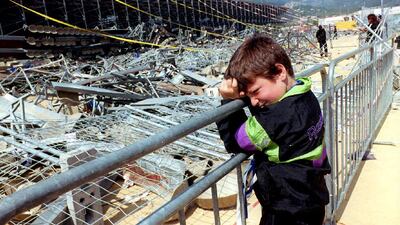
A child grieves at the site the day after a temporary stand collapsed at the Armand-Cesari stadium in Furiani near Bastia, France on May 5, 1992, causing 19 dead and over 2,000 injured. AFP -
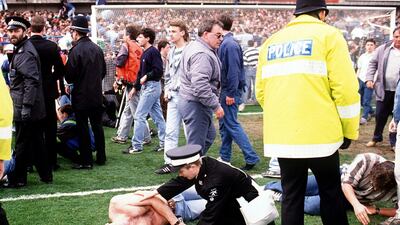
On April 15, 1989 at Hillsborough Stadium, in Sheffield, England, 96 fans were crushed to death and hundreds injured after support railings collapsed during a match between Liverpool and Nottingham forest. AFP -
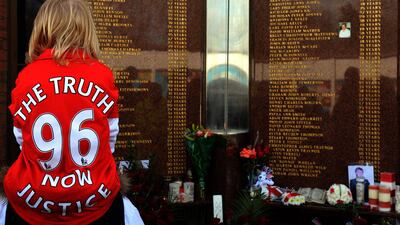
A child wears a jersey bearing the words "Justice for the 96" in front of the Hillsborough Memorial at Liverpool FC's Anfield football ground in Liverpool, England, on April 15, 2013, where supporters gathered for the 24th anniversary of the 1989 Hillsborough disaster where 96 Liverpool fans were crushed to death at Hillsborough Stadium. AFP -
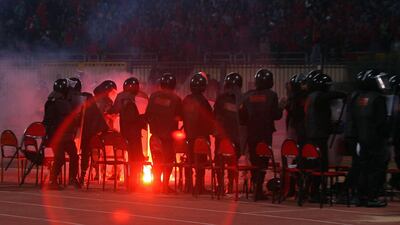
Egyptian riot policemen stand guard as a flare is thrown during a football match between Al Masry and Al Ahly at Port Said, where at least 74 people were killed and hundreds injured when rival fans clashed after the football match on February 1, 2012. AFP -

Confederation of African Football President Patrice Motesepe observes a minute of silence before a press conference on January 25 at Ahmadou Ahidjo stadium in Yaounde, in which eight people were killed and many more injured. AFP -
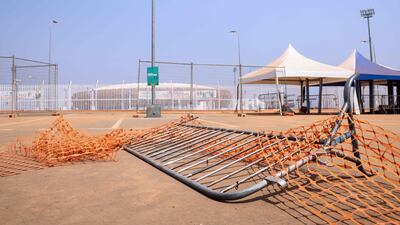
The entrance of Olembe stadium in Yaounde, Cameroon shows barriers on the ground at the scene of the stampede, on January 25. AFP


It has become apparent since the disaster in Indonesia that police and officials at the site breached the safety and security standards set out by world football’s governing body. The indiscriminate use of tear gas created panic in the stadium, and a rush by fans towards locked exit gates created the conditions that resulted in more than 130 people losing their lives at a football match.
Mr Widodo has said the stadium will be demolished and rebuilt to modern safety standards.
Indonesia will also host one of the governing body’s major tournaments next year, the Under-20 World Cup, so there is an obvious compulsion for Fifa to stay the course. Policing of age-grade tournament crowds will need careful planning too. If previous tournaments are a measure of how the 2023 iteration may look, there will be large swings in crowd sizes, with stadiums full for matches involving the host nation or the traditional big draws of world football, such as Brazil, while other games may be more sparsely attended.
Many may ask how can two mass fatalities at football stadiums happen only months apart in the 21st Century?
There are no simple answers to that question, but what is clear is that contrition has in the past sometimes been followed by inaction in the months and years after these fatal episodes. The mistakes of the past can too easily be forgotten. Only in January, football administrators in Africa said that “a tragedy of this nature should never be repeated” and yet, some of the hallmarks of that disaster – locked gates and crowd mismanagement by security staff – were apparent in Asia in October.
If dark days are to be avoided at football stadiums in the future, then lessons should not only be learnt but truly understood. History simply cannot be repeated, again.

