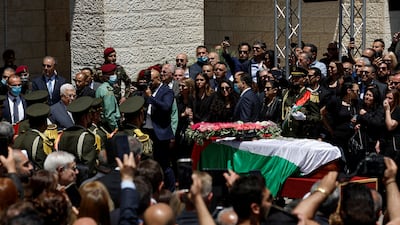
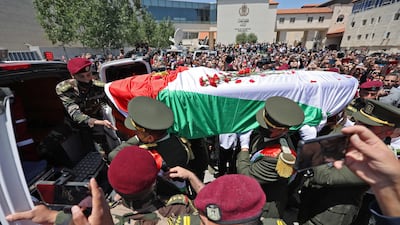
A tribute to Shireen Abu Akleh, who was shot dead during an Israeli military raid in the occupied West Bank, in Nazareth, on Monday. Reuters


A week on, what does Shireen Abu Akleh's killing say about being a Palestinian American?


  • English
  • Arabic

May 18, 2022

The killing of Shireen Abu Akleh has left a great many people furious. Furious that a wonderful woman journalist has been taken from the world. Furious because of the predictable way Israeli authorities have responded to this tragedy. And furious at the US for its failure to take a principled stand to ensure that the truth is known about Abu Akleh’s death and that there is accountability for it.

Much has already been written about Abu Akleh. She was, in addition to being a Palestinian, an American citizen and a journalist who for the past 25 years has been reporting from Palestine. She wasn’t just a journalist, she was a storyteller who, like other greats in her profession, was able to get “under the skin” of an event to lay bare its human drama. Where Palestinian officials failed, she succeeded.

Abu Akleh endeavoured to bring to life the stories of individuals and families bearing up under the indignity, pain and injustice of the occupation. Because of that, she posed a greater danger to the occupation than any gunman ever could. She threatened a dehumanising narrative that reduced Palestinians to faceless objects.

The US refusal to hold Israel to the same standard it insists upon for other countries is upsetting

In this context, it was revealing that the Israeli military spokesperson described Abu Akleh and her colleague, Ali Samodi, who was shot in the back, as being “armed with cameras, if you will permit me to say so”. That is what good journalists do – they arm themselves with cameras and laptops. They witness events as they happen and tell stories so that readers and viewers can understand the human drama that is unfolding.

The Israeli government’s response to Abu Akleh’s killing has been predictable. It involved a combination of denying, lying, and obfuscating what may have happened.

Even before the military investigated the killing, the early Israeli response was that they were “looking into the possibility that journalists were injured, possibly by Palestinian gunfire”. Another spokesperson added: “I don’t think we killed her…if we indeed killed her, we’ll take responsibility, but it doesn’t seem to be the case.”

While this effort at deflection was taking place, Israeli authorities took another tack, claiming they had offered to conduct a joint investigation with the Palestinians, even as the Israeli press noted no such offer had been made. After reading press reports of this “joint investigation”, the Palestinians rejected the “offer”, saying, “No one approached us and no one offered anything…Whoever wants a joint investigation knows who to turn to.”

This led an Israeli minister to suggest that the Palestinian refusal was “perhaps to cover up the truth”.

  • Palestinian President Mahmoud Abbas pays his respects to Al Jazeera journalist Shireen Abu Akleh in Ramallah, the Israeli-occupied West Bank. Reuters
    Palestinian President Mahmoud Abbas pays his respects to Al Jazeera journalist Shireen Abu Akleh in Ramallah, the Israeli-occupied West Bank. Reuters
  • Shireen Abu Akleh was killed during an Israeli raid. Reuters
    Shireen Abu Akleh was killed during an Israeli raid. Reuters
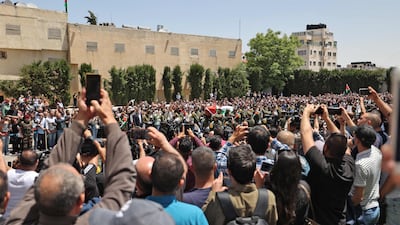
  • Palestinians bid farewell to the Al Jazeera journalist. Reuters
    Palestinians bid farewell to the Al Jazeera journalist. Reuters
  • In the hours after her death, young Palestinians described Abu Akleh, 51, as an inspiration. AFP
    In the hours after her death, young Palestinians described Abu Akleh, 51, as an inspiration. AFP
  • Shireen Abu Akleh was among Arab media’s most prominent figures and widely hailed for her bravery and professionalism. AFP
    Shireen Abu Akleh was among Arab media’s most prominent figures and widely hailed for her bravery and professionalism. AFP
  • Young female reporters said they were motivated to pursue journalism because of her. Reuters
    Young female reporters said they were motivated to pursue journalism because of her. Reuters
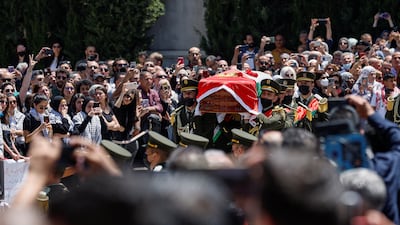
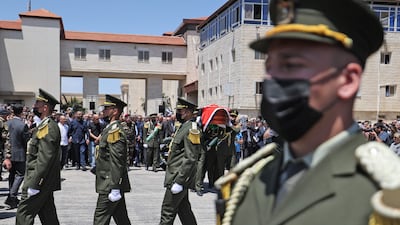
  • Palestinian honour guards carry the veteran journalist’s coffin. AFP
    Palestinian honour guards carry the veteran journalist’s coffin. AFP
  • Her body was carried in a hearse accompanied by vehicles containing armed police as thousands of Palestinians lined the streets to pay their respects. AFP
    Her body was carried in a hearse accompanied by vehicles containing armed police as thousands of Palestinians lined the streets to pay their respects. AFP

The effort to obfuscate and deflect blame was also in evidence in an Israeli Foreign Ministry tweet which read: “Palestinian terrorists, firing indiscriminately, are likely to have hit…Shireen Abu Aqla”. Prime Minister Naftali Bennett added: “Our forces from the IDF returned fire as accurately, carefully, and responsibly as possible. Sadly…Shireen Abu Akleh was killed in the exchange.”

To create further confusion, the Israeli side offered a video which they claimed showed the direction from which the bullets may have been fired by Palestinians. An Israeli human rights group using satellite maps debunked this claim by showing that it was impossible for Palestinian gunmen, given where they were located, to have fired through walls and around corners and hit Abu Akleh and Samodi.

To answer why the Israeli government might engage in such a relentless effort to obfuscate, one need only look at an article that appeared in the Israeli press the day after Shireen’s killing. It was written by the Israeli general who had been in charge of the division that was responsible for killing 12-year-old Muhammad Al Durrah in 2000. That killing was captured on camera and the image of a little boy being shielded by his father amidst a hail of bullets became iconic. In the article, the general confesses that he erred in immediately accepting responsibility, noting that in the days that followed other “explanations” were posited – including that it was all a hoax staged by the Palestinians to besmirch the good name of the Israeli military. The lesson he learnt was to not admit to anything up front. Better to wait for talking points that can muddy the waters for the public.

This is the approach suggested by the famous Marx Brothers’ comedic line: “Who do you believe, me or your lying eyes?”

Finally, there’s the equally frustratingly predictable US response to Abu Akleh’s killing that was in evidence at the State Department briefing the day of her death.

The spokesperson opened with: “We are absolutely heartbroken to learn of the killing of Palestinian American journalist Shireen Abu Akleh…We send our deepest condolences…and strongly condemn her killing as we do the killing of journalists around the world…We call for an immediate and thorough and full investigation and full accountability. Investigating attacks on independent media and prosecuting those responsible are of paramount importance.”

That resolve, however, faded under intense questioning by the journalists present at the press session. While insisting that the investigation be full and thorough and that there be accountability, the spokesperson resorted to the usual deflections. When reporters pointed to instances where Israel either exonerated itself or only offered a slap on the wrist to its forces who had been found guilty of atrocities, the spokesperson would only reaffirm that the US had full confidence in Israel’s ability to investigate itself.

The US refusal to hold Israel to the same standard it insists upon for other countries is upsetting. More so in this case because Abu Akleh is a journalist and a US citizen. In the more than four decades that I’ve been raising cases of US citizens in Israel who’ve been killed, arrested without charge, tortured, had properties confiscated or been denied entry, the US response has been the same: expressions of concern; quietly discussing the matter with their Israeli counterparts; and then doing nothing, as the issue is forgotten outside of Palestinian circles and those of their supporters.

The result is that Israel often operates with a sense of impunity and Palestinians are left defenceless. In the case of Palestinian Americans, the message sent is that to the Israeli and US governments, US citizenship offers no special protection. And so, I’m furious.


MOUNTAINHEAD REVIEW

Starring: Ramy Youssef, Steve Carell, Jason Schwartzman

Director: Jesse Armstrong

Rating: 3.5/5

COMPANY PROFILE

Name: Lamsa

Founder: Badr Ward

Launched: 2014

Employees: 60

Based: Abu Dhabi

Sector: EdTech

Funding to date: $15 million

The specs: 2019 Infiniti QX50

Price, base: Dh138,000 (estimate)
Engine: 2.0L, turbocharged, in-line four-cylinder
Transmission: Continuously variable transmission
Power: 268hp @ 5,600rpm
Torque: 380Nm @ 4,400rpm
Fuel economy: 6.7L / 100km (estimate)

INDIA SQUAD

Rohit Sharma (captain), Shikhar Dhawan (vice-captain), KL Rahul, Suresh Raina, Manish Pandey, Dinesh Karthik (wicketkeeper), Deepak Hooda, Washington Sundar, Yuzvendra Chahal, Axar Patel, Vijay Shankar, Shardul Thakur, Jaydev Unadkat, Mohammad Siraj and Rishabh Pant (wicketkeeper)

ATP WORLD No 1

2004 Roger Federer

2005 Roger Federer

2006 Roger Federer

2007 Roger Federer

2008 Rafael Nadal

2009 Roger Federer

2010 Rafael Nadal

2011 Novak Djokovic

2012 Novak Djokovic

2013 Rafael Nadal

2014 Novak Djokovic

2015 Novak Djokovic

2016 Andy Murray

2017 Rafael Nadal

2018 Novak Djokovic

2019 Rafael Nadal

Mobile phone packages comparison

Mercer, the investment consulting arm of US services company Marsh & McLennan, expects its wealth division to at least double its assets under management (AUM) in the Middle East as wealth in the region continues to grow despite economic headwinds, a company official said.

Mercer Wealth, which globally has $160 billion in AUM, plans to boost its AUM in the region to $2-$3bn in the next 2-3 years from the present $1bn, said Yasir AbuShaban, a Dubai-based principal with Mercer Wealth.

Within the next two to three years, we are looking at reaching $2 to $3 billion as a conservative estimate and we do see an opportunity to do so,” said Mr AbuShaban.

Mercer does not directly make investments, but allocates clients’ money they have discretion to, to professional asset managers. They also provide advice to clients.

“We have buying power. We can negotiate on their (client’s) behalf with asset managers to provide them lower fees than they otherwise would have to get on their own,” he added.

Mercer Wealth’s clients include sovereign wealth funds, family offices, and insurance companies among others.

From its office in Dubai, Mercer also looks after Africa, India and Turkey, where they also see opportunity for growth.

Wealth creation in Middle East and Africa (MEA) grew 8.5 per cent to $8.1 trillion last year from $7.5tn in 2015, higher than last year’s global average of 6 per cent and the second-highest growth in a region after Asia-Pacific which grew 9.9 per cent, according to consultancy Boston Consulting Group (BCG). In the region, where wealth grew just 1.9 per cent in 2015 compared with 2014, a pickup in oil prices has helped in wealth generation.

BCG is forecasting MEA wealth will rise to $12tn by 2021, growing at an annual average of 8 per cent.

Drivers of wealth generation in the region will be split evenly between new wealth creation and growth of performance of existing assets, according to BCG.

Another general trend in the region is clients’ looking for a comprehensive approach to investing, according to Mr AbuShaban.

“Institutional investors or some of the families are seeing a slowdown in the available capital they have to invest and in that sense they are looking at optimizing the way they manage their portfolios and making sure they are not investing haphazardly and different parts of their investment are working together,” said Mr AbuShaban.

Some clients also have a higher appetite for risk, given the low interest-rate environment that does not provide enough yield for some institutional investors. These clients are keen to invest in illiquid assets, such as private equity and infrastructure.

“What we have seen is a desire for higher returns in what has been a low-return environment specifically in various fixed income or bonds,” he said.

“In this environment, we have seen a de facto increase in the risk that clients are taking in things like illiquid investments, private equity investments, infrastructure and private debt, those kind of investments were higher illiquidity results in incrementally higher returns.”

The Abu Dhabi Investment Authority, one of the largest sovereign wealth funds, said in its 2016 report that has gradually increased its exposure in direct private equity and private credit transactions, mainly in Asian markets and especially in China and India. The authority’s private equity department focused on structured equities owing to “their defensive characteristics.”

Scream%20VI
%3Cp%3E%3Cstrong%3EDirectors%3A%3C%2Fstrong%3E%20Matt%20Bettinelli-Olpin%20and%20Tyler%20Gillett%3C%2Fp%3E%0A%3Cp%3E%3Cstrong%3EStars%3A%3C%2Fstrong%3E%20Melissa%20Barrera%2C%20Jasmin%20Savoy%20Brown%2C%20Jack%20Champion%2C%20Dermot%20Mulroney%2C%20Jenna%20Ortega%2C%20Hayden%20Panettiere%20and%20Courteney%20Cox%3C%2Fp%3E%0A%3Cp%3E%3Cstrong%3ERating%3A%3C%2Fstrong%3E%203%2F5%3C%2Fp%3E%0A
Dates for the diary

To mark Bodytree’s 10th anniversary, the coming season will be filled with celebratory activities:

  • September 21 Anyone interested in becoming a certified yoga instructor can sign up for a 250-hour course in Yoga Teacher Training with Jacquelene Sadek. It begins on September 21 and will take place over the course of six weekends.
  • October 18 to 21 International yoga instructor, Yogi Nora, will be visiting Bodytree and offering classes.
  • October 26 to November 4 International pilates instructor Courtney Miller will be on hand at the studio, offering classes.
  • November 9 Bodytree is hosting a party to celebrate turning 10, and everyone is invited. Expect a day full of free classes on the grounds of the studio.
  • December 11 Yogeswari, an advanced certified Jivamukti teacher, will be visiting the studio.
  • February 2, 2018 Bodytree will host its 4th annual yoga market.

Premier Futsal 2017 Finals

Al Wasl Football Club; six teams, five-a-side

Delhi Dragons: Ronaldinho
Bengaluru Royals: Paul Scholes
Mumbai Warriors: Ryan Giggs
Chennai Ginghams: Hernan Crespo
Telugu Tigers: Deco
Kerala Cobras: Michel Salgado

What are NFTs?

Are non-fungible tokens a currency, asset, or a licensing instrument? Arnab Das, global market strategist EMEA at Invesco, says they are mix of all of three.

You can buy, hold and use NFTs just like US dollars and Bitcoins. “They can appreciate in value and even produce cash flows.”

However, while money is fungible, NFTs are not. “One Bitcoin, dollar, euro or dirham is largely indistinguishable from the next. Nothing ties a dollar bill to a particular owner, for example. Nor does it tie you to to any goods, services or assets you bought with that currency. In contrast, NFTs confer specific ownership,” Mr Das says.

This makes NFTs closer to a piece of intellectual property such as a work of art or licence, as you can claim royalties or profit by exchanging it at a higher value later, Mr Das says. “They could provide a sustainable income stream.”

This income will depend on future demand and use, which makes NFTs difficult to value. “However, there is a credible use case for many forms of intellectual property, notably art, songs, videos,” Mr Das says.

Tips%20for%20holiday%20homeowners
%3Cp%3EThere%20are%20several%20factors%20for%20landlords%20to%20consider%20when%20preparing%20to%20establish%20a%20holiday%20home%3A%3C%2Fp%3E%0A%3Cul%3E%0A%3Cli%3E%3Cstrong%3ERevenue%20potential%20of%20the%20unit%3A%3C%2Fstrong%3E%20location%2C%20view%20and%20size%3C%2Fli%3E%0A%3Cli%3E%3Cstrong%3EDesign%3A%20furnished%20or%20unfurnished.%3C%2Fstrong%3E%20Is%20the%20design%20up%20to%20standard%2C%20while%20being%20catchy%20at%20the%20same%20time%3F%3C%2Fli%3E%0A%3Cli%3E%3Cstrong%3EBusiness%20model%3A%3C%2Fstrong%3E%20will%20it%20be%20managed%20by%20a%20professional%20operator%20or%20directly%20by%20the%20owner%2C%20how%20often%20does%20the%20owner%20wants%20to%20use%20it%20for%20personal%20reasons%3F%3C%2Fli%3E%0A%3Cli%3E%3Cstrong%3EQuality%20of%20the%20operator%3A%3C%2Fstrong%3E%20guest%20reviews%2C%20customer%20experience%20management%2C%20application%20of%20technology%2C%20average%20utilisation%2C%20scope%20of%20services%20rendered%3C%2Fli%3E%0A%3C%2Ful%3E%0A%3Cp%3E%3Cem%3ESource%3A%20Adam%20Nowak%2C%20managing%20director%20of%20Ultimate%20Stay%20Vacation%20Homes%20Rental%3C%2Fem%3E%3C%2Fp%3E%0A
What are the main cyber security threats?

Cyber crime - This includes fraud, impersonation, scams and deepfake technology, tactics that are increasingly targeting infrastructure and exploiting human vulnerabilities.
Cyber terrorism - Social media platforms are used to spread radical ideologies, misinformation and disinformation, often with the aim of disrupting critical infrastructure such as power grids.
Cyber warfare - Shaped by geopolitical tension, hostile actors seek to infiltrate and compromise national infrastructure, using one country’s systems as a springboard to launch attacks on others.

Updated: May 18, 2022, 4:00 AM