

With the parliamentary election over in Lebanon, the country will have to focus on three broad objectives. First, forming a government. Second, preparing for the presidential election in September or October. And third, moving forward on essential economic reforms to alleviate the suffering of the population. However, the election results may well indefinitely hinder the achievement of these objectives.
The first priority will be to form a new government. Under normal circumstances, this should not pose a major challenge, since the government should be in power only until the presidential election. However, if there is no consensus around the next head of state and Lebanon enters a presidential vacuum, the government will take on presidential powers and may last far longer than expected. That is why negotiations over its formation are bound to be highly divisive.
The question of who will succeed President Michel Aoun is also contentious. Until the parliamentary election, the two front-runners were Gebran Bassil, Mr Aoun’s son-in-law, and Suleiman Franjieh, a politician from northern Lebanon, whose grandfather was president from 1970 until 1976. However, the largest Christian bloc post-elections will be controlled by the Lebanese Forces, whose leader Samir Geagea also has presidential ambitions and who will strongly contest Mr Bassil and Mr Franjieh.
Mr Bassil, who heads the Free Patriotic Movement, lost ground in the legislative election, while the list backed by Mr Franjieh did relatively poorly. Neither man, therefore, will be able to credibly make the case that he is the most legitimate Maronite Christian candidate for the presidency. The fact that Hezbollah strenuously opposes Mr Geagea suggests there will be no easy agreement on a successor to Mr Aoun, and the outcome may be a long political void, unless a compromise can be reached.
The election results suggest that two broad blocs will emerge in Parliament – one led by the Lebanese Forces, with its allies, particularly from the Sunni community; and a Hezbollah-led coalition, formed with the Aounists. This may make for a period of stalemate ahead, because of Lebanon’s widening polarisation.
All this will have a fundamental, and very negative, bearing on economic reforms, which have not progressed since the economy collapsed in 2019. Yet, with economic indicators continuing to deteriorate and the World Bank predicting zero growth in 2022, Lebanon cannot afford to waste more time.
A report this month by the UN special envoy on poverty, Olivier de Schutter, accused the government and the central bank of human rights violations in impoverishing the population. The report said that Lebanese officials had “a sense of impunity", and appeared to be living “in a fantasy land".

Recently, the Lebanese government and the International Monetary Fund agreed to what is known as a staff agreement, in which the IMF said it would provide $3-4 billion to Lebanon if the country implemented required economic reforms and an audit of the banking sector. Yet, continued factionalism has hindered progress.
If political divisions are exacerbated in the coming months, a final agreement over an IMF-led reform programme will be highly improbable this year. What this would mean is that in the best-case scenario, Lebanon could begin focusing on economic priorities only after a new president comes to office, whenever that occurs.
What is unfortunate in this regard is that the government has reportedly advanced in its economic plan to take Lebanon out of its crisis. Recently, Deputy Prime Minister Saadeh Al-Shami, who is playing a key role in negotiations with the IMF, stated that the technical aspects of banking sector reform were completed. While this is good news, several more months of continuing deadlock could have a disastrous impact on the well-being of the Lebanese, and on banks in particular.
Finally, a major factor that will help define the period ahead is regional calculations. A number of Arab states have shown a renewed momentum in trying to contain Hezbollah’s power in Lebanon, which has made the party uneasy. This mood will not have been helped by the gains made by the Lebanese Forces in the election. The mainly Christian party has close ties with Saudi Arabia, which Hezbollah sees as a threat.
As the Arab states, especially the Gulf states, reinforce their stakes in Lebanon, this could lead to one of two possible outcomes: a struggle for influence with Iran in the country that is unlikely to come out with a clear winner. This can potentially bring about an eventual agreement to share influence. Alternatively, Hezbollah and Iran might try in some way to reimpose their hegemony. But this would be risky, as the strength of the party’s cross-sectarian alliances have been eroded.
The most likely outcome is that Lebanon will remain at a standstill in the coming months, and perhaps even beyond that, as the two broad alignments neutralise each other in Parliament. Neither side will be able to overcome the other, and both sides will want to avoid a civil war. Meanwhile, the Lebanese will continue to suffer as their political parties pursue clashing agendas, with little concern for the population.
-

An electoral worker sits next to ballot boxes, at the Justice Palace, in Jdeideh. Reuters -

A soldier stands guard as ballots are counted at the Justice Palace. Reuters -
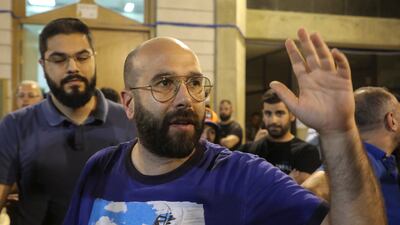
Jad Ghosn, an opposition candidate, gestures as people wait for the announcement of official election results, in Jdeideh. Reuters -
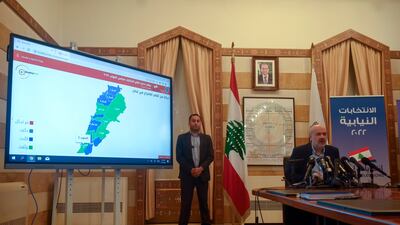
Lebanese Interior Minister Bassam Mawlawi announces the final results for some districts. EPA -

Opposition candidate Yassin Yassin gestures as he is greeted by supporters in Jeb Jennin, West Bekaa. Reuters -
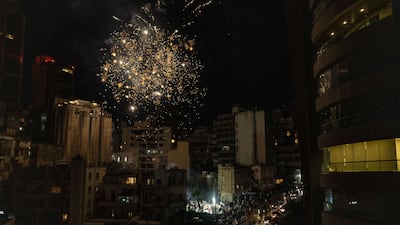
Supporters of the Lebanese Forces take to the streets during parliamentary elections in the Ashrafieh district of Beirut. Bloomberg -
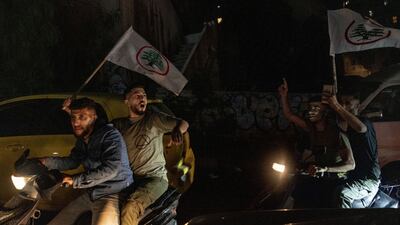
Lebanon headed to the polls with its economy in the grip of hyperinflation. Bloomberg -
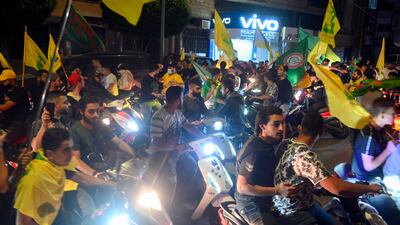
Lebanese youths supporting Hezbollah and Amal movement wave their party flags after parliamentary elections in a suburb of Beirut. EPA -
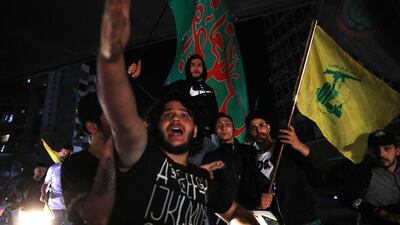
Supporters of Lebanon's Shiite groups Hezbollah and Amal lift their flags during a motorbike rally after voting. AFP -

Children swim in an inflatable pool that supporters of former prime minister Saad Hariri installed to illustrate their intention to boycott parliamentary elections in Beirut, Lebanon. AP Photo -
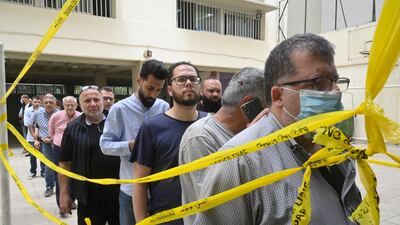
Voters queue to place their vote in parliamentary elections in Beirut, Lebanon. EPA -

Nabih Berri, Speaker of the Lebanese Parliament, stands in a polling booth to vote in Tebnin. Reuters -

Voters register at a polling station in Beirut. Bloomberg -
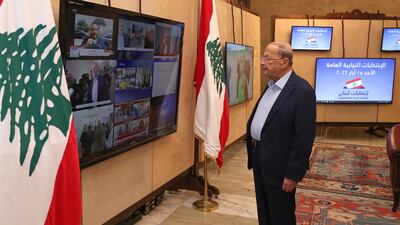
Lebanese President Michel Aoun follows the parliamentary elections on screens from the Presidential Palace in Beirut. AP -

A Lebanese woman shows her inked finger after she cast her vote at a polling station in Beirut. AP -
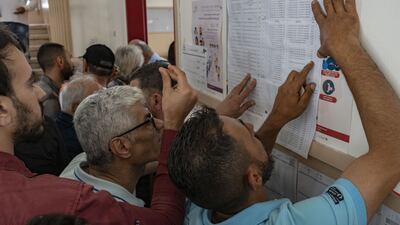
Voters look at a list of candidates at a polling station in Beirut. Bloomberg -

Lebanese policemen help a voter into a polling station in Beirut. AP -
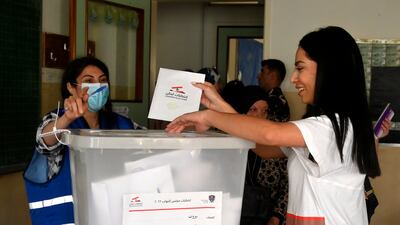
A Lebanese voter casts her ballot paper in Beirut. EPA -
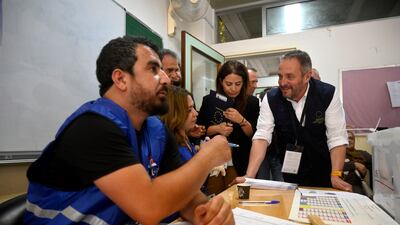
Gyorgy Holvenyi (R), chief observer of the European Union election observation mission, visits a polling station in Beirut. EPA -
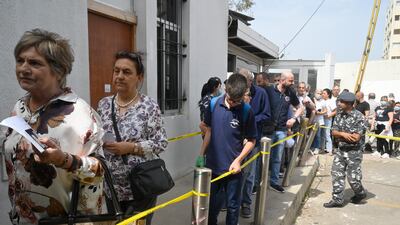
Lebanese people wait to vote during parliamentary elections in the capital city. EPA -
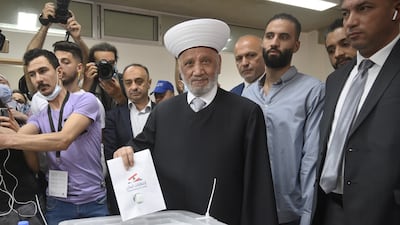
Sheikh Abdul Latif Derian, Grand Mufti of Lebanon, casts his ballot paper during parliamentary elections in Beirut. EPA -
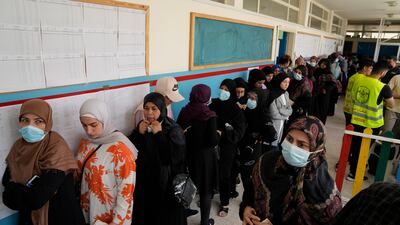
People queue to cast their votes in the Lebanese capital. AP -
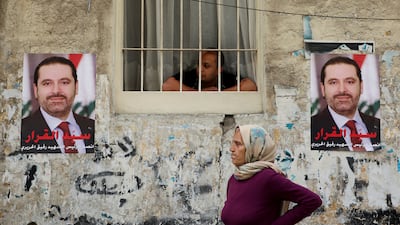
Posters in Al Tariq Al Jadida, Beirut, depict Lebanon’s former prime minister Saad Hariri. Reuters -
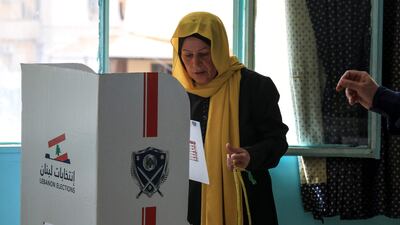
A woman prepares her ballot at a polling station in a southern suburb of Beirut. AFP -
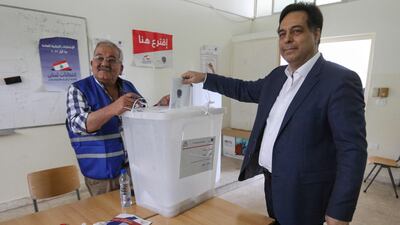
Former prime minister Hassan Diab, who succeeded Saad Hariri, casts his ballot in Beirut. AFP -

A voter checks lists for the parliamentary election at a polling station in the Lebanese capital Beirut. AFP -
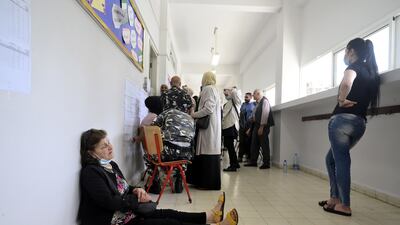
A woman waits to vote in Beirut. EPA -
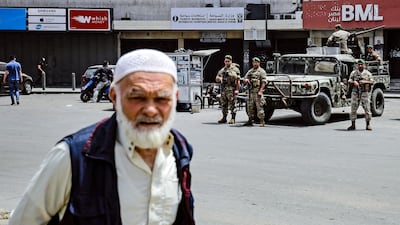
Security forces stand guard at Nur Square on the southern entrance of the northern Lebanese port city Tripoli. AFP -
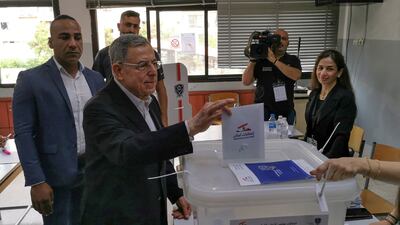
Former Lebanese prime minister Fouad Siniora casts his vote at a polling station during the parliamentary election, in Sidon, southern Lebanon. Reuters -
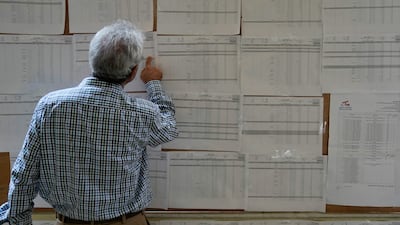
A man check voters' lists in the capital Beirut. AP -
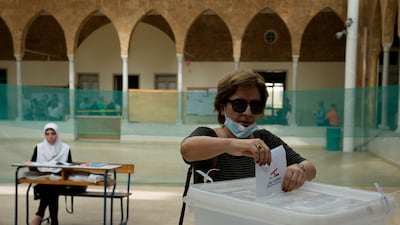
A woman votes in Lebanon's parliamentary elections in Beirut. AP -
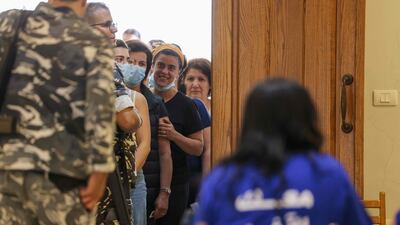
Police check the ID of voters outside a polling station near the Lebanese coastal city of Byblos (Jbeil), north of Beirut. AFP -
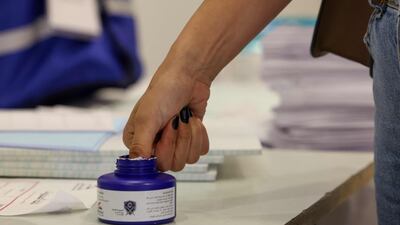
A voter dips her finger in ink after casting her ballot in the parliamentary election at a polling station near Byblos. AFP -
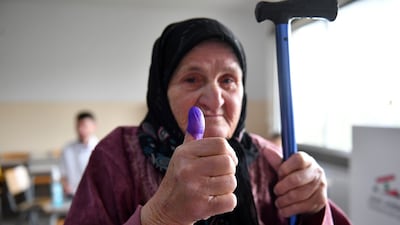
A Lebanese woman shows her ink-marked thumb after voting in Shmustar, Bekaa valley. EPA -
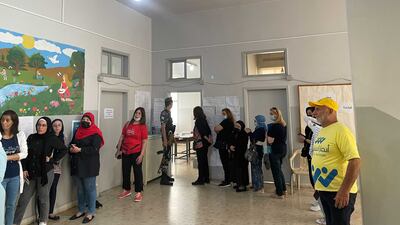
People queueing to vote at Ras El Nabeh Public School for Girls. Fatima Al Mahmoud/ The National



