


The dissolution of the Soviet Union in 1991 is often attributed to the then leader Mikhail Gorbachev’s perceived close ties to the West, particularly with Washington. Many in Russia, including its current leadership, continue to hurt from what they view to be the downsizing of the once mighty Soviet empire more than three decades ago. Now, however, it appears as if the same leadership may be further downgrading Russia’s global might because of the war in Ukraine.
Indeed, Moscow has unwittingly unified its adversaries in the West, with the latter now working in concert to provide Ukraine with all manner of assistance and punish Russia with sanctions. The once flagging levels of co-ordination between the US and its European allies have clearly picked up. Russia had long insisted that any move to induct Ukraine, formerly of the Soviet Union, into Nato amounted to a red line. Today, Ukraine may not be any closer to joining the western security alliance, but the war is pushing other neutral countries in Europe, such as Finland and Sweden, to seriously consider the idea.
The sanctions have been especially punishing on ordinary Russians, many in the West wondering if that would put any pressure on the leadership in Moscow.
Despite US President Joe Biden’s recent remark that Russian President Vladimir Putin “cannot remain in power”, western governments have strenuously denied that regime change is on their agenda. And yet, some of the measures they have taken since the war in Ukraine began seem to be attempts at immobilising the Kremlin and isolating it from the international community.
It’s a tricky strategy, because Moscow is unlikely to back down in the face of such pressure. On the contrary, it is likely to double down in Ukraine, as the focus of the war shifts to the Donbas region in the country’s east.
Questions abound, as I am told, at various levels in Russia, about what the endgame of the conflict is. What, for instance, would the status be of the two Ukrainian territories in Donbas? What flag (or flags) will be hoisted there? Who will pay for their reconstruction after the war is over? What currency will be accepted there, especially since the rouble is not used in that part of Ukraine? These are fundamental questions that the Kremlin will need to demystify sooner than later.
The picture isn’t any clearer on the diplomatic stage either. Russian Foreign Minister Sergey Lavrov has backtracked from giving the impression that there is progress in the negotiations with Ukraine in Istanbul, instead accusing Kyiv of reneging on its promises. The Ukrainian delegation, on the other hand, has engaged with a clear set of objectives and created room for compromise. That there has yet to be a deal could be down to there being little for the Russian leadership to take to the people by way of a win.
The West seems to have won the media battle, too, having made tactical leaks of its intelligence showing Moscow’s plans before the war began. It hasn’t helped Moscow’s cause that the war continues to rage on in the face of stiff Ukrainian resistance more than a month since the operation got under way.
-
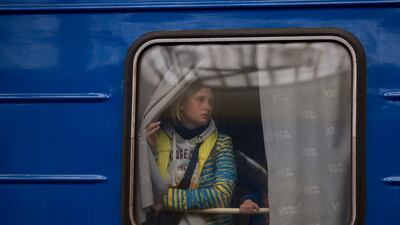
A young woman looks out the window as her train arrives from Pokrovsk, in the east of Ukraine, to Lviv in the country's centre. Getty -

A truck carries black bags containing bodies exhumed from a mass grave for investigations in Bucha, in the outskirts of Kyiv, Ukraine. AP -
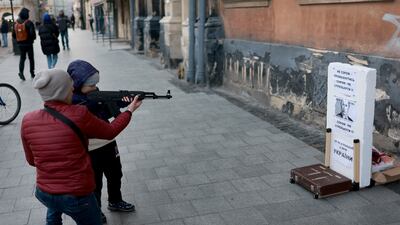
A child uses an air rifle to shoot at a target with the face of Russian President Vladimir Putin in Lviv, Ukraine. Getty -
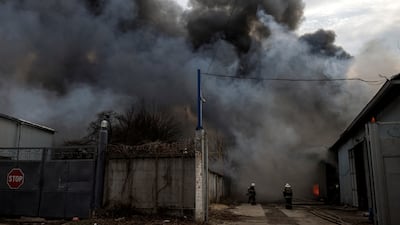
Firefighters try to contain a blaze at a factory after Russian shelling in Kharkiv, Ukraine. Reuters -
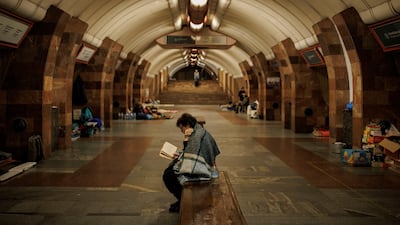
A woman reads as residents shelter from Russian shelling in a Kharkiv metro station. Reuters -
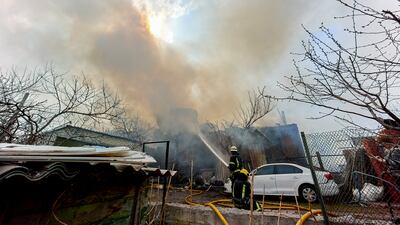
Ukrainian rescuers try to put out the fire at a private building after shelling in Kharkiv, Ukraine. EPA -
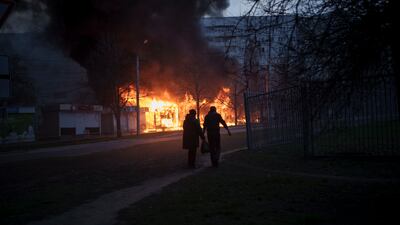
A couple of residents walk past burning shops after a Russian attack in Kharkiv, Ukraine. AP Photo -
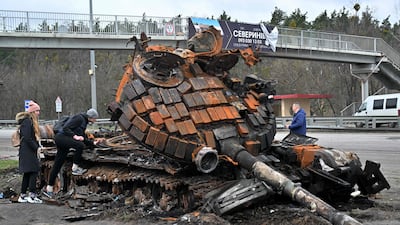
A destroyed Russian tank on the outskirts of Buzova village in Kyiv draws crowds of curious residents. AFP -

The Russian offensive in the Kyiv region has left a huge crater on a bridge in Makariv. AFP -
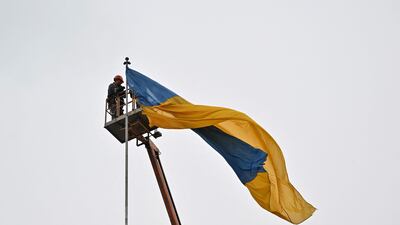
Workers put an Ukrainian flag on a pole in the centre of Makariv. AFP -
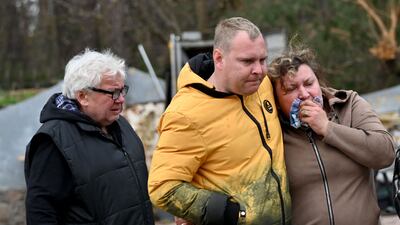
A Ukrainian mother is comforted by relatives after the body of her son was discovered in a manhole in Buzova village, west of Kyiv. AFP -
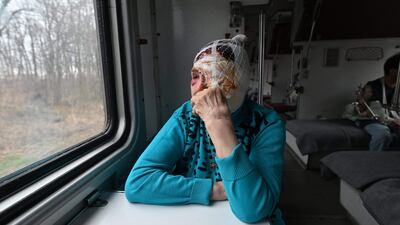
An injured Ukrainian on a medical evacuation train bound for the western Ukrainian city of Lviv. AFP -
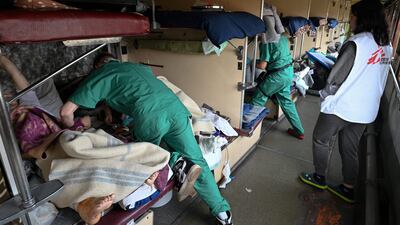
A Doctors Without Borders team at work on medical evacuation train. AFP -
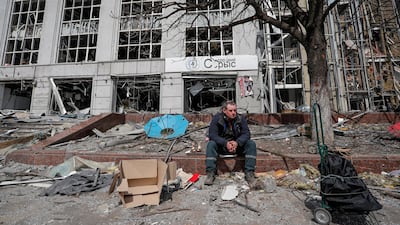
A damaged building in the southern port city of Mariupol. Reuters -
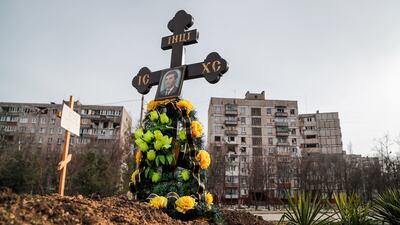
Graves of the victims of the Ukraine-Russia conflict in Mariupol. Reuters -
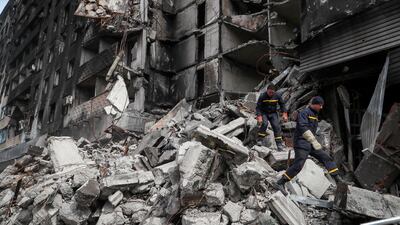
Emergency workers sift through debris of a damaged building in Mariupol. Reuters -

The conflict has forced Mariupol residents to wait in line for drinking water. Reuters -
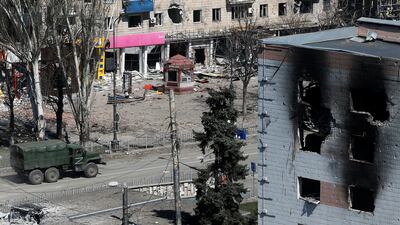
A Russian military vehicle in Mariupol. Reuters -

Food distribution at a church in the town of Borodyanka, north-west of Kyiv. AP -
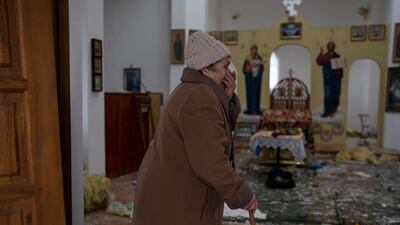
A visitor is in shock after returning to her church, which had come under Russian attack, in the Kyiv town of Makaro. AP -
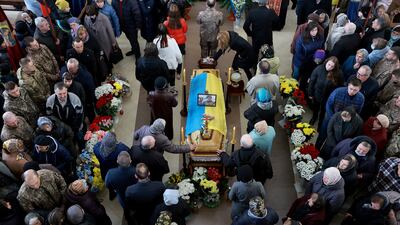
Mourners gather at the funeral of Ukrainian soldier Andriy Zagornyakon in Kamianka-Buzka. Getty Images -

A resident returns with his dog to survey his damaged building in Kharkiv. EPA -
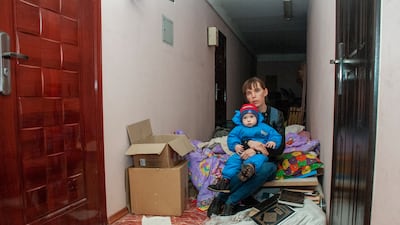
A woman and a child are forced to sit on the corridor of a building in Kharkiv that is used as a bomb shelter. EPA -
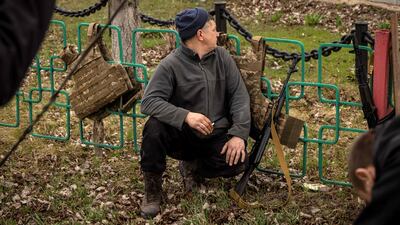
A Ukrainian guard in the eastern town of Barvinkove, during Russia's invasion of its neighbouring country. AFP -
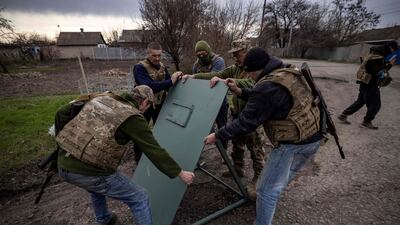
Ukrainian guards strengthen their position in the eastern town of Barvinkove. AFP -

Emotional farewell at the train station in the eastern Ukrainian city Kramatorsk, which has come under Russian attack. AFP -
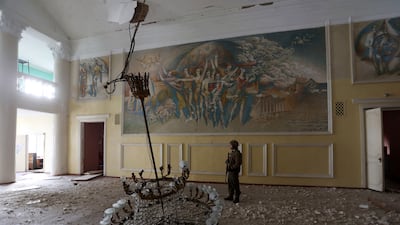
A Ukrainian serviceman surveys the damaged cultural centre, in the town of Rubizhne, Luhansk region. AFP -
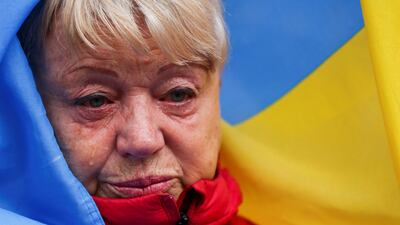
A participant at the pro-Ukrainian demonstration outside Downing Street in London. Reuters -
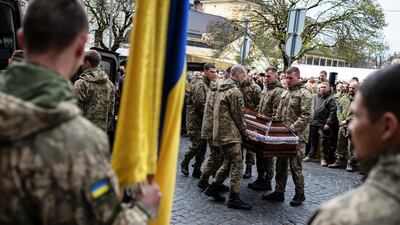
Colleagues bid farewell to Yuriy Dadak-Ruf and Taras Kryt, the Ukrainian soldiers killed in Russian shelling of the Luhansk region. Reuters -

A villager warms himself in the yard of his house in Bucha, on the outskirts of Kyiv. AP -
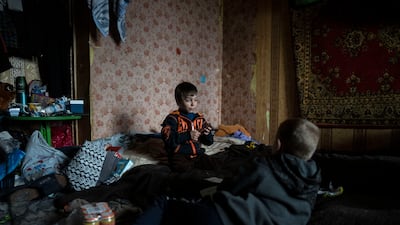
Vlad, the six-year old Ukrainian who lost his mother during their confinement in a Bucha basement amid the Russian invasion, plays with a friend inside his house. AP -
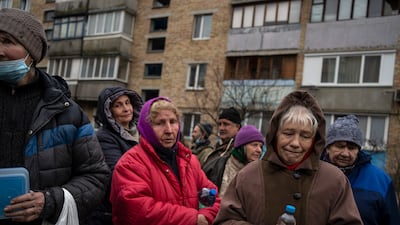
A group of women wait to receive free food in Bucha. AP -
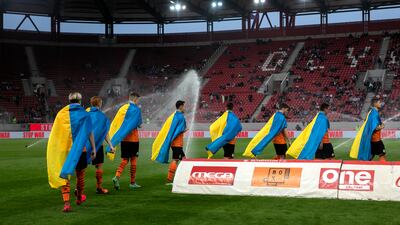
Shakhtar Donetsk players carry the Ukrainian flag before their football match against Olympiakos in Piraeus, near Athens. AP -
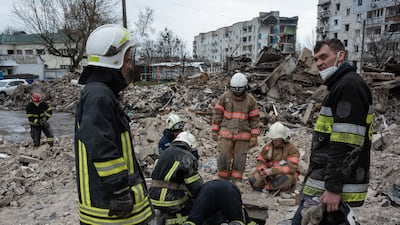
Rescue workers clear the rubble of an apartment building in Borodianka. Getty Images -
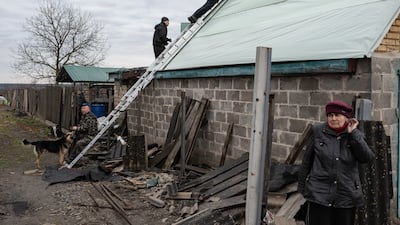
A man repairs the roof of a house while standing on a ladder, in Andriivka, Ukraine. Getty Images -

Valerii, 65, rides by his destroyed apartment building in Borodianka. Getty Images -
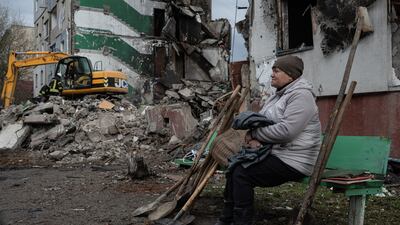
A Ukrainian woman in Borodianka waits as rescue workers search for her daughter, her son-in-law and her granddaughter among the rubble. Getty Images -
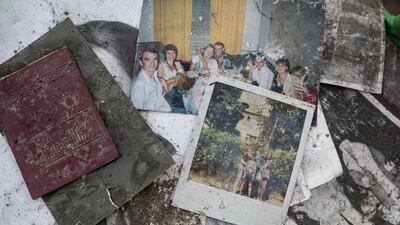
Family photos are scattered among the debris of a destroyed apartment tower in Borodianka. Getty Images -
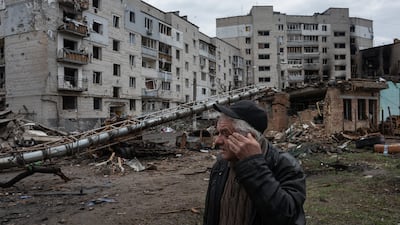
A distraught survivor of the attack on Borodianka. Getty Images -
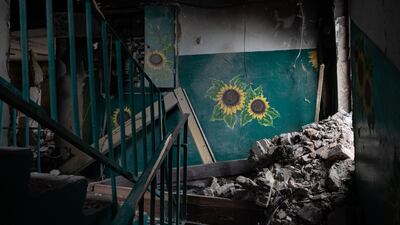
Debris of an apartment building in Borodianka. Getty Images -
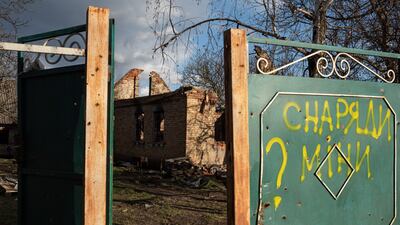
A writing on the gate of a destroyed building in Andriivka - 'Shells, mines?' - points to the threat faced by Ukrainians. Getty Images -
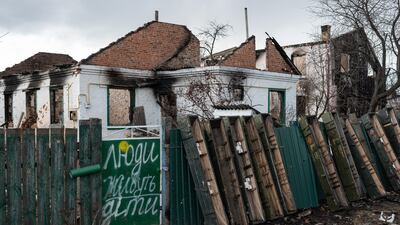
Another writing on the fence of a destroyed building, in Andriivka, reads 'People children live here'. Getty Images -
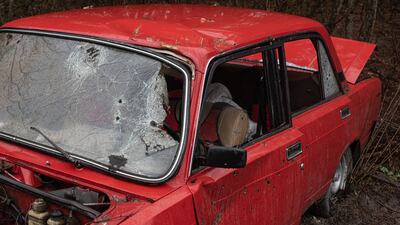
A bullet-riddled car near Ozera. Getty Images


And if the war continues to intensify, Russia’s international isolation is only likely to grow, with more steps such as its recent suspension from the UN Human Rights Council expected. But the Russian people wouldn’t want to be isolated.
Such a scenario makes it difficult for Moscow to create an effective narrative, especially in time for the upcoming annual national holidays.
The first 10 days in the month of May are a period of celebrations in Russia, beginning with Labour Day and leading up to Victory Day on May 9, which commemorates the Soviet Union’s triumph over Nazi Germany in the Second World War in 1945. The question, then, is what sort of narrative Moscow would create during this year’s holidays – particularly as a military victory in Ukraine in less than a month seems highly unlikely.
In the absence of an outright win, therefore, one can expect further escalation in Ukraine – with the Russian intention being to force the West to back down.
That may or may not be an effective strategy. For now, however, as the war continues to undermine the country’s influence in the global arena, it is difficult to imagine the mood in Russia being anything but sombre.

