China's borders have been virtually closed off for the past two years. Now, in a way, it's opening on a massive scale for the Winter Olympics. To pull this off in the middle of a pandemic, China is holding the Games in a fortress.
The journey into that strict bubble was like stepping into another world. The first thing I saw when I walked off the airplane was a sea of hazmat suits. It felt as if I had entered a giant medical facility, rather than an Olympic host city. Workers in white, full body protective gear, goggles, and masks directed passengers through the airport.
Beijing Capital International Airport, once among the busiest in the world, looked largely deserted. Olympic posters and "Welcome to Beijing" signs lined empty hallways. We were then led straight to a makeshift testing site, consisting of dozens of cubicles. After getting tested for Covid-19 – with a painful nasal and throat swab – I passed through immigration and customs.
But underneath the goggles and masks, I could still see excitement in some of the workers' eyes. As I waited for my bags, a crowd of workers in hazmat suits asked if they could take a selfie with me. They, too, wanted to remember this unique Olympic moment.
Since the pandemic started, I've been through five quarantines in Beijing, Hong Kong and Tokyo. Each government has a different approach to tackling Covid-19. But the bottom line is, traveling during Covid-19, especially in Asia, is exhausting and nerve-wracking. Even compared to my previous trips, this one required, by far, the most meticulous planning and preparation.
Two weeks before the Games, I was required to start tracking my health in an Olympic app every day. I self-isolated during that time to avoid infection.
By the time I departed for Beijing, I was fully vaccinated, had tested negative for Covid-19 twice, and had stocked my suitcase with face masks and snacks to eat if I failed a test and was forced to isolate alone for the entire Winter Games.
I boarded a special plane to Beijing just to transport Olympic participants. As the plane descended and the sky gradually turned into the dusty brown smog of Beijing's pollution, I longed to be able to travel throughout the city. I had lived in Beijing before moving to Tokyo 18 months ago and hadn't been back since. But this time, I won't be able to see relatives and friends, or visit my favourite restaurants.
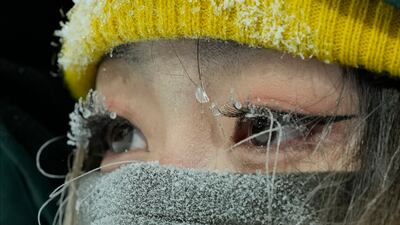
Underneath the goggles and masks, I could still see excitement in some of the workers' eyes
I took a special bus straight to a designated Olympic hotel surrounded by temporary walls. As I waited in my room for the results of the airport Covid-19 test, waves of anxiety hit me. What if my test came back positive? Or what if it came back negative, but I was somehow infected during travel and I'd get a positive result during the mandatory daily test in a few days?
After all the painstaking preparations, I just wanted to be able to do my job and not spend my assignment in isolation. Thankfully, after an anxious six hour wait, my results came back negative. I will, however, need to be tested every day.
But the scenarios I was mulling in my head pale in comparison to the angst Olympic athletes experienced in the lead up to this Games. Several athletes told me they were self-isolating for a month before the Games, paranoid that a positive test result could derail the moment they've worked their entire careers for.
During my entire stay, I'm strictly confined to what Olympic organisers are calling the "closed loop" – a system of multiple bubbles – including venues, conference centres, and hotels – connected by dedicated transport.
The local staff for the Games are also part of the closed loop. In fact, they will have to quarantine for as long as 21 days before they can leave the Olympic "bubbles" and return to their homes elsewhere in China. This is no small sacrifice, especially since they've already missed the chance to spend Lunar New Year, the most important holiday in China, with their families.
On Lunar New Year day, I spoke to a local staffer for the Olympics near the media centre. She was standing by the fence inside the closed loop. Her husband and two young sons were metres away, separated by another fence, outside the closed loop. It was the closest they could get to each other to usher in the Year of the Tiger. Her two sons waved from afar, telling their mother how much they loved and missed her.
The woman told me this was the longest she'd ever spent apart from her children. She had worked in the 2008 Summer Olympics as well. Back then, she said it was like a big party. This time, she says everything leading up to the Games has just been tough.

UAE currency: the story behind the money in your pockets
Mercer, the investment consulting arm of US services company Marsh & McLennan, expects its wealth division to at least double its assets under management (AUM) in the Middle East as wealth in the region continues to grow despite economic headwinds, a company official said.
Mercer Wealth, which globally has $160 billion in AUM, plans to boost its AUM in the region to $2-$3bn in the next 2-3 years from the present $1bn, said Yasir AbuShaban, a Dubai-based principal with Mercer Wealth.
“Within the next two to three years, we are looking at reaching $2 to $3 billion as a conservative estimate and we do see an opportunity to do so,” said Mr AbuShaban.
Mercer does not directly make investments, but allocates clients’ money they have discretion to, to professional asset managers. They also provide advice to clients.
“We have buying power. We can negotiate on their (client’s) behalf with asset managers to provide them lower fees than they otherwise would have to get on their own,” he added.
Mercer Wealth’s clients include sovereign wealth funds, family offices, and insurance companies among others.
From its office in Dubai, Mercer also looks after Africa, India and Turkey, where they also see opportunity for growth.
Wealth creation in Middle East and Africa (MEA) grew 8.5 per cent to $8.1 trillion last year from $7.5tn in 2015, higher than last year’s global average of 6 per cent and the second-highest growth in a region after Asia-Pacific which grew 9.9 per cent, according to consultancy Boston Consulting Group (BCG). In the region, where wealth grew just 1.9 per cent in 2015 compared with 2014, a pickup in oil prices has helped in wealth generation.
BCG is forecasting MEA wealth will rise to $12tn by 2021, growing at an annual average of 8 per cent.
Drivers of wealth generation in the region will be split evenly between new wealth creation and growth of performance of existing assets, according to BCG.
Another general trend in the region is clients’ looking for a comprehensive approach to investing, according to Mr AbuShaban.
“Institutional investors or some of the families are seeing a slowdown in the available capital they have to invest and in that sense they are looking at optimizing the way they manage their portfolios and making sure they are not investing haphazardly and different parts of their investment are working together,” said Mr AbuShaban.
Some clients also have a higher appetite for risk, given the low interest-rate environment that does not provide enough yield for some institutional investors. These clients are keen to invest in illiquid assets, such as private equity and infrastructure.
“What we have seen is a desire for higher returns in what has been a low-return environment specifically in various fixed income or bonds,” he said.
“In this environment, we have seen a de facto increase in the risk that clients are taking in things like illiquid investments, private equity investments, infrastructure and private debt, those kind of investments were higher illiquidity results in incrementally higher returns.”
The Abu Dhabi Investment Authority, one of the largest sovereign wealth funds, said in its 2016 report that has gradually increased its exposure in direct private equity and private credit transactions, mainly in Asian markets and especially in China and India. The authority’s private equity department focused on structured equities owing to “their defensive characteristics.”
Defence review at a glance
• Increase defence spending to 2.5% of GDP by 2027 but given “turbulent times it may be necessary to go faster”
• Prioritise a shift towards working with AI and autonomous systems
• Invest in the resilience of military space systems.
• Number of active reserves should be increased by 20%
• More F-35 fighter jets required in the next decade
• New “hybrid Navy” with AUKUS submarines and autonomous vessels
Indoor Cricket World Cup
Venue Insportz, Dubai, September 16-23
UAE squad Saqib Nazir (captain), Aaqib Malik, Fahad Al Hashmi, Isuru Umesh, Nadir Hussain, Sachin Talwar, Nashwan Nasir, Prashath Kumara, Ramveer Rai, Sameer Nayyak, Umar Shah, Vikrant Shetty
What are the GCSE grade equivalents?
- Grade 9 = above an A*
- Grade 8 = between grades A* and A
- Grade 7 = grade A
- Grade 6 = just above a grade B
- Grade 5 = between grades B and C
- Grade 4 = grade C
- Grade 3 = between grades D and E
- Grade 2 = between grades E and F
- Grade 1 = between grades F and G
SPEC SHEET
Display: 10.9" Liquid Retina IPS, 2360 x 1640, 264ppi, wide colour, True Tone, Apple Pencil support
Chip: Apple M1, 8-core CPU, 8-core GPU, 16-core Neural Engine
Memory: 64/256GB storage; 8GB RAM
Main camera: 12MP wide, f/1.8, Smart HDR
Video: 4K @ 25/25/30/60fps, full HD @ 25/30/60fps, slo-mo @ 120/240fps
Front camera: 12MP ultra-wide, f/2.4, Smart HDR, Centre Stage; full HD @ 25/30/60fps
Audio: Stereo speakers
Biometrics: Touch ID
I/O: USB-C, smart connector (for folio/keyboard)
Battery: Up to 10 hours on Wi-Fi; up to 9 hours on cellular
Finish: Space grey, starlight, pink, purple, blue
Price: Wi-Fi – Dh2,499 (64GB) / Dh3,099 (256GB); cellular – Dh3,099 (64GB) / Dh3,699 (256GB)
Skoda Superb Specs
Engine: 2-litre TSI petrol
Power: 190hp
Torque: 320Nm
Price: From Dh147,000
Available: Now
What vitamins do we know are beneficial for living in the UAE
Vitamin D: Highly relevant in the UAE due to limited sun exposure; supports bone health, immunity and mood.
Vitamin B12: Important for nerve health and energy production, especially for vegetarians, vegans and individuals with absorption issues.
Iron: Useful only when deficiency or anaemia is confirmed; helps reduce fatigue and support immunity.
Omega-3 (EPA/DHA): Supports heart health and reduces inflammation, especially for those who consume little fish.
Changing visa rules
For decades the UAE has granted two and three year visas to foreign workers, tied to their current employer. Now that's changing.
Last year, the UAE cabinet also approved providing 10-year visas to foreigners with investments in the UAE of at least Dh10 million, if non-real estate assets account for at least 60 per cent of the total. Investors can bring their spouses and children into the country.
It also approved five-year residency to owners of UAE real estate worth at least 5 million dirhams.
The government also said that leading academics, medical doctors, scientists, engineers and star students would be eligible for similar long-term visas, without the need for financial investments in the country.
The first batch - 20 finalists for the Mohammed bin Rashid Medal for Scientific Distinction.- were awarded in January and more are expected to follow.
The%20Genius%20of%20Their%20Age
%3Cp%3EAuthor%3A%20S%20Frederick%20Starr%3Cbr%3EPublisher%3A%20Oxford%20University%20Press%3Cbr%3EPages%3A%20290%3Cbr%3EAvailable%3A%20January%2024%3C%2Fp%3E%0A
Prophets of Rage
(Fantasy Records)
Brief scoreline:
Liverpool 5
Keita 1', Mane 23', 66', Salah 45' 1, 83'
Huddersfield 0
More from Rashmee Roshan Lall
