


Like many Americans, I was overjoyed by the news that a jury in the state of Georgia had found three white men guilty of murder of Ahmaud Arbery, a young black man. The jury rejected the defence's argument that the three men were "protecting and defending" their neighbourhood and were, therefore, justified in using their trucks to chase and trap Arbery before using a shotgun to shoot him three times at close range. This verdict was especially welcome, coming just a few days after a Wisconsin jury found Kyle Rittenhouse, a white teenager, innocent in the shooting deaths of two other young white men.
Though there were obvious differences between these two cases, at stake in both were issues and values fundamental to the future of America: an obscene, pathological obsession with guns; the right-wing's growing celebration of vigilantism; and racism.
First, a bit of background on the Rittenhouse story: in August of 2020, James Blake, a young Black man, was shot in the back by police in Kenosha, Wisconsin. He is alive but has been paralyzed as a result of the shootings. Coming on the heels of a series of such incidents nationwide, Kenosha erupted in protests that came to include some rioting and looting.
Heeding the calls of some white nationalist groups, 17-year-old Rittenhouse secured an AR-15 semi-automatic weapon, left his home in Illinois to join the effort to "defend property and help bring law and order" to Kenosha. It was there on August 25 that Rittenhouse killed two men and wounded another. His lawyers argued that Rittenhouse felt threatened and killed the men in self-defence. And the jury, after deliberating for four days, agreed and found him innocent.

The jury verdict in the Rittenhouse case was troubling, as it left several critical questions unanswered. How is it acceptable for a 17-year-old to secure a weapon of war? What is the justification for his crossing state lines with the intent to use this weapon? And if Rittenhouse had been a young black man, wouldn't he have been shot dead by police merely being seen on the streets holding a semi-automatic weapon?
During the past several years, there has not only been an epidemic of police killings of unarmed black men, but also a number of dangerous incidents where armed white men have menaced both unarmed black men and even elected officials with whom they disagree on matters of policy.
Examples include the group of white militia who threateningly took to the steps of Michigan's state capitol in April of 2020 to demonstrate their opposition their governor's Covid-19 lockdown order; and the couple in St Louis, Missouri, who menacingly brandished weapons as Black Lives Matter demonstrators peacefully marched through their neighbourhood. Who can forget the armed militia units who posted themselves along the US's southern border to shoot those whom they suspected were illegal migrants; or for that matter, George Zimmerman who, back in 2012, murdered Trayvon Martin because Zimmerman found it threatening that a young black male was walking in his all-white neighbourhood. And finally, one of the darkest days in US history was January 6, when armed militia groups stormed the US Capitol Building in a violent insurrection with the aim of threatening Congress, in order to overturn the result of the 2020 election.
-
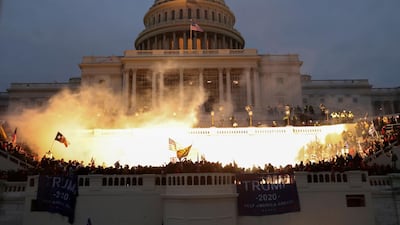
An explosion caused by a police munition is seen while supporters of former president Donald Trump gather in front of the US Capitol Building in Washington, US, January 6, 2021. Reuters -
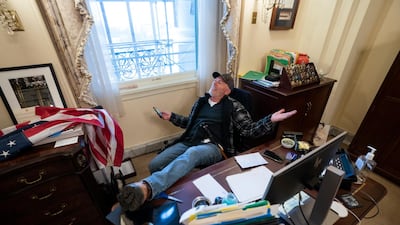
A supporter of US President Donald J. Trump sits on the desk of US House Speaker Nancy Pelosi, after supporters of US President Donald J. Trump breached the US Capitol security in Washington. EPA -
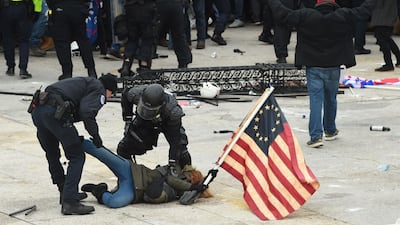
Police detain a person as supporters of US President Donald Trump protest outside the US Capitol. AFP -
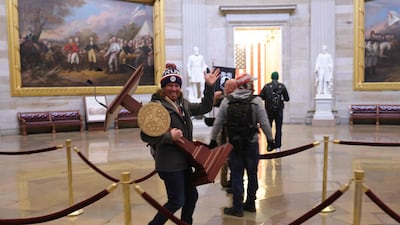
Protesters enter the US Capitol Building. AFP -
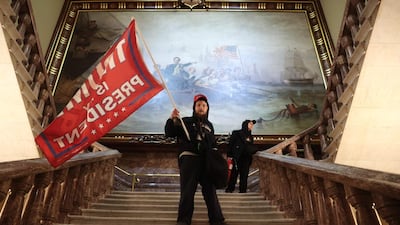
A protester holds a Trump flag inside the US Capitol Building near the Senate Chamber. AFP -
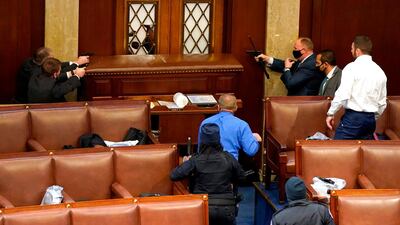
US Capitol police officers point their guns at a door that was vandalized in the House Chamber during a joint session of Congress. AFP -

Members of congress run for cover as protesters try to enter the House Chamber during a joint session of Congress. AFP -
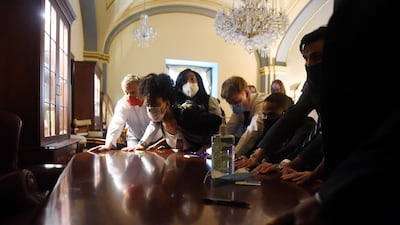
Congress staffers barricade themselves after Trump supporters stormed inside the US Capitol. AFP -
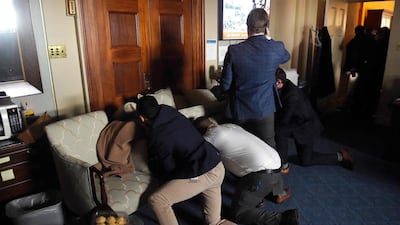
Congress staffers barricade themselves after Trump supporters stormed inside the US Capitol. AFP -
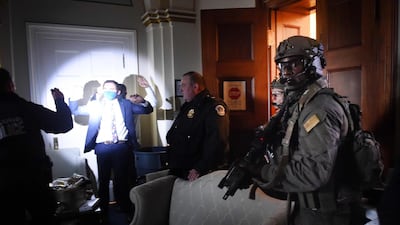
Congress staffers hold up their hands while Capitol Police Swat teams check everyone in the room as they secure the floor of Trump supporters. AFP -
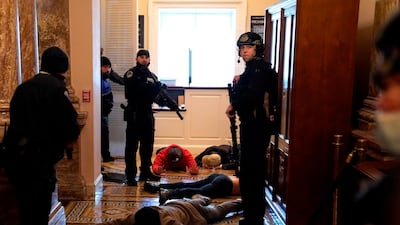
US Capitol Police stand detain protesters outside of the House Chamber during a joint session of Congress. AFP -
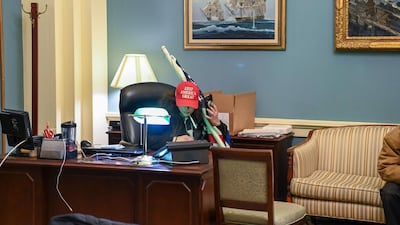
A supporter of US President Donald Trump sits at a desk after invading the Capitol Building. AFP -
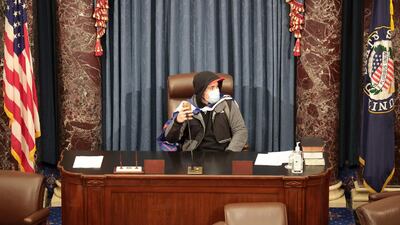
A protester sits in the Senate Chamber. AFP -
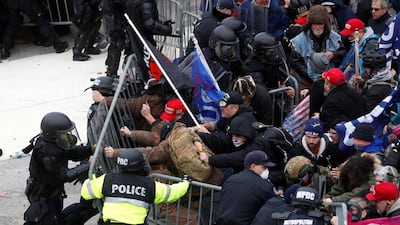
Pro-Trump protesters tear down a barricade as they clash with Capitol police during a rally to contest the certification of the 2020 US presidential election results by the US Congress. Reuters -
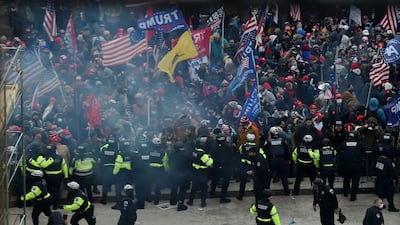
Police hold back supporters of US President Donald Trump as they gather outside the US Capitol's Rotunda. AFP -

Supporters of US President Donald Trump enter the US Capitol's Rotunda. AFP -
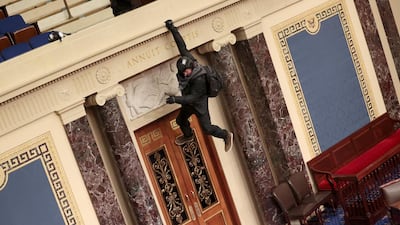
A protester is seen hanging from the balcony in the Senate Chamber. AFP -
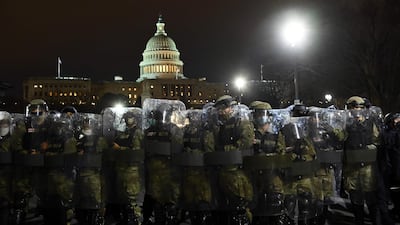
Riot police prepare to move demonstrators away from the US Capitol. AFP -
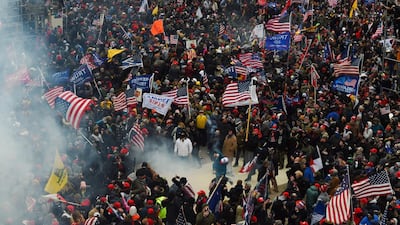
Trump supporters clash with police and security forces as they storm the US Capitol. AFP -
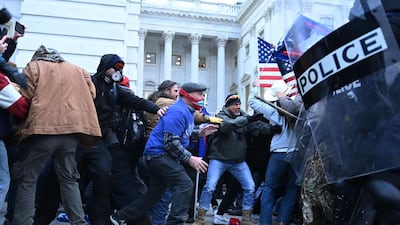
Trump supporters clash with police and security forces, as they storm the US Capitol. AFP -
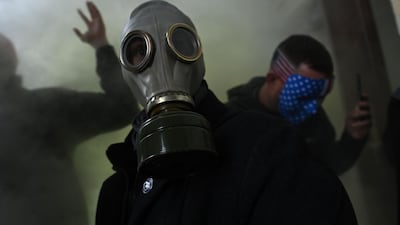
A supporter of US President Donald Trump wears a gas mask as he protests after storming the US Capitol. AFP -
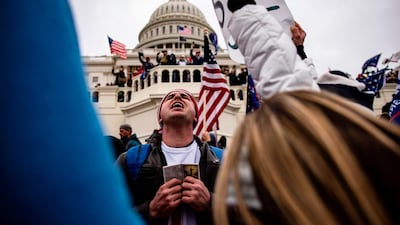
Pro-Trump supporters storm the US Capitol following a rally. AFP -
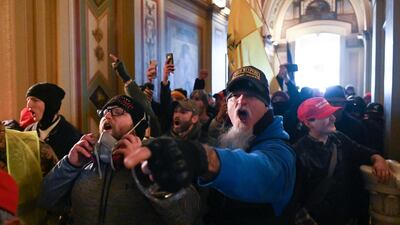
Supporters of US President Donald Trump protest inside the US Capitol. AFP -
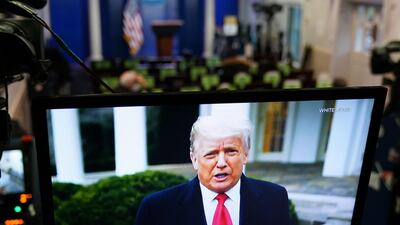
US President Donald Trump is seen on TV from a video message released on Twitter addressing rioters at the US Capitol, in the Brady Briefing Room at the White House in Washington, DC. AFP -
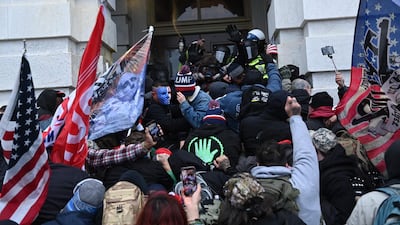
Trump supporters clash with police and security forces as they storm the US Capitol in Washington, DC. AFP -
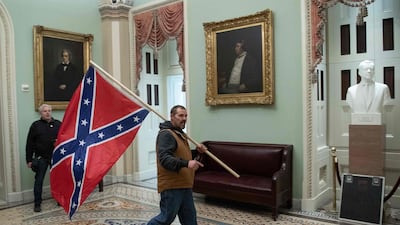
Supporters of US President Donald Trump protest in the US Capitol Rotunda. AFP -
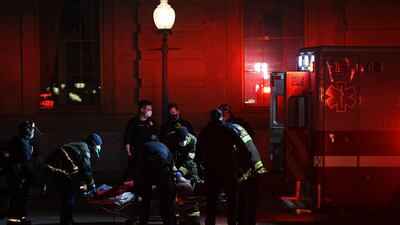
Paramedics perform cardiopulmonary resuscitation on a patient. AFP -
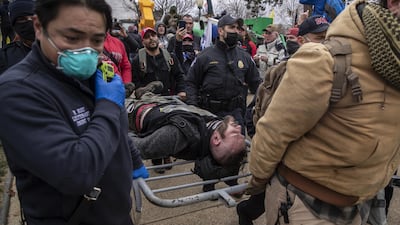
A wounded protester is carried on barricade as demonstrators breach the US Capital building grounds. Bloomberg -
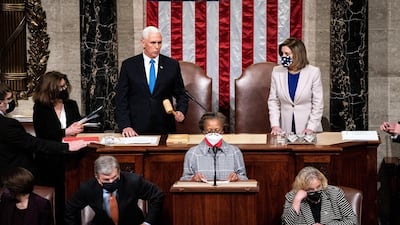
US Vice President Mike Pence and House Speaker Nancy Pelosi preside over a joint session of Congress to certify the 2020 Electoral College results after supporters of President Donald Trump stormed the Capitol earlier in the day on Capitol Hill in Washington, DC. EPA -
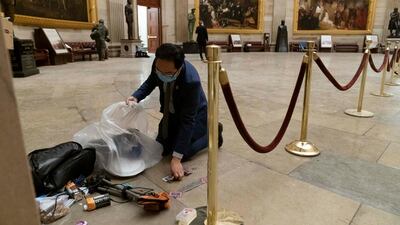
Rep. Andy Kim, D-N.J., cleans up debris and personal belongings strewn across the floor of the Rotunda in the early morning hours of the morning, after protesters stormed the Capitol in Washington. AP


In each instance, the perpetrators were lionised by the right as heroes because they have been white and their intent was deemed patriotic. Millions of dollars were raised for their defence; the St Louis couple were invited to speak at the Republican National Convention; the January 6 insurrectionists and the "border vigilantes" have been called "patriots" by former president Donald Trump and a host of Republicans leaders; and Rittenhouse has become a cause celebre. He was hosted by Mr Trump at his Mar-a-Lago residence, appeared on Fox TV and was offered congressional internships by a number of Republican congressional offices.
The danger all of this poses is real. In legitimising vigilante behaviour, the right is returning us to the days of the Wild West or post-Reconstruction, when mobs lynched thousands of black people and foreigners deemed a threat.
It's also important to consider the issue of guns and the right's insistence that the US Constitution's "right to bear arms" is absolute and without limits. While the Second Amendment does proclaim that right to the citizenry, it does so with the qualification as part of a "well-regulated militia". It is a bizarre stretch to interpret well-regulated militia to include the mobs that stormed the Capitol or threatened the safety of Michigan's governor or a 17-year-old who claimed to be on a mission to "protect property". And despite the successful pressure exerted by the National Rifle Association, Washington's most powerful lobby, the Constitution does not provide citizens the unfettered right to own, brandish and use weapons of war.
Finally, there's the critical issue of race. It is a fact that white vigilantes are often tolerated and celebrated by the right – even when they threaten "law and order" and our democracy. One doesn't have to imagine what the reaction might be should black vigilantes arm themselves with the expressed purpose of defending their communities or threatening a governor or Congress. All we need do is recall the way the Black Panthers group was violently suppressed in the late 1960s and early 1970s.
The fact that the hyperpartisan, polarised political environment in the US is becoming weaponised by white vigilantes, who are being validated by political leaders, poses an existential threat to our democracy. It is a danger we cannot ignore. That is why the guilty verdict in Arbery's murder is so important. While the jury decision in the Rittenhouse case threatened to open the door to the chaos of the "law of the jungle", in rejecting the defendants' argument that Arbery's killers were acting in self-defence and protection of property, the Georgia jury slams that door shut.

