


For a month, Sudan has left global powers and regional heavyweights with frayed nerves. The army and civilian politicians in such a pivotal country have been on war footing. Both sides have traded barbs publicly and blamed each other for their country’s difficulties.
The relationship between these unlikely bedfellows has been fractious and marred by mistrust since the removal of Omar Al Bashir in April 2019. But last month’s failed coup against the civilian-led administration responsible for transitioning the country to democracy after 30 years of dictatorship and kleptocracy was a turning point.
Civilian politicians and locals told me when I was in Khartoum at the time that it was just a ruse orchestrated by some army generals to strengthen their hand, more than two years after a power-sharing deal was inked following mass protests that led to the ouster of Al Bashir.
They believe that mistrust between the two sides of Sudan's government will be near-impossible to bridge in a country that has witnessed repeated military takeovers and failed attempts since its independence in 1956.
-
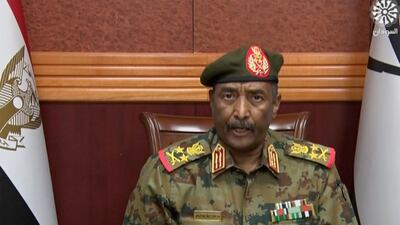
Sudan's Gen Abdel Fattah Al Burhan announced in a televised address that he was dissolving the country's ruling Sovereign Council and the government led by Prime Minister Abdalla Hamdok. Gen Al Burhan said the military would run the country until elections in 2023. Photo: Sudan TV / AP -
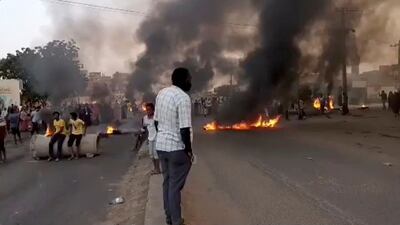
People gather on the streets of Khartoum as smoke rises after reports of a coup on Monday. Photo: Rasd Sudan Network / Reuters -

People gather on the streets of Khartoum as smoke rises after reports of a coup on October 25, 2021. Rasd Sudan Network via Reuters -
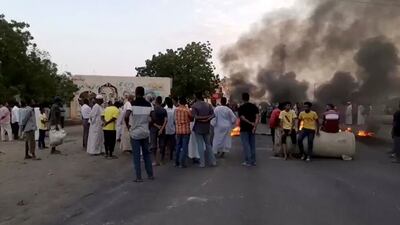
The scene on Khartoum's streets. Photo: Rasd Sudan Network / Reuters -

Sudanese Prime Minister Abdalla Hamdok has been arrested by the military and taken to an undisclosed location, the Information Ministry reported. AFP -
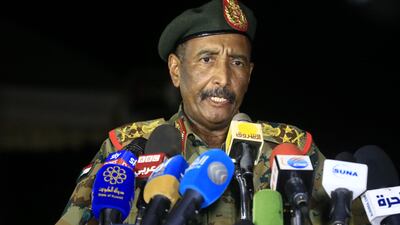
Political parties and pro-civilian rule groups have accused army general and head of the sovereign council Gen Abdel Fattah Al Burhan of ordering the military takeover. AFP -
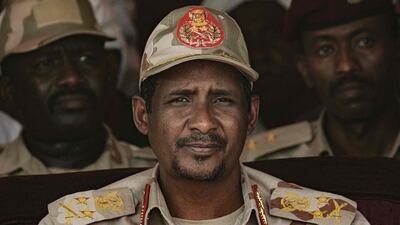
Mohamed Hamdan Dagalo, known as Himediti, is the deputy head of Sudan's ruling Transitional Military Council (TMC) and commander of the Rapid Support Forces (RSF) paramilitaries, making him one of the country’s most powerful generals. AFP -
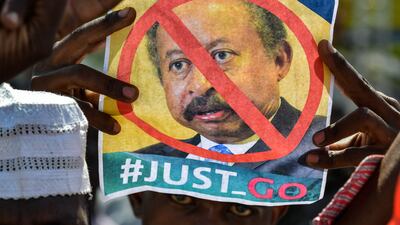
The military’s move comes after protests in favour of the military and against Mr Hamdok as well as those backing civilian rule. AFP -
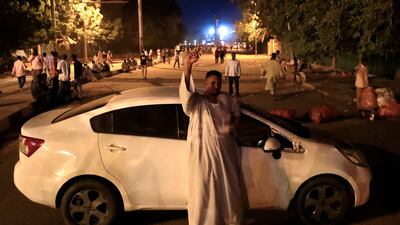
A protester blocks a street with his car during a demonstration to demand the dissolution of Sudan's transitional government. AFP -
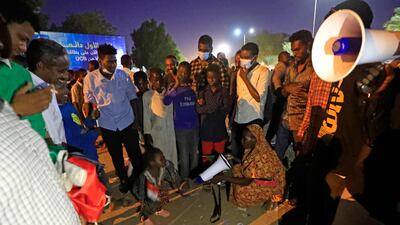
There have been numerous protests in recent days, including outside the presidential palace in Sudan's capital, Khartoum. AFP -
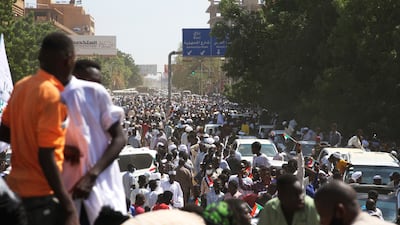
Protesters camping outside the presidential palace demand the dismissal of the government of Prime Minister Abdalla Hamdok. AP -
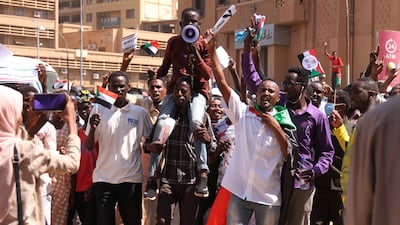
Protesters chant 'one army, one people' and 'the army will bring us bread' slogans during their demonstration outside the presidential palace in Khartoum. AP -

Pro-military protesters hold a rally demanding the dissolution of Sudan’s government, outside the presidential palace. AP -
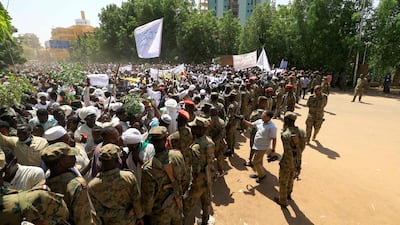
Mr Hamdok has issued a warning that the transition is facing its 'worst and most dangerous' crisis. AFP -
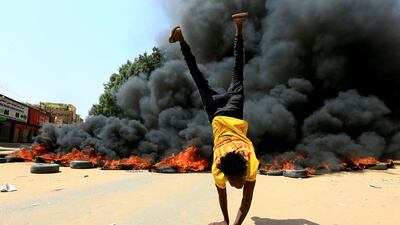
A person does a handstand in front of a burning pile of tyres during a pro-civilian rule protest against any military takeover in Khartoum on October 21. Reuters -
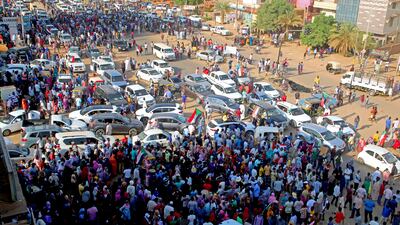
Thousands rallied to back Mr Hamdok’s government after protests by pro-military supporters. EPA -
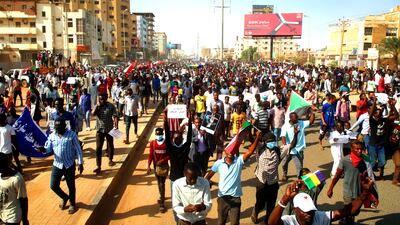
Thousands of people marched during a demonstration called by the Alliance of Forces for Freedom and Change, the Central Council Group to support the government of Abdullah Hamdok, while the army and police forces closed the roads leading to government headquarters and main markets. EPA -
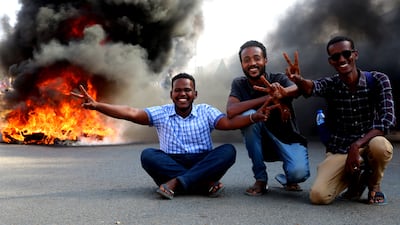
People attend demonstrations in support of the civilian government on October 21. EPA -
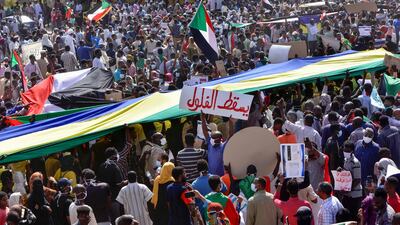
Sudanese demonstrators take part in a protest in the city of Khartoum Bahri, the northern twin city of the capital, to demand the government's transition to civilian rule. AFP


The simmering tensions, tit-for-tat accusations and growing public protests (as well as indifference) are very likely to have encouraged the army to put Prime Minister Abdallah Hamdouk under house arrest and detain a number of his colleagues.
The army also has its own narrative of the crisis. Its leader, Gen Abdel Fattah Al Burhan, has said repeatedly the military would always protect the revolution and has admitted that the army needs to purge its ranks of Al Bashir loyalists.
An adviser to Gen Al Burhan told me last month, however, the civilian alliance spearheaded by the Forces of Freedom and Change, the umbrella group that championed the months-long mass protests against Al Bashir, is split, with one splinter faction having broken from Mr Hamdouk and his allies.
Last week, thousands of pro-military demonstrators also gathered in front of the presidential palace in Khartoum, chanting “down with the government of hunger”.

These tensions are a source of considerable anxiety for everyone. The country already grapples with a wide array of national security problems. It has a border dispute with its eastern neighbour Ethiopia, which is also building a dam on the Nile that has sparked a regional diplomatic crisis.
If Sudan begins to unravel, it risks leaving a vacuum for extremist groups, such as Al Qaeda, which has used the country as a base before. Sudan’s proximity to the Horn of Africa, where Al Qaeda-allied terrorist group Al Shabab is powerful, is also cause for concern.
Unrest in Sudan also threatens to raise the spectre of an influx of refugees to regional transit points, such as neighbouring Egypt and Libya, and, eventually, Europe.
This week, US envoy for the Horn of Africa Jeffrey Feltman visited Khartoum for the second time in less than a month to voice the White House’s commitment to support the civilian-led transition to democracy in Sudan. His sense of urgency is understandable; many fear that just one spark could trigger a full-blown internecine conflict, with consequences that would likely extend far beyond Sudan’s borders.

