Afghans hold placards shouting anti-Pakistan slogans during a protest in Kabul, Afghanistan, on September 7, 2021. EPA


Afghanistan's propaganda war


  • English
  • Arabic

September 08, 2021

Within hours of Kabul falling to the Taliban on August 15, Ahmad Massoud, the 32-year-old son of Afghanistan's "national hero" Ahmad Shah Massoud, boarded a helicopter bound for Panjshir, where he planned to command resistance forces fighting the country's new regime. Few at the time believed it. Rumours swirled that he, like so many others in Afghanistan's elite, had fled the country.

The following night, Mr Massoud was filmed on an iPhone camera on a rooftop in Panjshir. "You can see with your own eyes that I am here," he said to the camera. "Don't believe what you read on Facebook. Sadly, Facebook can be useful, but it can also be destructive."

Over the next three weeks, social media would become central to the resistance's strategy, as well as its challenges.

For as long as there has been war in Afghanistan – or anywhere, for that matter – there has been psychological warfare. For most of this year, it was fought between the Taliban and the now-fallen government of the Islamic Republic. As district after district, then capital after capital, fell to the Taliban over the summer, the militants were diligent in their dissemination of videos showing surrendering Afghan soldiers, proud locals waving Taliban flags and eyewitnesses to battles swearing that any casualties were caused by the Afghan National Defence and Security Forces. Facts were combined with fantasy to create a sense of inevitability to the Taliban victory.

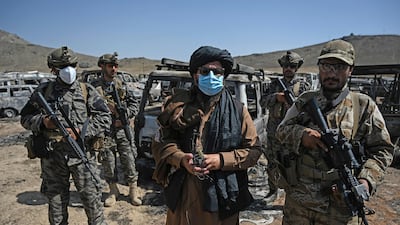
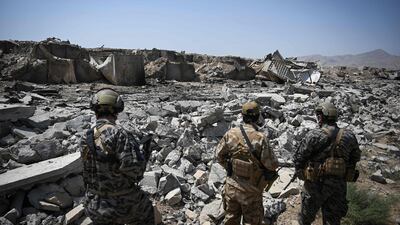
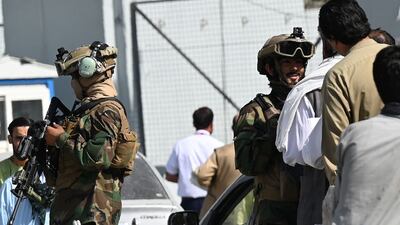
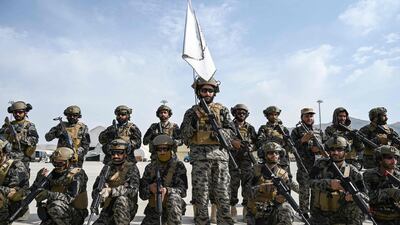
  • Members of the Taliban Badri 313 military unit stand beside damaged and discarded vehicles parked near the destroyed Central Intelligence Agency (CIA) base in Deh Sabz district northeast of Kabul. All photos by AFP
    Members of the Taliban Badri 313 military unit stand beside damaged and discarded vehicles parked near the destroyed Central Intelligence Agency (CIA) base in Deh Sabz district northeast of Kabul. All photos by AFP
  • The Badri 313 unit is highly trained and often uses US-made equipment.
    The Badri 313 unit is highly trained and often uses US-made equipment.
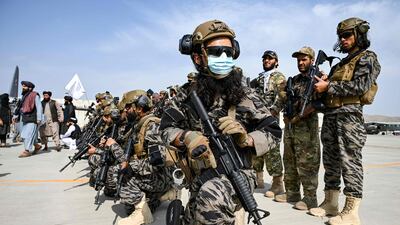
  • The unit starred in a Taliban propaganda campaign as the militant group swept to power in Afghanistan.
    The unit starred in a Taliban propaganda campaign as the militant group swept to power in Afghanistan.
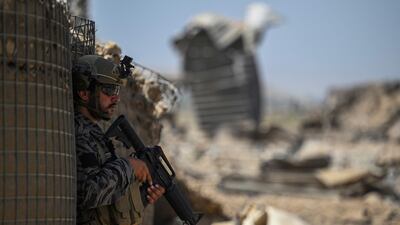
  • Unlike most Taliban insurgent fighters, the Badri 313 unit has access to modern body armour and even night vision equipment.
    Unlike most Taliban insurgent fighters, the Badri 313 unit has access to modern body armour and even night vision equipment.
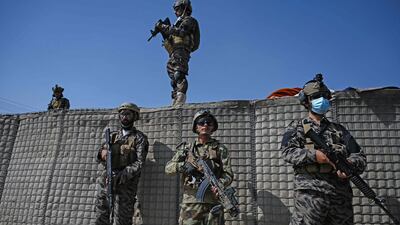
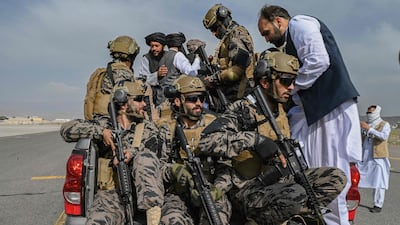
  • Members of the Taliban Badri 313 military unit stand guard at a check point as airport employees queue to enter to the Kabul International Airport.
    Members of the Taliban Badri 313 military unit stand guard at a check point as airport employees queue to enter to the Kabul International Airport.
  • The unit is named after the Prophet Mohammed's army of 313 men at the Battle of Badr.
    The unit is named after the Prophet Mohammed's army of 313 men at the Battle of Badr.
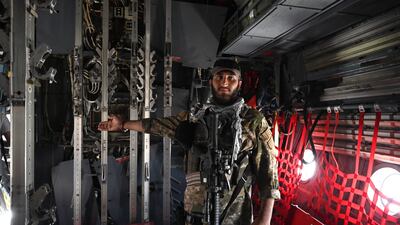
  • A Taliban special forces fighter seen inside an Afghan Air Force aircraft abandoned at Kabul airport.
    A Taliban special forces fighter seen inside an Afghan Air Force aircraft abandoned at Kabul airport.
  • The Badri 313 unit is believed to have been trained by the Haqqani network.
    The Badri 313 unit is believed to have been trained by the Haqqani network.
  • Experts say the Badri 313 unit played a key role in the Taliban takeover.
    Experts say the Badri 313 unit played a key role in the Taliban takeover.

The Afghan government's propaganda was less about inventing reality than denying it. In the first week of August, five provincial capitals fell to the Taliban. At the time, the government did not acknowledge any of it. Instead, the Ministry of Defence issued press releases and tweets indicating that it was slaying unprecedented numbers of Taliban fighters. Just a week later, when Taliban fighters entered Kabul and President Ashraf Ghani fled the country, it was clear that even if there was misinformation from both sides, the government's lines misinformed the most.

And then the Taliban became the government. And it was clear that it had no idea how to run a central bank, a national electrical grid or a modern education ministry. But it did know how to work social media and the media in general. The infrastructure for mass communication was already in place, and better thought out than almost every other aspect of government.

Front and centre of the Taliban's transitional administration has been the "Cultural Commission of the Islamic Emirate of Afghanistan", which is overseen by Taliban spokesman Zabiullah Mujahid and includes a dedicated social media team whose members expense their mobile data packages to the militant group.

The Cultural Commission includes photographers and "journalists", many of whom were previously fighters and continue to wield kalashnikovs in their social media photos.

A member of the commission's social media team told the BBC this week that the group first began developing its Twitter strategy in February 2020 in order to promote an op-ed written by Sirajuddin Haqqani, the Taliban's deputy leader, published by The New York Times.

Two days after Ahmad Massoud took to the Panjshir Valley to energise the anti-Taliban resistance, he, too, published an op-ed in a US outlet: The Washington Post. It made no mention of any intention to negotiate with the Taliban. Instead, it gave the singular impression that the resistance was about fighting. "We need more weapons, more ammunition and more supplies," Mr Massoud wrote. "We know that our military forces and logistics will not be sufficient. They will be rapidly depleted unless our friends in the West can find a way to supply us without delay."

This was the new line from the Afghan resistance. It differed from what sources close to Mr Massoud, and eventually Mr Massoud himself, told The National in interviews, which was that the ultimate goal of the resistance was a diplomatic solution.

The difference in messages is entirely understandable. One, gained through reporting and interrogation in the form of interviews with journalists, reflected reality, which was only hinted at in Mr Massoud's op-ed: that Panjshir was highly vulnerable, that the chances of success were very slim and that the fate of the 200,000 people in the valley – most of whom are women and children – could not be risked for the sake of a heroic battle to the end. The other message, disseminated unilaterally by the resistance's emerging public relations machinery, was aimed squarely at ideological friends in the West, and their pocketbooks: that it really was a zero-sum battle between good and evil, and that "you're either with us or against us". Panjshir's fighters had to be turned into inspirational figures and mythical heroes – not men, but lions.

That sense of urgency and fervour to stay "on message" has since become the driving force behind hundreds of Twitter accounts that have popped up in recent days. Some have circulated photographs of Taliban fighters surrendering to resistance forces. The photos, however, were actually taken years ago. Others circulated a video purportedly showing resistance fighters shooting down a Pakistan Air Force jet sent to help the Taliban in its recent attack on Panjshir. That video, as it happens, is a screen capture from the popular video game Arma 3. It has since been broadcast on several of India's largest news channels as evidence of Pakistani military support against the Panjshir resistance.

In the end, several rounds of negotiations between the Taliban and the resistance failed. With each failure, both sides ramped up the rhetoric, and in the end the great battle both spoke of took place. It, too, was shrouded in misinformation.

On September 5, several Taliban officials announced prematurely that Panjshir was conquered, resulting in celebratory aerial firing of guns across Kabul, killing 17 people. By the morning of September 6, Taliban forces actually did capture Panjshir's capital, Bazarak. Mr Massoud released an audio recording from an undisclosed location, in which he alluded to the social media theories alleging Pakistani military support to the Taliban in Panjshir.

Since the recording's release, protests have broken out in cities across Afghanistan, with demonstrators shouting "Death to Pakistan". Several demonstrators were beaten and arrested by the Taliban, who a day earlier had sought to project influence by hosting Pakistan's intelligence chief in Kabul. The protests have the potential to evolve into a broader movement that could challenge the Taliban. But there is also a risk that the anger will be directed at the more elusive issue of Pakistani political interference in Afghanistan, rather than the more immediate issues of how to ensure the Taliban governs effectively.

Mr Massoud's exact words in his recording, which he published on Facebook, were more cryptic than the lines on the demonstrators' placards. "Forces from Afghanistan's neighbour" assisted the Taliban, he claimed. By refraining from naming Pakistan directly, he could perhaps leave something to the imagination. Granular information – proof of specific crimes – is unnecessary if the people can fill the gaps with broader, contextual truths. In a propaganda war, such a tactic is, to quote Mr Massoud himself, useful, but also destructive.


Lexus LX700h specs

Engine: 3.4-litre twin-turbo V6 plus supplementary electric motor

Power: 464hp at 5,200rpm

Torque: 790Nm from 2,000-3,600rpm

Transmission: 10-speed auto

Fuel consumption: 11.7L/100km

On sale: Now

Price: From Dh590,000

Will the pound fall to parity with the dollar?

The idea of pound parity now seems less far-fetched as the risk grows that Britain may split away from the European Union without a deal.

Rupert Harrison, a fund manager at BlackRock, sees the risk of it falling to trade level with the dollar on a no-deal Brexit. The view echoes Morgan Stanley’s recent forecast that the currency can plunge toward $1 (Dh3.67) on such an outcome. That isn’t the majority view yet – a Bloomberg survey this month estimated the pound will slide to $1.10 should the UK exit the bloc without an agreement.

New Prime Minister Boris Johnson has repeatedly said that Britain will leave the EU on the October 31 deadline with or without an agreement, fuelling concern the nation is headed for a disorderly departure and fanning pessimism toward the pound. Sterling has fallen more than 7 per cent in the past three months, the worst performance among major developed-market currencies.

“The pound is at a much lower level now but I still think a no-deal exit would lead to significant volatility and we could be testing parity on a really bad outcome,” said Mr Harrison, who manages more than $10 billion in assets at BlackRock. “We will see this game of chicken continue through August and that’s likely negative for sterling,” he said about the deadlocked Brexit talks.

The pound fell 0.8 per cent to $1.2033 on Friday, its weakest closing level since the 1980s, after a report on the second quarter showed the UK economy shrank for the first time in six years. The data means it is likely the Bank of England will cut interest rates, according to Mizuho Bank.

The BOE said in November that the currency could fall even below $1 in an analysis on possible worst-case Brexit scenarios. Options-based calculations showed around a 6.4 per cent chance of pound-dollar parity in the next one year, markedly higher than 0.2 per cent in early March when prospects of a no-deal outcome were seemingly off the table.

Bloomberg

GAC GS8 Specs

Engine: 2.0-litre 4cyl turbo

Power: 248hp at 5,200rpm

Torque: 400Nm at 1,750-4,000rpm

Transmission: 8-speed auto

Fuel consumption: 9.1L/100km

On sale: Now

Price: From Dh149,900

Tailors and retailers miss out on back-to-school rush

Tailors and retailers across the city said it was an ominous start to what is usually a busy season for sales.
With many parents opting to continue home learning for their children, the usual rush to buy school uniforms was muted this year.
“So far we have taken about 70 to 80 orders for items like shirts and trousers,” said Vikram Attrai, manager at Stallion Bespoke Tailors in Dubai.
“Last year in the same period we had about 200 orders and lots of demand.
“We custom fit uniform pieces and use materials such as cotton, wool and cashmere.
“Depending on size, a white shirt with logo is priced at about Dh100 to Dh150 and shorts, trousers, skirts and dresses cost between Dh150 to Dh250 a piece.”

A spokesman for Threads, a uniform shop based in Times Square Centre Dubai, said customer footfall had slowed down dramatically over the past few months.

“Now parents have the option to keep children doing online learning they don’t need uniforms so it has quietened down.”

Seemar’s top six for the Dubai World Cup Carnival:

1. Reynaldothewizard
2. North America
3. Raven’s Corner
4. Hawkesbury
5. New Maharajah
6. Secret Ambition

'Shakuntala Devi'

Starring: Vidya Balan, Sanya Malhotra

Director: Anu Menon

Rating: Three out of five stars

Tomb%20Raider%20I%E2%80%93III%20Remastered
%3Cp%3EDeveloper%3A%20Aspyr%0D%3Cbr%3EPublisher%3A%20Aspyr%0D%3Cbr%3EConsole%3A%20Nintendo%20Switch%2C%20PlayStation%204%26amp%3B5%2C%20PC%20and%20Xbox%20series%20X%2FS%0D%3Cbr%3ERating%3A%203%2F5%3C%2Fp%3E%0A
Blackpink World Tour [Born Pink] In Cinemas

Starring: Rose, Jisoo, Jennie, Lisa

Directors: Min Geun, Oh Yoon-Dong

Rating: 3/5

ONCE UPON A TIME IN GAZA

Starring: Nader Abd Alhay, Majd Eid, Ramzi Maqdisi

Directors: Tarzan and Arab Nasser

Rating: 4.5/5

Last-16 Europa League fixtures

Wednesday (Kick-offs UAE)

FC Copenhagen (0) v Istanbul Basaksehir (1) 8.55pm

Shakhtar Donetsk (2) v Wolfsburg (1) 8.55pm

Inter Milan v Getafe (one leg only) 11pm

Manchester United (5) v LASK (0) 11pm 

Thursday

Bayer Leverkusen (3) v Rangers (1) 8.55pm

Sevilla v Roma  (one leg only)  8.55pm

FC Basel (3) v Eintracht Frankfurt (0) 11pm 

Wolves (1) Olympiakos (1) 11pm 

The alternatives

• Founded in 2014, Telr is a payment aggregator and gateway with an office in Silicon Oasis. It’s e-commerce entry plan costs Dh349 monthly (plus VAT). QR codes direct customers to an online payment page and merchants can generate payments through messaging apps.

• Business Bay’s Pallapay claims 40,000-plus active merchants who can invoice customers and receive payment by card. Fees range from 1.99 per cent plus Dh1 per transaction depending on payment method and location, such as online or via UAE mobile.

• Tap started in May 2013 in Kuwait, allowing Middle East businesses to bill, accept, receive and make payments online “easier, faster and smoother” via goSell and goCollect. It supports more than 10,000 merchants. Monthly fees range from US$65-100, plus card charges of 2.75-3.75 per cent and Dh1.2 per sale.

2checkout’s “all-in-one payment gateway and merchant account” accepts payments in 200-plus markets for 2.4-3.9 per cent, plus a Dh1.2-Dh1.8 currency conversion charge. The US provider processes online shop and mobile transactions and has 17,000-plus active digital commerce users.

• PayPal is probably the best-known online goods payment method - usually used for eBay purchases -  but can be used to receive funds, providing everyone’s signed up. Costs from 2.9 per cent plus Dh1.2 per transaction.

3%20Body%20Problem
%3Cp%3E%3Cstrong%3ECreators%3A%3C%2Fstrong%3E%20David%20Benioff%2C%20D%20B%20Weiss%2C%20Alexander%20Woo%3C%2Fp%3E%0A%3Cp%3E%3Cstrong%3EStarring%3A%20%3C%2Fstrong%3EBenedict%20Wong%2C%20Jess%20Hong%2C%20Jovan%20Adepo%2C%20Eiza%20Gonzalez%2C%20John%20Bradley%2C%20Alex%20Sharp%3C%2Fp%3E%0A%3Cp%3E%3Cstrong%3ERating%3A%3C%2Fstrong%3E%203%2F5%3C%2Fp%3E%0A
'Saand Ki Aankh'

Produced by: Reliance Entertainment with Chalk and Cheese Films
Director: Tushar Hiranandani
Cast: Taapsee Pannu, Bhumi Pednekar, Prakash Jha, Vineet Singh
Rating: 3.5/5 stars

The President's Cake

Director: Hasan Hadi

Starring: Baneen Ahmad Nayyef, Waheed Thabet Khreibat, Sajad Mohamad Qasem 

Rating: 4/5

Company profile

Date started: Founded in May 2017 and operational since April 2018

Founders: co-founder and chief executive, Doaa Aref; Dr Rasha Rady, co-founder and chief operating officer.

Based: Cairo, Egypt

Sector: Health-tech

Size: 22 employees

Funding: Seed funding 

Investors: Flat6labs, 500 Falcons, three angel investors

The%20specs
%3Cp%3E%3Cstrong%3EPowertrain%3A%20%3C%2Fstrong%3ESingle%20electric%20motor%0D%3Cbr%3E%3Cstrong%3EPower%3A%20%3C%2Fstrong%3E201hp%0D%3Cbr%3E%3Cstrong%3ETorque%3A%20%3C%2Fstrong%3E310Nm%0D%3Cbr%3E%3Cstrong%3ETransmission%3A%20%3C%2Fstrong%3ESingle-speed%20auto%0D%3Cbr%3E%3Cstrong%3EBattery%3A%20%3C%2Fstrong%3E53kWh%20lithium-ion%20battery%20pack%20(GS%20base%20model)%3B%2070kWh%20battery%20pack%20(GF)%0D%3Cbr%3E%3Cstrong%3ETouring%20range%3A%20%3C%2Fstrong%3E350km%20(GS)%3B%20480km%20(GF)%0D%3Cbr%3E%3Cstrong%3EPrice%3A%20%3C%2Fstrong%3EFrom%20Dh129%2C900%20(GS)%3B%20Dh149%2C000%20(GF)%0D%3Cbr%3E%3Cstrong%3EOn%20sale%3A%3C%2Fstrong%3E%20Now%3C%2Fp%3E%0A
COMPANY%20PROFILE
%3Cp%3E%3Cstrong%3EName%3A%20%3C%2Fstrong%3EShaffra%3Cbr%3E%3Cstrong%3EStarted%3A%20%3C%2Fstrong%3E2023%3Cbr%3E%3Cstrong%3EBased%3A%20%3C%2Fstrong%3EDIFC%20Innovation%20Hub%3Cbr%3E%3Cstrong%3ESector%3A%20%3C%2Fstrong%3Emetaverse-as-a-Service%20(MaaS)%3Cbr%3E%3Cstrong%3EInvestment%3A%20%3C%2Fstrong%3Ecurrently%20closing%20%241.5%20million%20seed%20round%3Cbr%3E%3Cstrong%3EInvestment%20stage%3A%20%3C%2Fstrong%3Epre-seed%3Cbr%3E%3Cstrong%3EInvestors%3A%20%3C%2Fstrong%3EFlat6Labs%20Abu%20Dhabi%20and%20different%20PCs%20and%20angel%20investors%20from%20Saudi%20Arabia%3Cbr%3E%3Cstrong%3ENumber%20of%20staff%3A%20%3C%2Fstrong%3Enine%3C%2Fp%3E%0A

Small Victories: The True Story of Faith No More by Adrian Harte
Jawbone Press

Teaching your child to save

Pre-school (three - five years)

You can’t yet talk about investing or borrowing, but introduce a “classic” money bank and start putting gifts and allowances away. When the child wants a specific toy, have them save for it and help them track their progress.

Early childhood (six - eight years)

Replace the money bank with three jars labelled ‘saving’, ‘spending’ and ‘sharing’. Have the child divide their allowance into the three jars each week and explain their choices in splitting their pocket money. A guide could be 25 per cent saving, 50 per cent spending, 25 per cent for charity and gift-giving.

Middle childhood (nine - 11 years)

Open a bank savings account and help your child establish a budget and set a savings goal. Introduce the notion of ‘paying yourself first’ by putting away savings as soon as your allowance is paid.

Young teens (12 - 14 years)

Change your child’s allowance from weekly to monthly and help them pinpoint long-range goals such as a trip, so they can start longer-term saving and find new ways to increase their saving.

Teenage (15 - 18 years)

Discuss mutual expectations about university costs and identify what they can help fund and set goals. Don’t pay for everything, so they can experience the pride of contributing.

Young adulthood (19 - 22 years)

Discuss post-graduation plans and future life goals, quantify expenses such as first apartment, work wardrobe, holidays and help them continue to save towards these goals.

* JP Morgan Private Bank 

The%20Secret%20Kingdom%20
%3Cp%3E%3Cstrong%3EDirector%3A%3C%2Fstrong%3E%20Matt%20Drummond%3C%2Fp%3E%0A%3Cp%3E%3Cstrong%3EStars%3A%20%3C%2Fstrong%3EAlyla%20Browne%2C%20Alice%20Parkinson%2C%20Sam%20Everingham%3C%2Fp%3E%0A%3Cp%3E%3Cstrong%3ERating%3A%3C%2Fstrong%3E%203%2F5%26nbsp%3B%3C%2Fp%3E%0A

White hydrogen: Naturally occurring hydrogenChromite: Hard, metallic mineral containing iron oxide and chromium oxideUltramafic rocks: Dark-coloured rocks rich in magnesium or iron with very low silica contentOphiolite: A section of the earth’s crust, which is oceanic in nature that has since been uplifted and exposed on landOlivine: A commonly occurring magnesium iron silicate mineral that derives its name for its olive-green yellow-green colour

How to apply for a drone permit
  • Individuals must register on UAE Drone app or website using their UAE Pass
  • Add all their personal details, including name, nationality, passport number, Emiratis ID, email and phone number
  • Upload the training certificate from a centre accredited by the GCAA
  • Submit their request
What are the regulations?
  • Fly it within visual line of sight
  • Never over populated areas
  • Ensure maximum flying height of 400 feet (122 metres) above ground level is not crossed
  • Users must avoid flying over restricted areas listed on the UAE Drone app
  • Only fly the drone during the day, and never at night
  • Should have a live feed of the drone flight
  • Drones must weigh 5 kg or less
Common OCD symptoms and how they manifest

Checking: the obsession or thoughts focus on some harm coming from things not being as they should, which usually centre around the theme of safety. For example, the obsession is “the building will burn down”, therefore the compulsion is checking that the oven is switched off.

Contamination: the obsession is focused on the presence of germs, dirt or harmful bacteria and how this will impact the person and/or their loved ones. For example, the obsession is “the floor is dirty; me and my family will get sick and die”, the compulsion is repetitive cleaning.

Orderliness: the obsession is a fear of sitting with uncomfortable feelings, or to prevent harm coming to oneself or others. Objectively there appears to be no logical link between the obsession and compulsion. For example,” I won’t feel right if the jars aren’t lined up” or “harm will come to my family if I don’t line up all the jars”, so the compulsion is therefore lining up the jars.

Intrusive thoughts: the intrusive thought is usually highly distressing and repetitive. Common examples may include thoughts of perpetrating violence towards others, harming others, or questions over one’s character or deeds, usually in conflict with the person’s true values. An example would be: “I think I might hurt my family”, which in turn leads to the compulsion of avoiding social gatherings.

Hoarding: the intrusive thought is the overvaluing of objects or possessions, while the compulsion is stashing or hoarding these items and refusing to let them go. For example, “this newspaper may come in useful one day”, therefore, the compulsion is hoarding newspapers instead of discarding them the next day.

Source: Dr Robert Chandler, clinical psychologist at Lighthouse Arabia

Updated: September 08, 2021, 5:47 AM