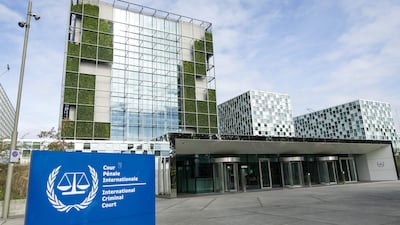

The US imposed more sanctions on the International Criminal Court (ICC) on Friday, sanctioning the entire tribunal for the first time as the Trump administration escalated its campaign against the institution in The Hague.
Secretary of State Marco Rubio said the US will ban transactions with “this rogue court, cutting off their resources and crippling its ability to operate against us."
“Either the ICC will end its threats, or we will end the ICC,” Mr Rubio said in a video posted on social media.
The sanctions are expected to restrict the ICC's ability to use the US financial system, with a transition period before most prohibited transactions become unlawful. Previous US sanctions were imposed on individual ICC officials, including its prosecutor and several judges, over investigations involving American and Israeli officials.
“President Trump will never allow the International Criminal Court to prosecute Americans,” Mr Rubio said. He also warned US allies that belong to the court and “rely on American service members for their defence” to bring the tribunal under control or face further American efforts to dismantle it “brick by brick”.
The US action came the same day that former ICC judge Navanethem “Navi” Pillay was awarded the Nobel Peace Prize for her efforts to promote peace and international law. The ICC “strongly” rejected the sanctions, calling them an attack on international justice and warning that “history will judge this moment”.
“It is an attempt to obstruct the course of justice and to prevent the Court from doing what it was created to do. It is an assault on the rule of law and on the very foundations of the international legal order which strikes at the simple principle that no one stands above the law,” the court said in a statement.
ICC President Tomoko Akane urged its member states to defend the institution against mounting US pressure.
“The Court cannot stand alone. Its fate now rests also in the hands of the states that created it. The Rome Statute is a collective promise that the most serious crimes of concern to the international community as a whole must not go unpunished. That promise is only as strong as the resolve of those who made it,” she said.
The EU called the sanctions “deeply regrettable” and said it was “ready to take any necessary measures to enable the court to carry out its work”.
The latest confrontation follows Mr Trump's call last month for all ICC member states to withdraw from the tribunal, which he called “out of control” and a “rogue institution”.
Established in 2002, the ICC has 125 member states, although major powers, including the US, Russia, China, India and Israel are not members. Under its founding Rome Statute, the court can prosecute people for war crimes, crimes against humanity and genocide only when national authorities are unwilling or unable to do so themselves.
UN Secretary General Antonio Guterres also condemned the sanctions, warning that they could severely undermine the court's ability to carry out its work. Human rights groups condemned the US sanctions, warning that they could severely undermine the court's ability to pursue justice for victims of atrocities around the world.
“By sanctioning the entire International Criminal Court, the Trump administration has taken a sledgehammer to the most important development in international justice in half a century,” said Omar Shakir, executive director of Dawn, a US-based human rights organisation.
“US sanctions threaten to shut the last viable road to justice for millions of victims of serious crimes, from Gaza and Sudan to Afghanistan and Ukraine, all to shield Israeli officials who have perpetrated a genocide from justice.”