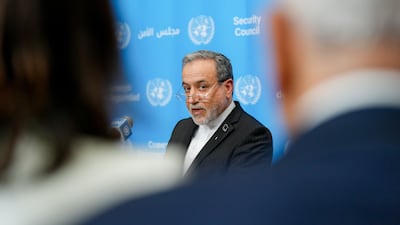
Iranian Foreign Minister Abbas Araghchi has said that Iran will remain steadfast "in the face of any aggression, even if it comes to an apocalyptic war", in a social media post
Earlier in the day, Mr Araghchi said Tehran was still awaiting an official US response through mediators to its proposal to reopen the Strait of Hormuz within seven days.
Iran remained ready for diplomacy despite repeated attacks during previous negotiations, he said.

Mr Araghchi said Iran was prepared to reopen the strait if the US met conditions including ending what he called the “war of aggression”, releasing Iranian assets he said had been illegally frozen and allowing Tehran to sell its oil.
“Our proposal is very clear. We are ready to open the strait if certain things are done by the US, and these certain things are not new,” Mr Araghchi told NBC. “These are our rights that we want to be respected.”
He questioned why Washington was unwilling to release Iranian funds before the reopening of the strait, saying the money belonged to Iran.
Mr Araghchi said diplomacy had not failed but Iran had little reason to return to negotiations with the current US administration, blaming what he described as repeated attacks during previous rounds of talks.
"Iran nonetheless remains steadfast in the face of any aggression, even if it comes to an apocalyptic war. At the same time, we are ready for real diplomacy," he said.
“In 2025, they offered negotiation. We accepted and we engaged in the negotiation, and then in the middle of negotiations they attacked us.
“Eight months later, in 2026, February, again they offered negotiation, again we accepted, and again they attacked us right in the middle of negotiations.”
Mr Araghchi said Iran had accepted a US offer to negotiate and held three months of talks, only for Washington to breach an agreement after two weeks.
He said Tehran remained willing to pursue diplomacy because it did not want to miss an opportunity for peace.
“Diplomacy can never fail, there is always hope for diplomacy,” he said. “We are ready to negotiate as much as we are ready to face any challenge.”
Mr Araghchi added that Iran was focused on its national interests rather than US political considerations, including the midterm elections, and warned that Tehran was prepared to confront further aggression.
Although US President Donald Trump had rejected Iran’s proposal, Tehran was still waiting for an official response through mediators, he added.
Also on Sunday, Mike Waltz, the US ambassador to the UN said Mr Trump did not believe Iran was operating in good faith with its recent proposal to reopen the strait.
“The President is just not confident that the Iranians are coming in good faith and that they will truly negotiate the end of their nuclear programme,” he said during an appearance on CNN.
“They were asking for everything up front.” The US feels Tehran is demanding relief from sanctions implemented during what the White House has called Operation Economic Fury, he added.
“Also and more importantly, they were asking to end snapback sanctions from the United Nations that have been in place for many years,” he said, referring to punitive measures linked to Iran's nuclear programme.
Mr Waltz said there were a number of reasons to be sceptical of Iran's proposals, including what he called breaches of the ceasefire agreement in June.
“Once we got to the MoU [memorandum of understanding] … the Iranians immediately violated it by attacking international shipping in violation of international law, and 146 nations have joined us in condemning Iran for those attacks,” he said.
There has been little progress at calming tension between the US and Iran since the US and Israel commenced strikes against Iran at the end of February.
During his appearance on NBC on Sunday, Mr Araghchi suggested that the US was not entirely aware of what Iran put in its most recent proposal.
“I'm surprised that the ambassador is talking about our seven-day plan as if he hasn't read it, maybe he hasn't been given a copy,” he alleged, also responding to the notion that Iran had violated a previous agreement.
"First of all, we didn't violate the deal, they violated it first, but if they have their story and they think that we have violated the deal, why did they bomb us? They could have activated paragraph 12 of the MOU, which is for, you know, dispute settlement."
When asked whether he trusted US President Donald Trump, Araghchi responded, in part, “We trust ourselves.”
In an phone interview with Axios on Sunday, Mr Trump said that he expected US negotiators “to engage in more talks” with Iran in the days ahead.

