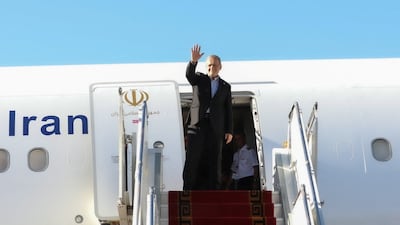

Iranian President Masoud Pezeshkian left Tehran for New York on Tuesday to confront Washington on its own soil at the UN General Assembly, as the conflict between the two countries widens and Yemen's Iran-backed Houthi rebels escalate attacks.
Mr Pezeshkian is due to address the General Assembly on Wednesday and to hold meetings with foreign leaders, Iranian expatriates, US experts and think tank members, state media reported.
Iran's Foreign Minister, Abbas Araghchi, arrived in New York on Monday after travelling via Doha, where he held talks with Qatari officials on regional developments. He said Iran would use the UN gathering as a platform to defend its interests in the war with the US.

“Our most important goal is to be present on a major international platform to defend the legitimacy, rights and interests of the Iranian people,” Mr Araghchi said in New York, state media reported.
Mr Pezeshkian echoed that message before his departure, saying Iran would “powerfully defend our positions in international forums” and convey the Iranian people’s message to the world.
“Despite all the hardships that our dear people and our fighters have endured along this path, the reality is that we have emerged from it with our heads held high,” said the Iranian President. “We have stood, and will continue to stand, to the very end in defence of our country, our people and our beliefs and convictions.”

Mr Araghchi said Mr Pezeshkian would hold “multiple bilateral meetings” with foreign leaders on the sidelines of the UN General Assembly, and would meet foreign ministers to review relations and push Iran’s positions.
The diplomatic drive comes after the Houthis made rapid territorial gains in Yemen and intensified attacks on Saudi Arabia, including against energy infrastructure and shipping.
The escalation has also put Washington under pressure to support Riyadh. Saudi Crown Prince Mohammed bin Salman has repeatedly urged US President Donald Trump to intervene against the Houthis.
Delegates denied visas
US military preparations had reportedly advanced significantly, with target lists approved and aircraft being loaded with weapons before Mr Trump called off the strikes, at least temporarily, The New York Times reported.
The Houthi escalation gives Iran another regional pressure point as Washington and Tehran remain at odds. The Houthis have said they will not target US vessels but have maintained attacks against Saudi-linked targets.
Mr Araghchi said Iran would also use the UN meetings to highlight what his country sees as the international system’s failure to uphold peace and security.
“This year, after the war that took place, naturally this platform will be a place to convey the suffering of the Iranian people,” he said.
Mr Pezeshkian also accused Washington of restricting media access to prevent the consequences of the conflict from being seen and heard, saying: “The Americans are afraid of these tragedies being seen and heard, and that is why they have imposed restrictions on the media.”
He said Iran had repeatedly negotiated and signed agreements, only for commitments to be disregarded. “The whole world saw how the commitments were not honoured and the written agreements were trampled on,” he said.
The Iranian delegation’s presence at the meeting has itself become a point of friction with Washington. The US issued visas to Mr Pezeshkian and Mr Araghchi but denied visas to several members of the wider delegation, including members of the president’s communications team.
Iran will also participate in meetings involving the Organisation of Islamic Co-operation and Non-Aligned Movement, as well as a leaders’ summit on the environment.
Mr Araghchi said Tehran had a “packed programme of four to five days”, with bilateral meetings offering an opportunity to review Iran’s relations with countries around the world.

