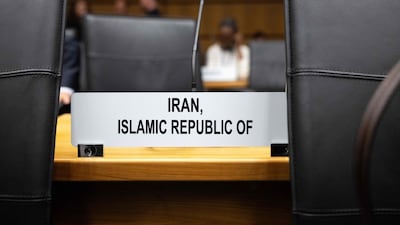

Russia and China have opposed a UN Security Council call for the full resumption of the committee overseeing sanctions on Iran, urging Tehran to give up its stockpile of highly enriched uranium.
The push came a day after the International Atomic Energy Agency's (IAEA) Board of Governors voted to refer Iran to the Security Council over its nuclear non-compliance, intensifying international pressure on Tehran over its nuclear programme.
Russia rejected the effort to revive the committee, with its envoy Vasily Nebenzya stating that Moscow “won't allow sanctions on Tehran to be reimposed under any circumstances” and accusing Western powers of distorting facts surrounding Iran's nuclear programme.

“The Russian Federation categorically repudiates attempts to manipulate the authority of the Security Council to settle political scores with Tehran,” Mr Nebenzya said. “Such irresponsible actions make the prospect of a negotiated solution a more far-off prospect.”
The Security Council established the 1737 Sanctions Committee in 2006 to oversee sanctions imposed over Iran's nuclear programme. It became defunct following the 2015 nuclear agreement.
The committee was formally restored following the reimposition of UN sanctions last year, but has remained largely paralysed by a dispute with Russia and China over the legality of the sanctions snapback. It currently has no chair and its panel of experts has not been reconstituted.
Britain's ambassador Sarah MacIntosh said all UN member states were required to implement sanctions resolutions on Iran, including an arms embargo.
“Our UN Charter requires the full implementation of all sanctions resolutions, including the arms embargo,” Ms MacIntosh told the council. “All member states, including Iran, are obliged to implement these Chapter 7 resolutions without exception.”
She added that the committee must deliver on its mandate and called for the prompt appointment of a chair and members of the panel of experts. Ms MacIntosh said Iran had not given IAEA inspectors access to nuclear sites since June 2025 and urged Tehran to “choose” diplomacy.
“Iran should address the international community's long-standing concerns over her nuclear programme by returning to negotiations, co-operating fully with the IAEA, and restoring full transparency on her nuclear programme,” she said.
US representative for special political affairs Jennifer Loretta said Washington “will look to partners in the coming days to weigh options to ensure that there is sufficient infrastructure in place to support that goal”.
Bahrain called on council members to work constructively and urgently to reach a consensus on the appointment of the members of the panel of experts.
“The kingdom of Bahrain and a number of countries in the region have been directly subjected to the consequences of Iran's launch of ballistic missiles and drones, the targeting of civilians, civilian objects, critical infrastructure and energy facilities, as well as threats to the security and safety of navigation and international maritime routes. Highly sensitive facilities were also exposed to serious risk,” said its ambassador, Jamal Fares Alrowaiei.

