
From the Golden Dome missile defence system to a Golden Fleet of warships and a secret weapon dubbed the Discombobulator, President Donald Trump has been hyping developments in the Pentagon's arsenal.
In an unpredictable new era where raw power rules and gunboat diplomacy swamps the niceties of international relations, the US leader has blended his salesman's instinct with swaggering boasts about America's military might.
While some of his hyperbolic rhetoric is out of step with reality, his claims highlight transformations in how the US military is acquiring new weapons and expanding capabilities as it focuses more on countering China.
He wants next year's defence budget to be $1.5 trillion, a 50 per cent increase from today that would result in the US having a “dream military”. That amount would represent about 5 per cent of the nation's GDP, which is the same proportion Mr Trump is demanding Nato allies pay for defence.
The US already spends more on its military than the next nine countries combined, a total of about 40 per cent of global defence outlays. The world's next biggest defence spender is China, at about $300 billion annually. The Trump administration has ordered massive new military spending commitments, including a modernisation of US nuclear forces and an overhaul in acquisitions to speed up the buying of weapons.
The President's willingness to order military strikes, albeit limited, has surprised many of his supporters who thought the self-described peacemaker would avoid foreign entanglements.
-
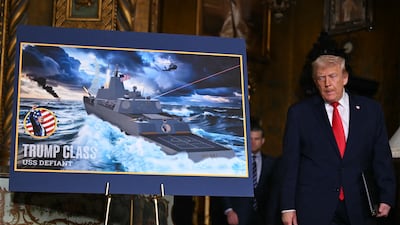
US President Donald Trump announces the American Navy's new Golden Fleet initiative, unveiling a new class of warships, at Mar-a-Lago, Florida, in December 2025. AFP -
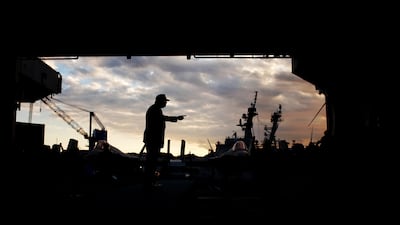
Mr Trump aboard the USS George Washington in Yokosuka, Japan. Getty Images -
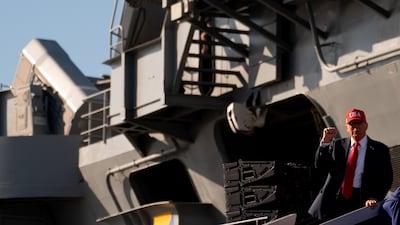
Mr Trump at Naval Station Norfolk in Virginia in 2025. Getty Images -
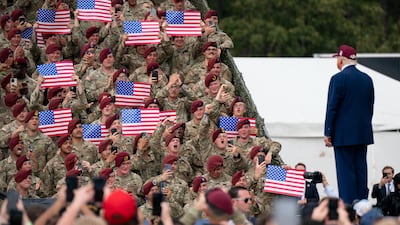
Members of the military hold US flags as Mr Trump arrives at Fort Bragg, North Carolina, in 2025. Getty Images -
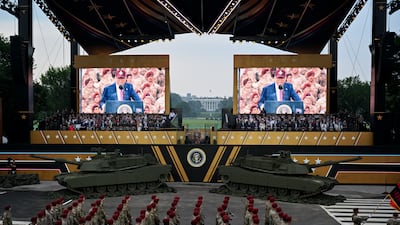
Mr Trump on screen, as members of the military march during the US Army's 250th Anniversary Parade in Washington DC in 2025. Getty Images -
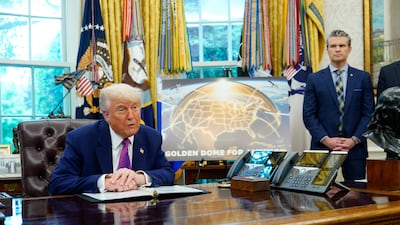
Mr Trump and Pete Hegseth, US Secretary of War, in the Oval Office of the White House, promoting the 'Golden Dome' missile-defence shield. Getty Images -
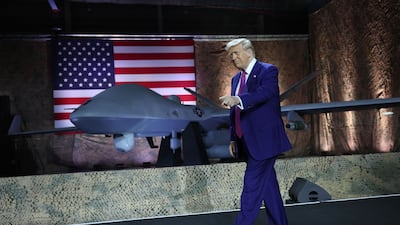
Mr Trump on stage as he tours Al Udeid Airbase in Doha, Qatar in 2025. Getty Images -
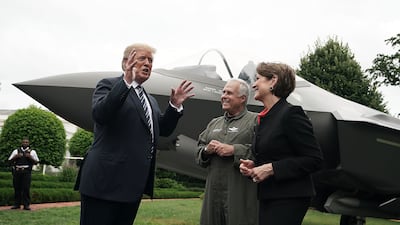
Mr Trump in conversation beside a Lockheed Martin F-35 fighter jet outside the White House in 2018. Getty Images


New tech, new ships
Mr Trump last weekend caused a stir when he told the New York Post that a secret US weapon had knocked out Venezuelan air-defence systems during the raid to capture Nicolas Maduro in Caracas on January 3.
Venezuela had purchased both the Russian S-300 and China's JY-27A systems, but the US used new technology to stop them from detecting inbound US jets and helicopters used in the predawn operation.
“The Discombobulator. I’m not allowed to talk about it,” he said of the technology. “They never got their rockets off. They had Russian and Chinese rockets, and they never got one off. We came in, they pressed buttons and nothing worked.”
His comments followed recent reports that the Pentagon under Joe Biden had purchased and tested some sort of directed energy weapon that may have been tied to the mysterious Havana Syndrome, a sickness that affected hundreds of US officials posted to the Cuban capital and elsewhere. The government has not confirmed the claim.
And Mr Trump's press secretary Karoline Leavitt raised eyebrows when she posted on X a purported interview with one of the guards that survived the Caracas raid who indicated an energy weapon had been used. In the supposed interview, the guard said: “We all started bleeding from the nose. Some were vomiting blood. We fell to the ground, unable to move.” The claims have not been verified.
Beyond the sensational headlines, Mr Trump is pushing for massive military spending commitments that could take decades to fully realise, such as demanding a so-called Golden Fleet of new warships, which he calls “Trump-class” battleships, that would be larger than any other ship except aircraft carriers. He also has touted a next-generation fighter called the F-47, named after himself, the 47th US president.
But no new funding for the warships programme has been allocated and a future administration could easily cancel it, especially as the US Navy wants to move on from the era of hulking sea giants towards a less vulnerable and more mobile fleet.
Golden Dome
A year ago, Mr Trump signed an executive order to create the Golden Dome defence system designed to protect the US and potentially Canada from incoming intercontinental ballistic missiles (ICBMs).
He said it would cost $175 billion, but some observers consider that a wild underestimate, especially given the plan includes space-based interceptors.
Nonetheless, work on the project has begun after an initial $25 billion in funding was approved last year. Mr Trump had said the system would be up and running by 2028, but completing a programme that requires missile launchers across a vast continent in that time frame seems improbable.
Mr Trump introduced the idea of building a defence system similar to Israel's Iron Dome during his presidential campaign. The US helped develop the system in Israel and has spent nearly $1.7 billion to keep it stocked.
Mr Trump's repeated desire to “acquire” Greenland is driven in part by the potential need to base Golden Dome missile interceptors there.
“The majority of ICBMs, were they to be launched, say from Russia or China, would fly over Greenland if they were targeting New York or Washington DC,” said Alex Plitsas, head of the Atlantic Council's Counterterrorism Project and a former chief of sensitive activities for special operations and combating terrorism in the Office of the Secretary of Defence.
“It seems that the President is looking for permanent, basing options in Greenland to support that programme,” he told The National.

A brasher military outlook
Mark Jones, a professor at Rice University in Houston, Texas and an expert on Venezuela, said the Maduro raid may have emboldened Mr Trump’s broader foreign policy approach, influencing his posture towards Greenland and potentially Iran. No US troops died in the risky operation, while dozens of Venezuelan and Cuban forces were killed.
“He attempted an audacious move in Venezuela and came out of it with flying colours,” Mr Jones said. Credibility is central to the threat of force, he added.
“What Venezuela signalled is that when the Trump administration says it will remove or kill a target, that threat now carries more weight,” he told The National.
Mr Trump, who famously got five deferments from being drafted into the military during the Vietnam War, this month told The New York Times he is not concerned about international law and sees the only check on his power to order military strikes is his “own morality”.
But that sort of aggressive foreign policy runs counter to the core tenets of his Maga movement.
“One of the risks Trump runs is being seen by his base as overly active in places like Iran, Venezuela, Russia, or Ukraine, which could be viewed as a betrayal of his promise to focus on domestic issues rather than regime change abroad,” Mr Jones said.

