
US President Donald Trump shakes hands with Syria's President Ahmad Al Shara, in Riyadh on May 14. Saudi Royal Palace via AP

Trump signs executive order lifting Syria sanctions


  • English
  • Arabic

President Donald Trump on Monday signed an executive order lifting US sanctions on Syria, to allow Syria to rebuild after a prolonged civil war.

Mr Trump announced during his visit to Riyadh last month that he would be giving Syria near-total sanctions relief. But unwinding the US laws and designations is a complex process and requires Congressional action in some cases.

Brad Smith, acting undersecretary for terrorism and financial intelligence at the US Treasury Department, said "the significance of this moment cannot be overstated".
"Today's actions … will end [Syria's] isolation from the international financial system, setting the stage for global commerce and galvanising investments from its neighbours in the region, as well as from the United States," Mr Smith said.

Mr Trump's executive order takes effect on Tuesday. The text tells of "developments over the past six months, including the positive actions taken by the new Syrian government under President Ahmad Al Shara."

Syrian Foreign Minister Asaad Al Shibani said on X that the termination of the Syria sanctions programme allows for "long-awaited reconstruction and development".

Syria's interim President, Ahmad Al Shara. AP

Thomas Barrack, the US ambassador to Turkey and special envoy to Syria, said Syria needed "to be given a chance".

"And that’s what’s happened. What you have this afternoon is the culmination of a very tedious, detailed, excruciating process of how you unwrap these sanctions," he told reporters on Monday.

State Department spokeswoman Tammy Bruce said the executive order reaffirms Mr Trump's "belief that the Syrian people deserve a future of safety and prosperity".

The executive order will remove sanctions on Syria while maintaining sanctions on former president Bashar Al Assad.

"His associates, human rights abusers, drug traffickers, persons linked to chemical weapons activities, ISIS and their affiliates, and Iranian policies" will remain under sanctions, White House press secretary Karoline Leavitt said.

Syria was originally designated a state sponsor of terrorism by the Carter administration in 1979, when Hafez Al Assad, Bashar's father, ruled the country. Further sanctions were imposed in 2004 and in 2011, when civil war broke out.

While Mr Trump is easing many sanctions by executive order, undoing all of them would require Congress to repeal the 2019 Caesar Syria Civilian Protection Act, which penalises almost anyone who tries to do business with Syria.

Two senators this month introduced legislation to overturn the Caesar Act.

The Assad regime fell last December after a lightning offensive by groups led by Hayat Tahrir Al Sham. HTS's leader, Mr Al Shara, was chosen as transitional President.

The new government in Damascus lobbied for western countries to remove sanctions levied during the Assad regime's rule. Although Washington has been wary of the new government, because HTS was previously allied with Al Qaeda, Mr Trump said the US would remove sanctions.

Stephen Rapp, former ambassador-at-large for war crimes, welcomed the development.

“We are pleased to see commitment to accountability for the crimes committed by the Assad regime and by the terrorists of ISIS," Mr Rapp, who is a board member on the Syrian Emergency Task Force, said in a statement.

"This means helping the Syrians gather and analyse the documents and excavate the mass graves to determine the fate of more than 100,000 missing persons, including Americans Austin Tice and Dr Majd Kamalmaz, and to lay the groundwork for trials of the major perpetrators."


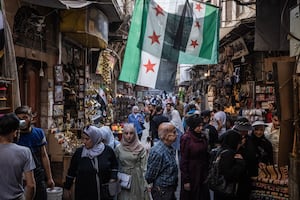
People shop in a market on June 17, 2025 in Damascus, Syria. Getty Images

What can victims do?

Always use only regulated platforms

Stop all transactions and communication on suspicion

Save all evidence (screenshots, chat logs, transaction IDs)

Report to local authorities

Warn others to prevent further harm

Courtesy: Crystal Intelligence

Company Profile

Name: Thndr
Started: 2019
Co-founders: Ahmad Hammouda and Seif Amr
Sector: FinTech
Headquarters: Egypt
UAE base: Hub71, Abu Dhabi
Current number of staff: More than 150
Funds raised: $22 million

The Melbourne Mercer Global Pension Index

The Melbourne Mercer Global Pension Index

Mazen Abukhater, principal and actuary at global consultancy Mercer, Middle East, says the company’s Melbourne Mercer Global Pension Index - which benchmarks 34 pension schemes across the globe to assess their adequacy, sustainability and integrity - included Saudi Arabia for the first time this year to offer a glimpse into the region.

The index highlighted fundamental issues for all 34 countries, such as a rapid ageing population and a low growth / low interest environment putting pressure on expected returns. It also highlighted the increasing popularity around the world of defined contribution schemes.

“Average life expectancy has been increasing by about three years every 10 years. Someone born in 1947 is expected to live until 85 whereas someone born in 2007 is expected to live to 103,” Mr Abukhater told the Mena Pensions Conference.

“Are our systems equipped to handle these kind of life expectancies in the future? If so many people retire at 60, they are going to be in retirement for 43 years – so we need to adapt our retirement age to our changing life expectancy.”

Saudi Arabia came in the middle of Mercer’s ranking with a score of 58.9. The report said the country's index could be raised by improving the minimum level of support for the poorest aged individuals and increasing the labour force participation rate at older ages as life expectancies rise.

Mr Abukhater said the challenges of an ageing population, increased life expectancy and some individuals relying solely on their government for financial support in their retirement years will put the system under strain.

“To relieve that pressure, governments need to consider whether it is time to switch to a defined contribution scheme so that individuals can supplement their own future with the help of government support,” he said.

The bio

Who inspires you?

I am in awe of the remarkable women in the Arab region, both big and small, pushing boundaries and becoming role models for generations. Emily Nasrallah was a writer, journalist, teacher and women’s rights activist

How do you relax?

Yoga relaxes me and helps me relieve tension, especially now when we’re practically chained to laptops and desks. I enjoy learning more about music and the history of famous music bands and genres.

What is favourite book?

The Perks of Being a Wallflower - I think I've read it more than 7 times

What is your favourite Arabic film?

Hala2 Lawen (Translation: Where Do We Go Now?) by Nadine Labaki

What is favourite English film?

Mamma Mia

Best piece of advice to someone looking for a career at Google?

If you’re interested in a career at Google, deep dive into the different career paths and pinpoint the space you want to join. When you know your space, you’re likely to identify the skills you need to develop.  


Know your camel milk:
Flavour: Similar to goat’s milk, although less pungent. Vaguely sweet with a subtle, salty aftertaste.
Texture: Smooth and creamy, with a slightly thinner consistency than cow’s milk.
Use it: In your morning coffee, to add flavour to homemade ice cream and milk-heavy desserts, smoothies, spiced camel-milk hot chocolate.
Goes well with: chocolate and caramel, saffron, cardamom and cloves. Also works well with honey and dates.

The%20Color%20Purple
%3Cp%3E%3Cstrong%3EDirector%3A%20%3C%2Fstrong%3EBlitz%20Bazawule%3Cbr%3E%3Cstrong%3EStarring%3A%20%3C%2Fstrong%3EFantasia%20Barrino%2C%20Taraji%20P%20Henson%2C%20Danielle%20Brooks%2C%20Colman%20Domingo%3Cbr%3E%3Cstrong%3ERating%3A%3C%2Fstrong%3E%204%2F5%3C%2Fp%3E%0A
The burning issue

The internal combustion engine is facing a watershed moment – major manufacturer Volvo is to stop producing petroleum-powered vehicles by 2021 and countries in Europe, including the UK, have vowed to ban their sale before 2040. The National takes a look at the story of one of the most successful technologies of the last 100 years and how it has impacted life in the UAE.

Part three: an affection for classic cars lives on

Read part two: how climate change drove the race for an alternative 

Read part one: how cars came to the UAE

OPENING FIXTURES

Saturday September 12

Crystal Palace v Southampton

Fulham v Arsenal

Liverpool v Leeds United

Tottenham v Everton

West Brom v Leicester

West Ham  v Newcastle

Monday  September 14

Brighton v Chelsea

Sheffield United v Wolves

To be rescheduled

Burnley v Manchester United

Manchester City v Aston Villa

UAE currency: the story behind the money in your pockets
Our family matters legal consultant

Name: Hassan Mohsen Elhais

Position: legal consultant with Al Rowaad Advocates and Legal Consultants.

if you go

The flights

Flydubai flies to Podgorica or nearby Tivat via Sarajevo from Dh2,155 return including taxes. Turkish Airlines flies from Abu Dhabi and Dubai to Podgorica via Istanbul; alternatively, fly with Flydubai from Dubai to Belgrade and take a short flight with Montenegro Air to Podgorica. Etihad flies from Abu Dhabi to Podgorica via Belgrade. Flights cost from about Dh3,000 return including taxes. There are buses from Podgorica to Plav. 

The tour

While you can apply for a permit for the route yourself, it’s best to travel with an agency that will arrange it for you. These include Zbulo in Albania (www.zbulo.org) or Zalaz in Montenegro (www.zalaz.me).


Mercer, the investment consulting arm of US services company Marsh & McLennan, expects its wealth division to at least double its assets under management (AUM) in the Middle East as wealth in the region continues to grow despite economic headwinds, a company official said.

Mercer Wealth, which globally has $160 billion in AUM, plans to boost its AUM in the region to $2-$3bn in the next 2-3 years from the present $1bn, said Yasir AbuShaban, a Dubai-based principal with Mercer Wealth.

Within the next two to three years, we are looking at reaching $2 to $3 billion as a conservative estimate and we do see an opportunity to do so,” said Mr AbuShaban.

Mercer does not directly make investments, but allocates clients’ money they have discretion to, to professional asset managers. They also provide advice to clients.

“We have buying power. We can negotiate on their (client’s) behalf with asset managers to provide them lower fees than they otherwise would have to get on their own,” he added.

Mercer Wealth’s clients include sovereign wealth funds, family offices, and insurance companies among others.

From its office in Dubai, Mercer also looks after Africa, India and Turkey, where they also see opportunity for growth.

Wealth creation in Middle East and Africa (MEA) grew 8.5 per cent to $8.1 trillion last year from $7.5tn in 2015, higher than last year’s global average of 6 per cent and the second-highest growth in a region after Asia-Pacific which grew 9.9 per cent, according to consultancy Boston Consulting Group (BCG). In the region, where wealth grew just 1.9 per cent in 2015 compared with 2014, a pickup in oil prices has helped in wealth generation.

BCG is forecasting MEA wealth will rise to $12tn by 2021, growing at an annual average of 8 per cent.

Drivers of wealth generation in the region will be split evenly between new wealth creation and growth of performance of existing assets, according to BCG.

Another general trend in the region is clients’ looking for a comprehensive approach to investing, according to Mr AbuShaban.

“Institutional investors or some of the families are seeing a slowdown in the available capital they have to invest and in that sense they are looking at optimizing the way they manage their portfolios and making sure they are not investing haphazardly and different parts of their investment are working together,” said Mr AbuShaban.

Some clients also have a higher appetite for risk, given the low interest-rate environment that does not provide enough yield for some institutional investors. These clients are keen to invest in illiquid assets, such as private equity and infrastructure.

“What we have seen is a desire for higher returns in what has been a low-return environment specifically in various fixed income or bonds,” he said.

“In this environment, we have seen a de facto increase in the risk that clients are taking in things like illiquid investments, private equity investments, infrastructure and private debt, those kind of investments were higher illiquidity results in incrementally higher returns.”

The Abu Dhabi Investment Authority, one of the largest sovereign wealth funds, said in its 2016 report that has gradually increased its exposure in direct private equity and private credit transactions, mainly in Asian markets and especially in China and India. The authority’s private equity department focused on structured equities owing to “their defensive characteristics.”

Sole survivors
  • Cecelia Crocker was on board Northwest Airlines Flight 255 in 1987 when it crashed in Detroit, killing 154 people, including her parents and brother. The plane had hit a light pole on take off
  • George Lamson Jr, from Minnesota, was on a Galaxy Airlines flight that crashed in Reno in 1985, killing 68 people. His entire seat was launched out of the plane
  • Bahia Bakari, then 12, survived when a Yemenia Airways flight crashed near the Comoros in 2009, killing 152. She was found clinging to wreckage after floating in the ocean for 13 hours.
  • Jim Polehinke was the co-pilot and sole survivor of a 2006 Comair flight that crashed in Lexington, Kentucky, killing 49.
Updated: July 04, 2025, 10:04 AM
