

Columbia University says it has expelled or suspended some students who took over a campus building during pro-Palestinian protests last spring, and temporarily revoked the diplomas of some who have since graduated.
In a campus-wide email sent on Thursday, the university said its judicial board had issued its sanctions against dozens of students who occupied Hamilton Hall, based on its “evaluation of the severity of behaviours”.
The university did not provide a breakdown of how many students were expelled, suspended or had their degree revoked.
The culmination of the months-long investigations comes as the university’s student community is reeling from the arrest of a well-known campus activist, Mahmoud Khalil, by federal immigration authorities last Saturday – the “first of many” such arrests, according to President Donald Trump.
At the same time, the Trump administration has stripped the university of more than $400 million in federal funds over what it describes as its inaction against widespread campus anti-Semitism.
Hamilton Hall was taken over on April 30 last year, in an escalation led by a smaller group of students of the tent camp protesting against the war in Gaza that had been set up on Columbia’s campus.
Students and their allies barricaded themselves inside the hall with furniture and padlocks in a major escalation of campus protests.
At the request of university leaders, hundreds of officers with the New York Police Department stormed on to campus the following night. Police carrying zip ties and riot shields poured in to the occupied building through a window and arrested dozens of people.
At a court hearing in June, the Manhattan District Attorney’s office said it would not pursue criminal charges for 31 of the 46 people initially arrested on trespassing charges inside the administration building – but all of the students still faced disciplinary hearings and possible expulsion from the university.
The District Attorney’s office said at the time that they were dismissing charges against most of those arrested inside the building, due in part to a lack of evidence tying them to specific acts of property damage and the fact that none of the students had criminal histories.
More than a dozen of those arrested were offered deals that would have eventually led to the dismissal of their charges, but they refused them, protest organisers said, “in a show of solidarity with those facing the most extreme repression”. Most in that group were past students, but two were still studying there, prosecutors said.
-
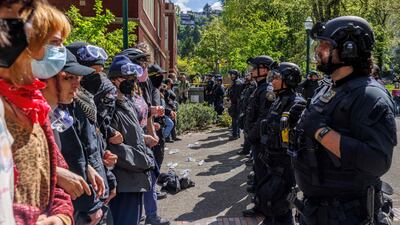
Students and activists protesting against the Gaza war face police after demonstrators were evicted from the library at Portland State University in Oregon. AFP -

A car is damaged after it was driven towards protesters at Portland State University. AFP -
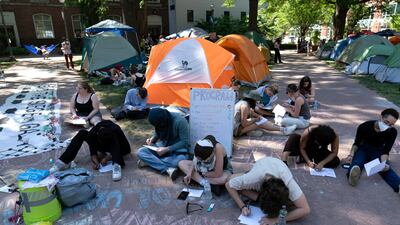
Students write letters in support of Palestinians in Gaza at an encampment at George Washington University, in Washington. AP -
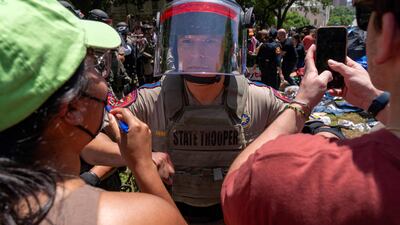
Pro-Palestinian protesters confront a state trooper at the University of Texas in Austin. AFP -
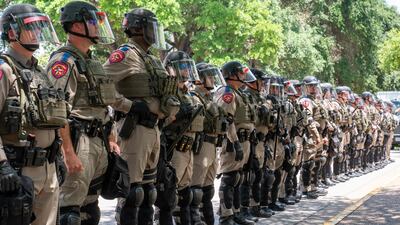
Texas State troopers stand guard at the University of Texas. AFP -
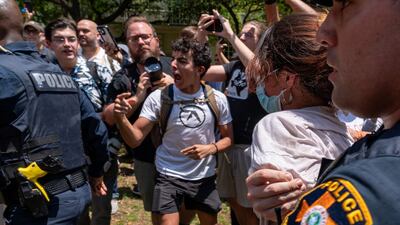
A protester confronts University of Texas police. AFP -

A demonstrator protests outside the encampment established in support of Palestinians in Gaza at Columbia University, in New York City. AFP -
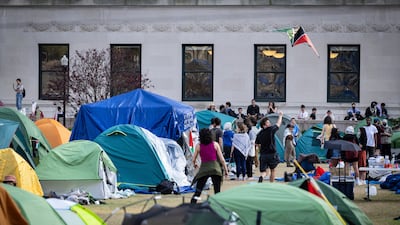
A student protester flies a kite inside the protest encampment at Columbia University. AP -
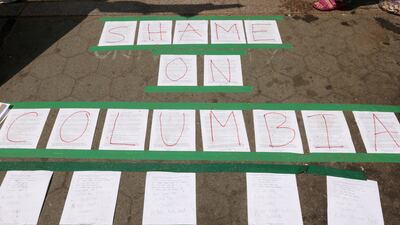
Students at Columbia University write a message as the conflict between Israel and Hamas continues. Reuters -
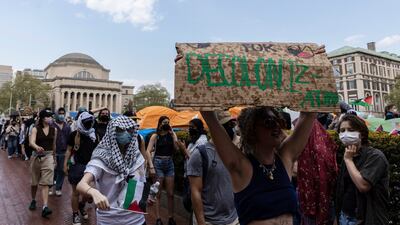
Student protesters march round their encampment at Columbia University. AP -
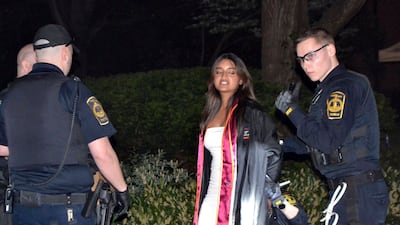
A student is arrested at a protest encampment on the Virginia Tech campus in Blacksburg. AP -
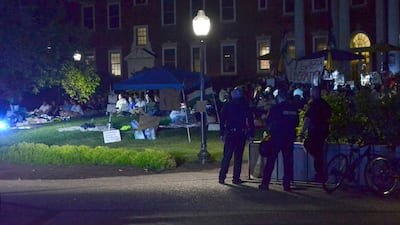
Police move to bring down an encampment after several days of protests by pro-Palestinian activists on the Virginia Tech campus. AP -

Vish Gill, a prominent figure at pro-Palestine protests, is arrested at Virginia Tech campus. AP -
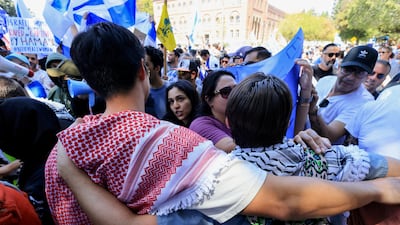
Pro-Israel counter-protesters gather at a pro-Palestine demonstration at the University of California, Los Angeles. Reuters -
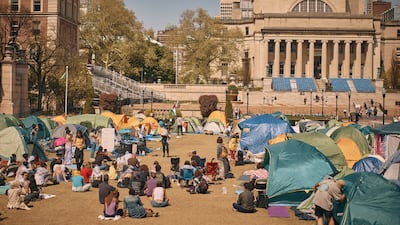
Pro-Palestine demonstrators gather on the campus of Columbia University. AP



