


Newly inaugurated President Donald Trump had a busy first 24 hours, signing a series of executive orders that he says will usher in a “golden age” in the US.
The executive orders ran the gamut from wind turbines to working from home, and there are reportedly more to come.
“President Trump is using the power of the pen and the authority granted to him by Congress to secure our borders, restore American energy dominance, slash unnecessary government bureaucracy, cut regulations and reverse the disaster wrought by the Biden administration,” Speaker of the House Mike Johnson said. “We are witnessing the beginning hours of America’s golden age, and in the days ahead we can expect President Trump to revive our nation’s strength and values, drain the swamp and return us to prosperity.”
Foreign policy
One of the executive orders directed his new Secretary of State, Marco Rubio, to “champion core American interests” and “always put America and American citizens first”. During the first Trump administration, this policy meant withdrawing from international organisations that were accused of taking advantage of the US.
Mr Trump issued another executive order withdrawing the US from the Paris Climate Accords, which aimed to align international reductions in carbon emissions and limit global warming to about 1.5°C above pre-industrial levels. He withdrew the US from the agreements during his first administration but former president Joe Biden rejoined. Mr Trump also used an executive order to withdraw from the World Health Organisation.
He also designated Mexican cartels as foreign terrorist organisations. The order means the Trump administration will work “to ensure the total elimination of these organisations’ presence in the United States and their ability to threaten the territory, safety and security” of Americans.
Immigration
Throughout his campaign, Mr Trump criticised the Biden administration's response to the high influx of migrants along the US southern border. He issued an executive order declaring a national emergency on the border, with another mandating the sealing of the border by declaring an “invasion” was under way.
“I have determined that the current state of the southern border reveals that the federal government has failed in fulfilling this obligation to the States and hereby declare that an invasion is ongoing at the southern border, which requires the federal government to take measures to fulfil its obligation to the States,” the second order says.
-
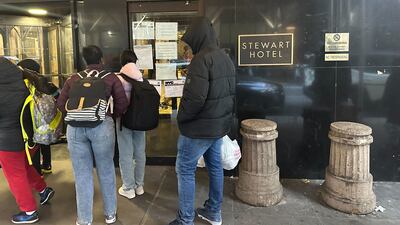
Migrants stand outside the Stewart Hotel in Midtown Manhattan, New York. Vacant hotels and office spaces have been turned into accommodation for arrivals. Adla Massoud / The National -
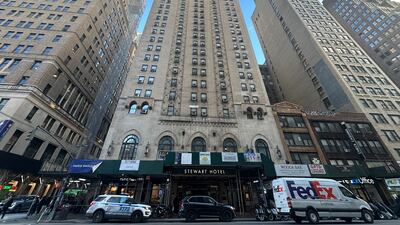
The exterior of the Stewart Hotel in New York. Adla Massoud / The National -
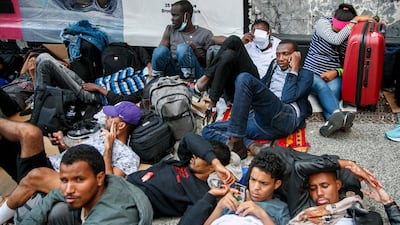
A group of migrants rest outside the former Roosevelt Hotel. EPA-EFE -
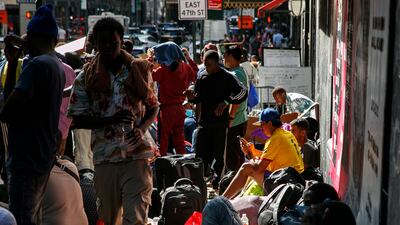
Migrants wait outside of the former Roosevelt Hotel in New York. EPA-EFE -

A migrant woman consoles her daughter as they leave a bus during their commute from Brooklyn to the Queens borough of New York. AP -

A man carries a young girl on his shoulders as he and a group of several hundred migrants wade across the Rio Grande into Eagle Pass, Texas, from Piedras Negras, Coahuila, Mexico. Reuters


Mr Trump moved to eliminate birthright citizenship, which is given to a person if they were born in the US, granted by the Fourteenth Amendment. The order has already been challenged by human rights organisations and 18 states.
He also issued an order directing that “entry into the United States of refugees under the USRAP [US Refugee Admissions Programme] be suspended”.
January 6
The Justice Department carried out an unprecedented number of prosecutions against those who took part in the January 6, 2021, Capitol insurrection. In one of his first executive orders, Mr Trump commuted the sentences or pardoned all people prosecuted over involvement in the riot.
“This proclamation ends a grave national injustice that has been perpetrated upon the American people over the last four years and begins a process of national reconciliation,” the order stated.
He also issued an order “ending the weaponisation of the federal government”. Mr Trump and his allies have accused the Justice Department of targeting them due to their political beliefs. He was the focus of several state and federal cases focused on his mishandling of classified documents and alleged involvement in election interference.
Energy
Mr Trump also issued an order declaring a “national energy emergency”, stating that “the harmful and shortsighted policies of the previous administration” has caused an inadequate energy supply and infrastructure, which “causes and makes worse the high energy prices that devastate Americans”.
To increase US energy independence, Mr Trump issued an order “unleashing” Alaska's energy potential. The order includes provisions that would allow the US to “fully avail itself of Alaska’s vast lands and resources” and “efficiently and effectively maximise” their development, particularly energy-focused projects such as developing the state's liquefied natural gas stores.

During his speech at his inaugural parade, Mr Trump railed against wind power, telling supporters “if you're into whales, you don't want windmills”, referring to reports that a larger than average number of whales were dying off the coast of the US north-east, implying it was due to wind turbines there. Among the executive orders he issued was one temporarily withdrawing “from disposition for wind energy leasing all areas within the Offshore Continental Shelf”.
Economy
Another mainstay of the Trump campaign was the high cost of living, which Mr Trump blamed on the Biden administration. One of his executive orders mandated “emergency price relief” to Americans, directing all agencies to, within the law, work to lower the cost of housing, create employment opportunities and eliminate “harmful, coercive 'climate' policies” that raise food prices.
He issued an order mandating an “America First trade policy”, which includes “addressing unfair and unbalanced trade”. Mr Trump has said he plans to issue massive tariffs on countries including China, Canada and Mexico, which he claims will generate large flows of income for the US.
Federal workforce
Mr Trump and his allies have vowed to reduce the size of the federal workforce to try to eliminate waste. One of his executive orders called for a hiring freeze until the Office of Management and Budget, in consultation with the Office of Personnel Management and the new Department of Government Efficiency – led by billionaire Elon Musk – submits “a plan to reduce the size of the federal government’s workforce through efficiency improvements and attrition”.
He also ordered that all government departments “take all necessary steps to terminate remote work arrangements and require employees to return to work in-person … on a full-time basis”. Another order called for “accountability” in the federal workforce, and said that while an employee's personal political affiliation was unimportant, they must implement “to the best of their ability” the administration's policies.
Another mandated the end of “diversity, equity and inclusion” programmes – a major fixture in the so-called culture war – in an effort to end “immense public waste and shameful discrimination”. “Federal employment practices … shall reward individual initiative, skills, performance and hard work and shall not under any circumstances consider DEI … goals, policies, mandates or requirements,” the order read.

