

Live updates: Follow the latest on Donald Trump’s inauguration
President Donald Trump withdrew the US from the Paris Climate Agreement on Monday, hours after he officially entered office.
In front of a large crowd during the inaugural parade, which was moved indoors due to extreme cold, Mr Trump signed an executive order ending US participation in the "unfair, one-sided Paris Climate Accord rip-off".
"The United States will not sabotage our own industries while China pollutes with impunity," he said, claiming that the country had the cleanest air and water during his previous administration.
Mr Trump has also promised to pursue increased US energy independence through a policy summarised by "drill, baby, drill" – or drilling for oil and natural gas at an accelerated rate.
The Paris Agreement, also known as the Paris Accords or Paris Climate Accords, is an international treaty on climate change signed in 2015.

The treaty covers climate change mitigation, adaptation and finance. It is aimed at limiting long-term global temperatures to 1.5°C above pre-industrial levels.
The agreement is voluntary and allows nations to provide targets to cut their own emissions of greenhouse gases from the burning of coal, oil and natural gas. Those targets are supposed to become more stringent over time, with countries facing a February deadline for new individual plans.
Mr Trump has long been a critic of the plan. The Republican President also withdrew from the accords during his first term in office. Joe Biden re-entered the agreement after he took office in 2020.
Iran, Libya and Yemen are the only countries that have not ratified the agreement.
After the announcement, the UN released a statement in which it said: "The last 10 years have been the hottest in recorded history. We have to look no further than Los Angeles to see this human, ecological and economic disaster play out. The collective efforts under the Paris Agreement have made a difference but we need to go much further and faster together."
It added that UN Secretary General Antonio Guterres hoped individual US cities, states and businesses would continue to pursue lowering carbon emissions.
-
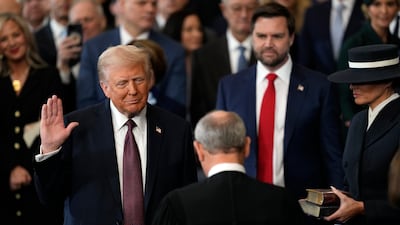
Donald Trump is sworn in as the 47th president of the United States by Chief Justice John Roberts in the Rotunda of the US Capitol in Washington. AP -
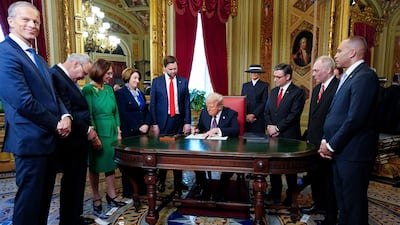
Mr Trump takes part in a signing ceremony in the President's Room at the US Capitol. AP -
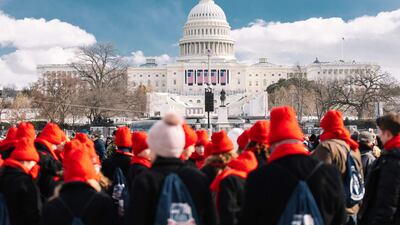
Pro-Trump supporters gather at the National Mall in Washington. AFP -
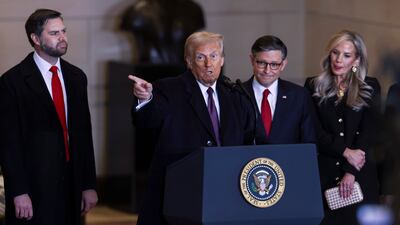
Mr Trump speaks from Emancipation Hall at the US Capitol. AP -
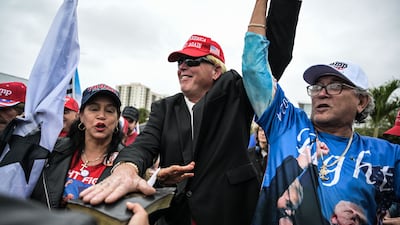
Supporters of Mr Trump celebrate in Miami, Florida. AFP -
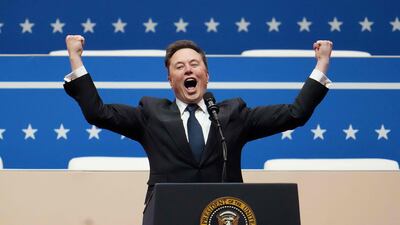
Elon Musk arrives to speak during an inauguration event at Capital One Arena in Washington. AFP -
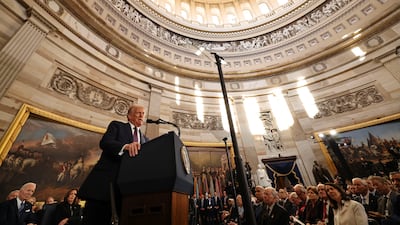
Mr Trump speaks in the Rotunda as his second presidency begins in Washington. AP -
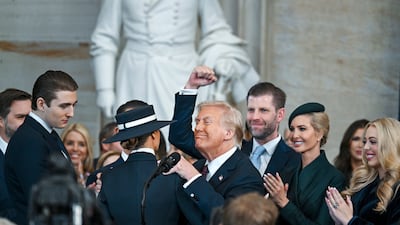
Mr Trump with his family in the Rotunda immediately after taking the oath of office. AP -
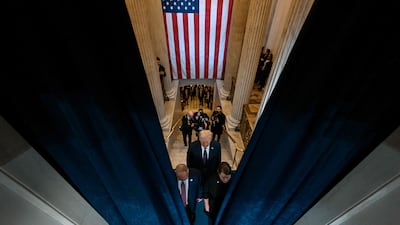
Mr Trump enters the Rotunda to a fanfare before his inauguration as the 47th President of the US. AFP -
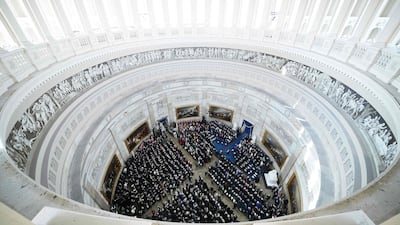
Guests attend the inauguration of Donald Trump at the US Capitol. AFP -
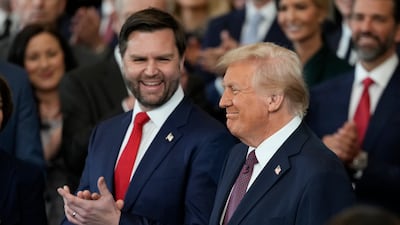
Mr Trump and vice president-elect JD Vance arrive in the Rotunda of the US Capitol in Washington. AP -
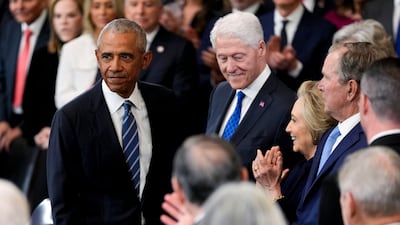
Former US president Barack Obama in the Rotunda. Bloomberg -
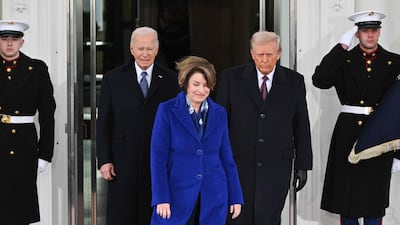
US President Joe Biden, Senator Amy Klobuchar, Democrat from Minnesota, and Mr Trump leave the White House for the US Capitol in Washington. AFP -
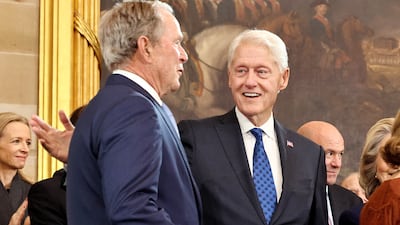
Former US presidents George W Bush, left, and Bill Clinton arrive. Reuters -
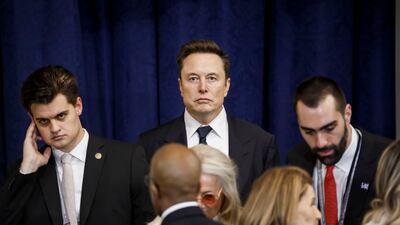
Mr Musk, centre, arrives at the US Capitol in Washington. EPA -
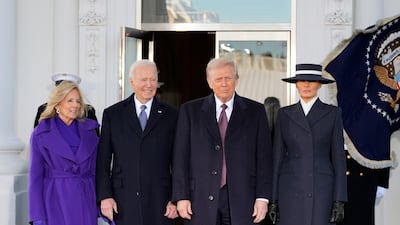
Mr Trump and wife Melania are greeted by President Joe Biden and his wife Jill on their arrival at the White House. AP -
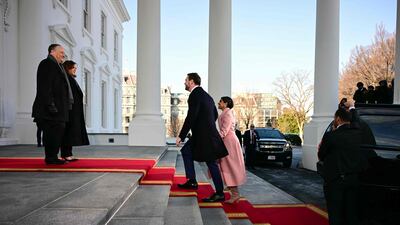
Vice President Kamala Harris and her husband Douglas Emhoff greet vice president-elect JD Vance and his wife Usha Vance as they arrive at the White House. AFP -
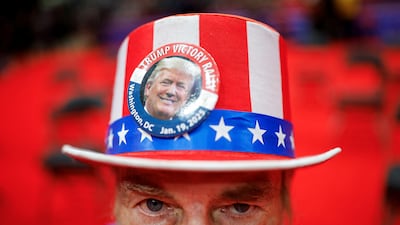
A Trump supporter poses for a picture inside Capital One arena. Reuters -
President-elect Donald Trump arrives for mass at St John's Church in Washington before the 60th presidential inauguration. Bloomberg -
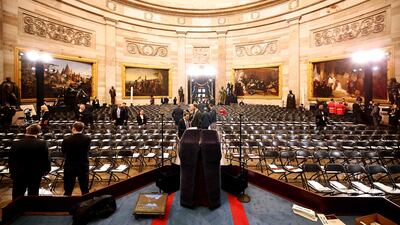
Staff prepare for the inauguration in the US Capitol. AFP -
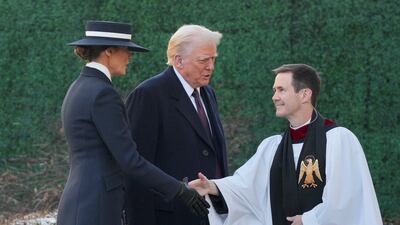
Mr Trump and his wife Melania arrive for a service at St John's Episcopal Church. Reuters -
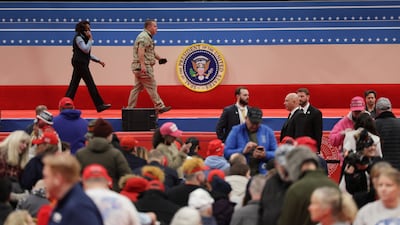
Guests begin to arrive for the relocated parade at the Capitol One Arena in Washington. EPA -
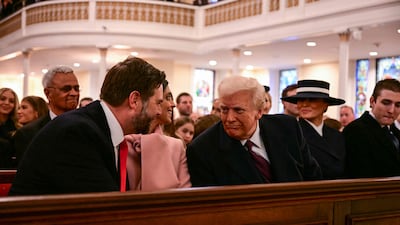
Mr Trump speaks with vice president-elect JD Vance during a church service at St John's. AFP -
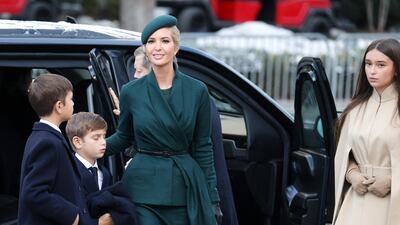
Ivanka Trump, daughter of Mr Trump, arrives with her family for the church service. AFP -
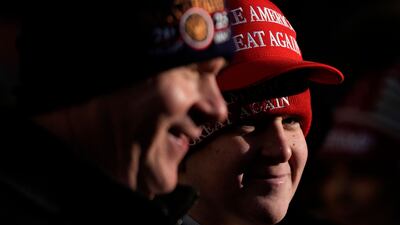
Supporters from Arkansas make their way through the line at Capital One Arena. AFP



