
Live updates: Follow the latest on Donald Trump’s inauguration
Donald Trump said a "golden age" had begun for the US as he was sworn in as President on Monday, capping an extraordinary political comeback. His second term in the White House is expected to reshape American institutions and set the country on a starkly different path than the past four years under Joe Biden.
The new President took his oath of office at a solemn ceremony under the Rotunda of the US Capitol, the same building his supporters stormed in 2021, leading to Mr Trump's second impeachment.
"The golden age of America begins right now," he said in his inaugural address. "From this day forward, our country will flourish and be respected again all over the world. We will be the envy of every nation, and we will not allow ourselves to be taken advantage of any longer. During every single day of the Trump administration, I will very simply put America first."
Mr Trump was sworn in immediately after his Vice President, former senator J D Vance, took the oath of office. Mr Trump ordered the event to be held indoors because of snow, ice and freezing temperatures in Washington. Cannon fired a salute outside the Capitol as he was sworn in.
Mr Trump, 78, moved quickly to put America on a new course after four years of Democrat rule under Mr Biden. Within hours of his inauguration, he signed several far-reaching executive orders, including on immigration and the environment. He ordered the US to leave the Paris Climate Accord, as he did in his first term, only for Mr Biden to rejoin in 2021.
Mr Trump said he would declare a national emergency at the US-Mexico border and would "begin the process of returning millions and millions of criminal aliens back to the places from which they came".
During his 30-minute address, he declared the beginning of “a thrilling new era of national success” as “a tide of change is sweeping the country" and criticised the Biden administration as a "betrayal" against the American people.
The former government could not "manage even a simple crisis at home, while at the same time stumbling into a continuing catalogue of catastrophic events abroad", Mr Trump said, as Mr Biden looked on. "It fails to protect our magnificent, law-abiding American citizens, but provides sanctuary and protection for dangerous criminals."
Mr Trump added that his legacy would be that of "peacemaker" and his administration would "stop all wars".
He also referred to his difficult path back to the White House, which included two assassination attempts, one of which involved a bullet nicking his ear at a campaign event in Pennsylvania.
"My life was saved for a reason. I was saved by God to make America great again," he said.
The Republican won the election and a second term by building a new coalition that included working-class voters of all races. His economic message resonated with an electorate furious with the Biden administration over high inflation and rising prices for goods ranging from eggs to petrol.
Mr Trump said he would reinvigorate American manufacturing by declaring a "national energy emergency" and pledged to exploit the country's fossil fuel resources.
“We will drill, baby drill,” he said. “America will be a manufacturing nation once again and we have something that no other manufacturing nation will ever have, the largest amount of oil and gas of any country on Earth, and we are going to use it.”
-
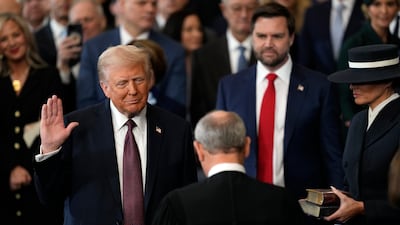
Donald Trump is sworn in as the 47th president of the United States by Chief Justice John Roberts in the Rotunda of the US Capitol in Washington. AP -
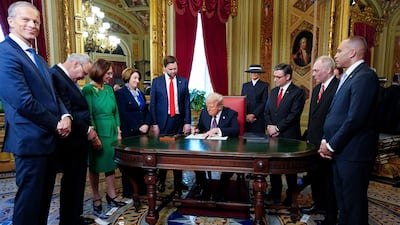
Mr Trump takes part in a signing ceremony in the President's Room at the US Capitol. AP -
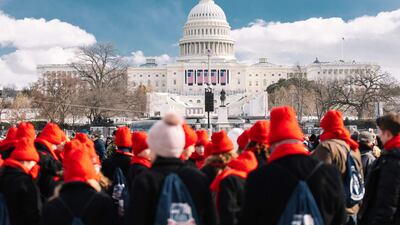
Pro-Trump supporters gather at the National Mall in Washington. AFP -
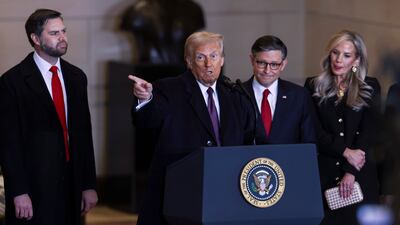
Mr Trump speaks from Emancipation Hall at the US Capitol. AP -
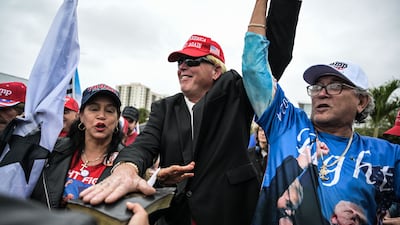
Supporters of Mr Trump celebrate in Miami, Florida. AFP -
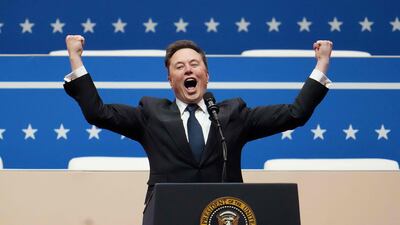
Elon Musk arrives to speak during an inauguration event at Capital One Arena in Washington. AFP -
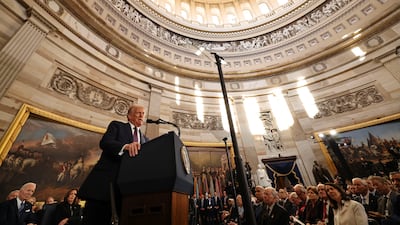
Mr Trump speaks in the Rotunda as his second presidency begins in Washington. AP -
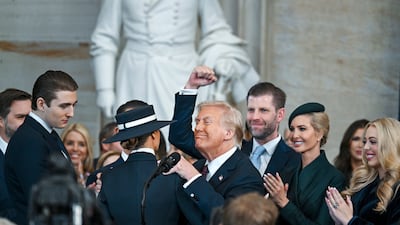
Mr Trump with his family in the Rotunda immediately after taking the oath of office. AP -
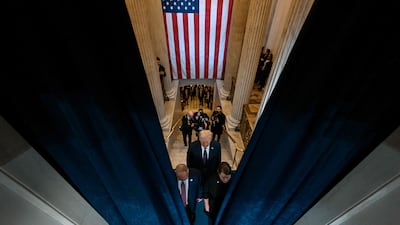
Mr Trump enters the Rotunda to a fanfare before his inauguration as the 47th President of the US. AFP -
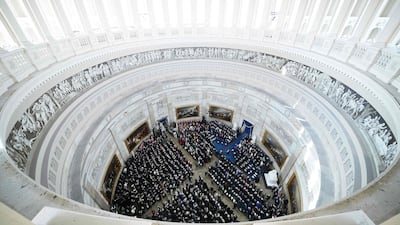
Guests attend the inauguration of Donald Trump at the US Capitol. AFP -
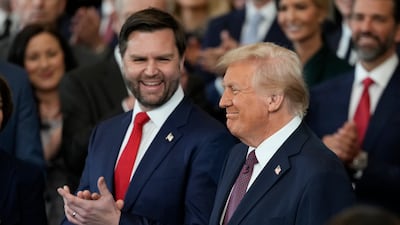
Mr Trump and vice president-elect JD Vance arrive in the Rotunda of the US Capitol in Washington. AP -
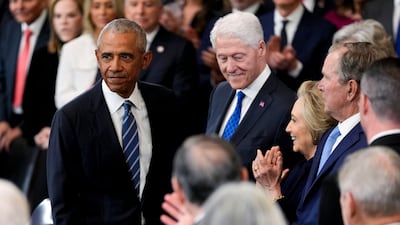
Former US president Barack Obama in the Rotunda. Bloomberg -
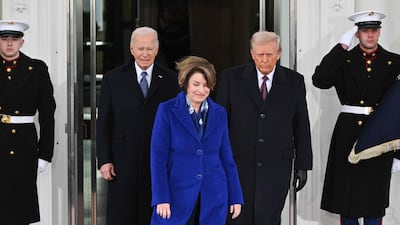
US President Joe Biden, Senator Amy Klobuchar, Democrat from Minnesota, and Mr Trump leave the White House for the US Capitol in Washington. AFP -
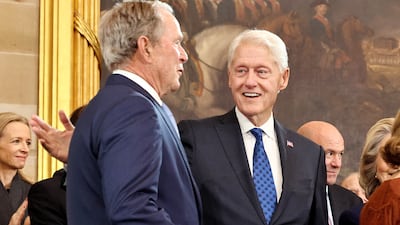
Former US presidents George W Bush, left, and Bill Clinton arrive. Reuters -
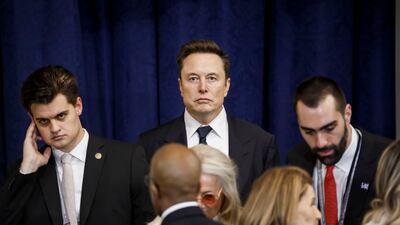
Mr Musk, centre, arrives at the US Capitol in Washington. EPA -
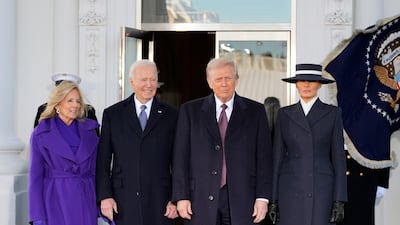
Mr Trump and wife Melania are greeted by President Joe Biden and his wife Jill on their arrival at the White House. AP -
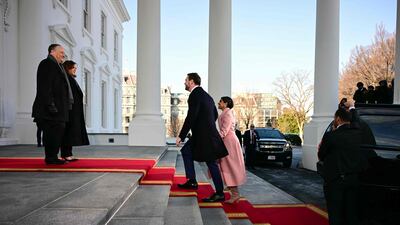
Vice President Kamala Harris and her husband Douglas Emhoff greet vice president-elect JD Vance and his wife Usha Vance as they arrive at the White House. AFP -
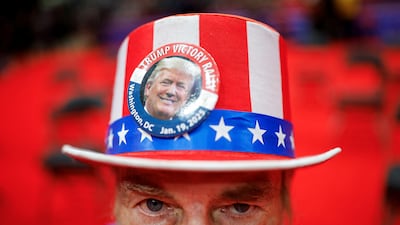
A Trump supporter poses for a picture inside Capital One arena. Reuters -
President-elect Donald Trump arrives for mass at St John's Church in Washington before the 60th presidential inauguration. Bloomberg -
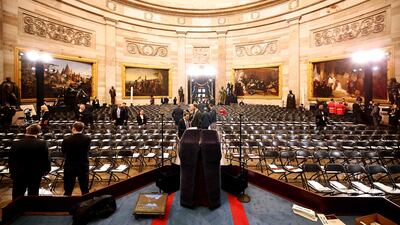
Staff prepare for the inauguration in the US Capitol. AFP -
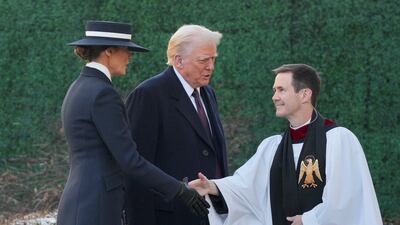
Mr Trump and his wife Melania arrive for a service at St John's Episcopal Church. Reuters -
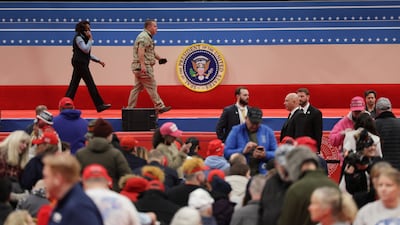
Guests begin to arrive for the relocated parade at the Capitol One Arena in Washington. EPA -
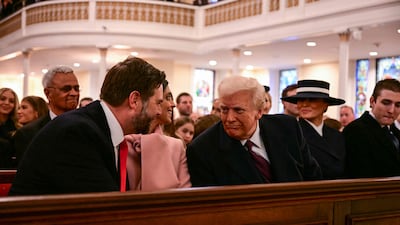
Mr Trump speaks with vice president-elect JD Vance during a church service at St John's. AFP -
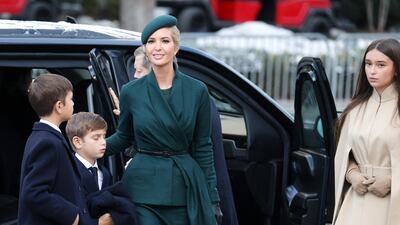
Ivanka Trump, daughter of Mr Trump, arrives with her family for the church service. AFP -
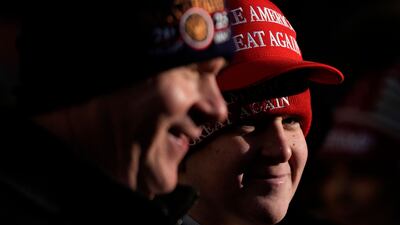
Supporters from Arkansas make their way through the line at Capital One Arena. AFP


After the ceremony, Mr Trump attended an event at a local arena where he signed several executive orders in front of a cheering crowd. He was due to sign more on his return to the White House late on Monday, including orders aimed at clamping down on border crossings, increasing fossil fuel development and ending diversity and inclusion programmes across the federal government.
Mr Trump is only the second US leader to return to the White House for a non-consecutive second term. He was voted out of office during the Covid-19 pandemic, largely because of his response to the disaster that killed more than a million people in the US.
He has also made history by returning to the White House as a felon, having being convicted in New York for covering up hush money payments during his first campaign in 2016.
He claimed that election was “rigged”, leading his supporters to rally in Washington on January 6, 2021. Thousands went on to storm the Capitol. Mr Trump said he would order the release of most of those convicted for their actions that day.
“I return to the presidency confident and optimistic that we are at the start of a thrilling new era of national success. A tide of change is sweeping the country,” Mr Trump said in his inaugural address. “My message to Americans today is that it is time for us to once again act with courage, vigour and the vitality of history’s greatest civilisation.”
Mr Trump, who benefitted from the support of SpaceX chief executive Elon Musk, said the US would go to Mars. He was joined by the world's richest man and other tech titans at the inauguration.
“We will pursue our manifest destiny into the stars, launching American astronauts to plant the Stars and Stripes on the planet Mars,” the President said. “If we work together, there's nothing we cannot do, and no dream we cannot achieve.”
He will enjoy a Republican majority in both chambers of Congress, as well as a conservative-leaning Supreme Court.
The Senate, under Republican control, worked into the evening to help Mr Trump, and senators unanimously approved Marco Rubio's nomination for Secretary of State.
Before dawn on Monday, thousands of Trump supporters braved temperatures of about minus 7°C to queue in hope of entering the arena that was to host Mr Trump. Ordinarily, inaugurations are held on the National Mall, however Mr Trump's decision to take the event inside meant only a fraction of his supporters would be able to see him.
-

President Donald Trump and wife Melania, the first lady, arrive at the Commander and Chief inaugural ball in Washington. AFP -
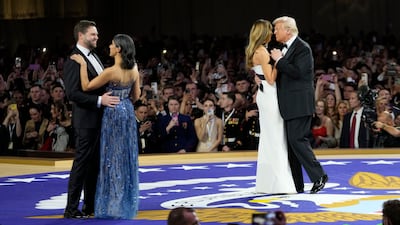
President Trump with first lady Melania and Vice President JD Vance with his wife, Usha Vance, dance at the Commander and Chief inaugural ball. AP -
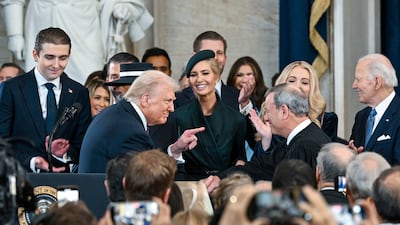
President Trump points to Supreme Court Chief Justice John Roberts after taking the oath of office. AP -
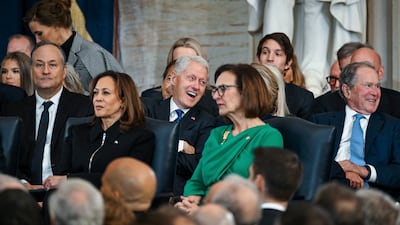
Kamala Harris, Bill Clinton and former George W Bush are among those in attendance at the Presidential Inauguration in the Rotunda of the US Capitol. AP -
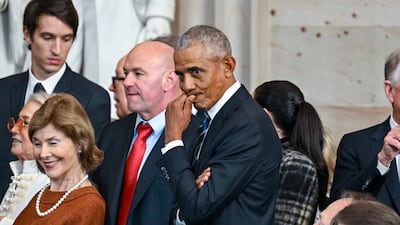
Former President Barack Obama, right, and Laura Bush, left. AP -
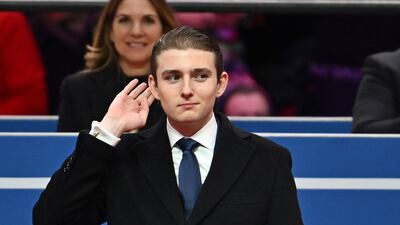
Barron Trump gestures after being acknowledged by his father inside Capital One Arena. AFP -
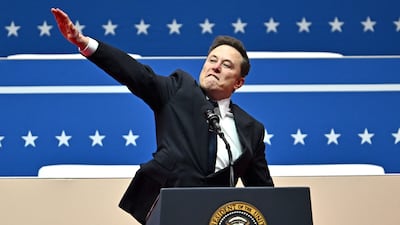
Elon Musk salutes, controversially, during celebrations at the Capital One Arena. AFP -
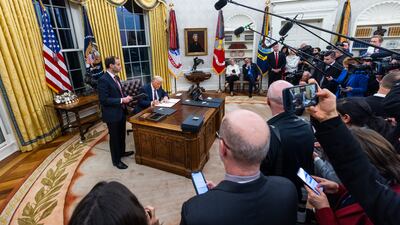
Trump signs numerous executive orders on the first day of his presidency in the Oval Office. EPA -
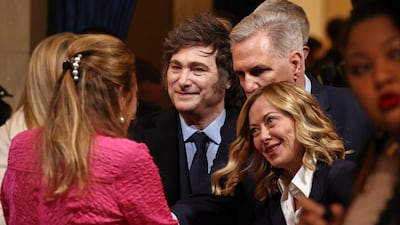
Argentina's President Javier Milei, centre, former Speaker of the House Kevin McCarthy, top right, and Italian Prime Minister Giorgia Meloni arrive for the inauguration. AP -
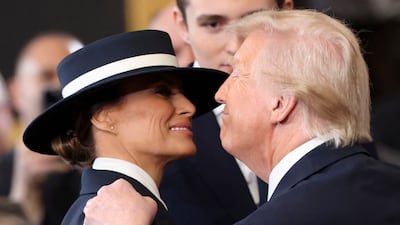
President Trump and wife Melania Trump, the first lady. AP


Connie Waters, 56, said she was excited for Mr Trump to “put us back in action”.
“We have a small business, and we were closing it last year to retire and weren't planning to sell it or reopen it because of the way the economy was,” Ms Waters told The National. "But since he's in office now, our son's going to take it over and we're going to keep it rolling."
She added that the Gaza ceasefire and hostage exchange deal, which came into effect on Sunday, was proof that “other countries respect him immensely”.
The National Mall, in front of the Capitol building, was largely quiet, but a few Trump supporters made the most of the moment regardless.
“We’re from Florida and we drove up here,” said Chris Miller. "We tried to return into Capital One Arena where the rally was being held, but the lines were too long."
Chris Gibson from South Carolina said he was in Washington for Barack Obama's inauguration and is now back for Mr Trump's.
"I'm very happy with the way it's turned out," he told The National, referring to Mr Trump's electoral win in November.
But Mr Gibson expressed disappointment over the inauguration being moved indoors because of extreme cold weather. "Because, obviously, you can see we're not covered in six foot of snow. Nobody's dying out here, not from snow, you know, and nobody's out here starting fights," he added.


