Live updates: Follow the latest on Israel-Gaza
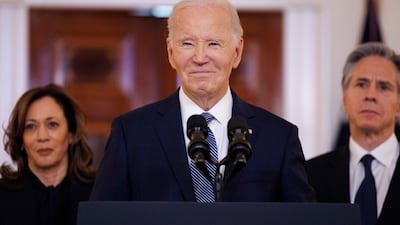
After months of frustrated diplomacy, President Joe Biden on Wednesday finally got the Middle East success he had staked much of his reputation on – a Gaza ceasefire agreement between Hamas and Israel, but his successor-in-waiting Donald Trump moved quickly to steal the limelight.
Mr Biden described the historic deal, which takes effect on Sunday, as being essentially the same as the one he announced on May 31 and said it had been made possible through his resolute support of Israel as it attacked Hamas, as well as through his team's non-stop political efforts.
The deal is a “result not only of the extreme pressure that Hamas has been under and the changed regional equation after a ceasefire in Lebanon and weakening of Iran – but also of dogged and painstaking American diplomacy”, Mr Biden said.
Yet even before the agreement was officially announced, president-elect Trump sought to take credit for the accord, arguing it was only thanks to his election in November that Israel and Hamas they finally agreed on a deal.
“This epic ceasefire agreement could have only happened as a result of our historic victory in November, as it signalled to the entire world that my administration would seek peace and negotiate deals to ensure the safety of all Americans, and our allies,” Mr Trump said on Truth Social.
He added that he would use momentum from the ceasefire to expand the Abraham Accords.
Mr Biden said he had directed his team to co-ordinate closely with the Trump team to “make sure we're all speaking with the same voice, because that's what American presidents do.".
But when a reporter at the White House asked him if Mr Trump deserved credit, the departing President said: “Is that a joke?”
It is natural for rival presidents to cast competing narratives on crucial issues, but experts say more important is the remarkable fact that both the incoming and departing administrations worked so closely together in recent months on this issue.
“The co-ordination that has occurred is virtually unprecedented,” said Aaron David Miller, a former long-time Middle East analyst at the State Department. “This is really quite remarkable.”
Khaled Elgindy, an adjunct professor at Georgetown, said it made sense for both teams to be involved because the ceasefire will be implemented under the new Trump administration.
“It does set it up in a way that allows Trump to claim credit, and that will not be an absurd narrative,” Mr Elgindy said. “He should get some of the credit because he's the different factor. If what is on the table now, in terms of the content of the ceasefire deal, is not radically different than what's been on the table since May, then why hasn't Biden been able to clinch the deal?”
Mr Trump has repeatedly warned Hamas that there will be “hell to pay” if it does not free the remaining captives before his inauguration. Israeli Prime Minister Benjamin Netanyahu has also appeared more willing to listen to Mr Trump than Mr Biden, whose demands the Israeli politician has frequently brushed aside since October 7, 2023.
David Makovsky, senior fellow at the Washington Institute for Near East Policy, said the deal came about due to there being "a lot of pressure on Hamas, both on the battlefield, the isolation of Hamas with the decapitation of Hezbollah", as well as the weakening of Iran.
"I think this a rare moment of Biden and Trump kind of converging – I've never seen this before an incoming and an outgoing president in the same negotiation, having their representatives in the same negotiation," he told The National, adding that regional players wanted to "start a new page with the new administration".
Senator Marco Rubio, perhaps displaying his diplomatic skills, said at his confirmation hearing to become the next secretary of state that both administrations should be acknowledged for helping to secure a deal.
“Credit to both the Biden administration and the Trump Transition. They’ve worked side by side on helping this come about,” Mr Rubio said.
A senior Hamas official told The National that it was the election of Mr Trump and his appointment of Steve Witkoff as Middle East envoy that finally got things moving during negotiations.
“US pressures led by Donald Trump through his envoy to the negotiations succeeded in putting an end to the Israeli intransigence that tried hard to obstruct the agreement," the source said.
A senior official from the Biden administration praised the partnership with Mr Witkoff, describing the co-ordination between the two administrations as “almost unprecedented.
The official said the Biden team wanted a seamless transition to the Trump administration, which will oversee the implementation of the ceasefire after January 20.
Senator Chuck Schumer, the highest-ranking Jewish-American official in US history, said the deal “couldn't have happened without steadfast diplomacy and until the potency of Hamas was radically reduced, we will not rest until every hostage comes home".
Senate Majority Leader John Thune called the deal "a relief to a world on edge" and said he was hopeful the deal would lead to the return of all hostages.
State Department spokesman Matt Miller said the deal shows “that when Americans are willing to work together across partisan lines, as we were willing to do on this occasion, because it's in the national interest of the United States, there's a lot that we can get done.”

Mercer, the investment consulting arm of US services company Marsh & McLennan, expects its wealth division to at least double its assets under management (AUM) in the Middle East as wealth in the region continues to grow despite economic headwinds, a company official said.
Mercer Wealth, which globally has $160 billion in AUM, plans to boost its AUM in the region to $2-$3bn in the next 2-3 years from the present $1bn, said Yasir AbuShaban, a Dubai-based principal with Mercer Wealth.
“Within the next two to three years, we are looking at reaching $2 to $3 billion as a conservative estimate and we do see an opportunity to do so,” said Mr AbuShaban.
Mercer does not directly make investments, but allocates clients’ money they have discretion to, to professional asset managers. They also provide advice to clients.
“We have buying power. We can negotiate on their (client’s) behalf with asset managers to provide them lower fees than they otherwise would have to get on their own,” he added.
Mercer Wealth’s clients include sovereign wealth funds, family offices, and insurance companies among others.
From its office in Dubai, Mercer also looks after Africa, India and Turkey, where they also see opportunity for growth.
Wealth creation in Middle East and Africa (MEA) grew 8.5 per cent to $8.1 trillion last year from $7.5tn in 2015, higher than last year’s global average of 6 per cent and the second-highest growth in a region after Asia-Pacific which grew 9.9 per cent, according to consultancy Boston Consulting Group (BCG). In the region, where wealth grew just 1.9 per cent in 2015 compared with 2014, a pickup in oil prices has helped in wealth generation.
BCG is forecasting MEA wealth will rise to $12tn by 2021, growing at an annual average of 8 per cent.
Drivers of wealth generation in the region will be split evenly between new wealth creation and growth of performance of existing assets, according to BCG.
Another general trend in the region is clients’ looking for a comprehensive approach to investing, according to Mr AbuShaban.
“Institutional investors or some of the families are seeing a slowdown in the available capital they have to invest and in that sense they are looking at optimizing the way they manage their portfolios and making sure they are not investing haphazardly and different parts of their investment are working together,” said Mr AbuShaban.
Some clients also have a higher appetite for risk, given the low interest-rate environment that does not provide enough yield for some institutional investors. These clients are keen to invest in illiquid assets, such as private equity and infrastructure.
“What we have seen is a desire for higher returns in what has been a low-return environment specifically in various fixed income or bonds,” he said.
“In this environment, we have seen a de facto increase in the risk that clients are taking in things like illiquid investments, private equity investments, infrastructure and private debt, those kind of investments were higher illiquidity results in incrementally higher returns.”
The Abu Dhabi Investment Authority, one of the largest sovereign wealth funds, said in its 2016 report that has gradually increased its exposure in direct private equity and private credit transactions, mainly in Asian markets and especially in China and India. The authority’s private equity department focused on structured equities owing to “their defensive characteristics.”
Skoda Superb Specs
Engine: 2-litre TSI petrol
Power: 190hp
Torque: 320Nm
Price: From Dh147,000
Available: Now
Honeymoonish
%3Cp%3E%3Cstrong%3EDirector%3A%3C%2Fstrong%3E%20Elie%20El%20Samaan%3C%2Fp%3E%0A%3Cp%3E%3Cstrong%3EStarring%3A%20%3C%2Fstrong%3ENour%20Al%20Ghandour%2C%20Mahmoud%20Boushahri%3C%2Fp%3E%0A%3Cp%3E%3Cstrong%3ERating%3A%3C%2Fstrong%3E%203%2F5%3C%2Fp%3E%0A
In Full Flight: A Story of Africa and Atonement
John Heminway, Knopff
The Bio
Name: Lynn Davison
Profession: History teacher at Al Yasmina Academy, Abu Dhabi
Children: She has one son, Casey, 28
Hometown: Pontefract, West Yorkshire in the UK
Favourite book: The Alchemist by Paulo Coelho
Favourite Author: CJ Sansom
Favourite holiday destination: Bali
Favourite food: A Sunday roast
Milestones on the road to union
1970
October 26: Bahrain withdraws from a proposal to create a federation of nine with the seven Trucial States and Qatar.
December: Ahmed Al Suwaidi visits New York to discuss potential UN membership.
1971
March 1: Alex Douglas Hume, Conservative foreign secretary confirms that Britain will leave the Gulf and “strongly supports” the creation of a Union of Arab Emirates.
July 12: Historic meeting at which Sheikh Zayed and Sheikh Rashid make a binding agreement to create what will become the UAE.
July 18: It is announced that the UAE will be formed from six emirates, with a proposed constitution signed. RAK is not yet part of the agreement.
August 6: The fifth anniversary of Sheikh Zayed becoming Ruler of Abu Dhabi, with official celebrations deferred until later in the year.
August 15: Bahrain becomes independent.
September 3: Qatar becomes independent.
November 23-25: Meeting with Sheikh Zayed and Sheikh Rashid and senior British officials to fix December 2 as date of creation of the UAE.
November 29: At 5.30pm Iranian forces seize the Greater and Lesser Tunbs by force.
November 30: Despite a power sharing agreement, Tehran takes full control of Abu Musa.
November 31: UK officials visit all six participating Emirates to formally end the Trucial States treaties
December 2: 11am, Dubai. New Supreme Council formally elects Sheikh Zayed as President. Treaty of Friendship signed with the UK. 11.30am. Flag raising ceremony at Union House and Al Manhal Palace in Abu Dhabi witnessed by Sheikh Khalifa, then Crown Prince of Abu Dhabi.
December 6: Arab League formally admits the UAE. The first British Ambassador presents his credentials to Sheikh Zayed.
December 9: UAE joins the United Nations.
Ten tax points to be aware of in 2026
1. Domestic VAT refund amendments: request your refund within five years
If a business does not apply for the refund on time, they lose their credit.
2. E-invoicing in the UAE
Businesses should continue preparing for the implementation of e-invoicing in the UAE, with 2026 a preparation and transition period ahead of phased mandatory adoption.
3. More tax audits
Tax authorities are increasingly using data already available across multiple filings to identify audit risks.
4. More beneficial VAT and excise tax penalty regime
Tax disputes are expected to become more frequent and more structured, with clearer administrative objection and appeal processes. The UAE has adopted a new penalty regime for VAT and excise disputes, which now mirrors the penalty regime for corporate tax.
5. Greater emphasis on statutory audit
There is a greater need for the accuracy of financial statements. The International Financial Reporting Standards standards need to be strictly adhered to and, as a result, the quality of the audits will need to increase.
6. Further transfer pricing enforcement
Transfer pricing enforcement, which refers to the practice of establishing prices for internal transactions between related entities, is expected to broaden in scope. The UAE will shortly open the possibility to negotiate advance pricing agreements, or essentially rulings for transfer pricing purposes.
7. Limited time periods for audits
Recent amendments also introduce a default five-year limitation period for tax audits and assessments, subject to specific statutory exceptions. While the standard audit and assessment period is five years, this may be extended to up to 15 years in cases involving fraud or tax evasion.
8. Pillar 2 implementation
Many multinational groups will begin to feel the practical effect of the Domestic Minimum Top-Up Tax (DMTT), the UAE's implementation of the OECD’s global minimum tax under Pillar 2. While the rules apply for financial years starting on or after January 1, 2025, it is 2026 that marks the transition to an operational phase.
9. Reduced compliance obligations for imported goods and services
Businesses that apply the reverse-charge mechanism for VAT purposes in the UAE may benefit from reduced compliance obligations.
10. Substance and CbC reporting focus
Tax authorities are expected to continue strengthening the enforcement of economic substance and Country-by-Country (CbC) reporting frameworks. In the UAE, these regimes are increasingly being used as risk-assessment tools, providing tax authorities with a comprehensive view of multinational groups’ global footprints and enabling them to assess whether profits are aligned with real economic activity.
Contributed by Thomas Vanhee and Hend Rashwan, Aurifer
PFA Team of the Year: David de Gea, Kyle Walker, Jan Vertonghen, Nicolas Otamendi, Marcos Alonso, David Silva, Kevin De Bruyne, Christian Eriksen, Harry Kane, Mohamed Salah, Sergio Aguero