

Mohamad Hafez, a Syrian architect and artist whose detailed sculptures depict his beloved homeland, wants to give his work to willing institutions to make it more accessible to a new generation of Syrians.
Mr Hafez, who lives in New Haven, Connecticut, was born in Damascus and grew up in Syria and Saudi Arabia. He emigrated to the US in the early 2000s and began his professional career designing skyscrapers but eventually shifted to art.
“I am saying, for me as Mohamad Hafez, I could make a lot of money selling this work, and I'm going to be the first one to put it out for Syria for free,” Mr Hafez, 40, told The National. “Syria comes first and I hope many people will join me in this initiative and say, 'Syria first'.”
His dioramas, which can take years to complete, are incredibly detailed and lifelike portraits of Syria that in part tell a story of longing and nostalgia.
Mr Hafez has not been home since May 2011, when he watched the first signs of the civil war in Deraa, when anti-government protests erupted. He attended one such protest in Damascus at the time.
Until just a few days ago, he was convinced he would never set foot in Syria again.
-

'We have won' by Mohamad Hafez. Credit: Rodney Nelson -
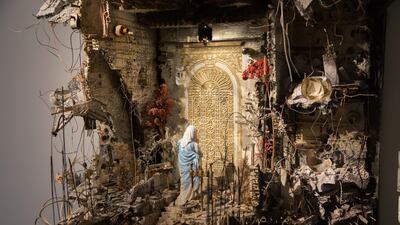
'Have you forsaken us' by Mohamed Hafez. Credit: Rodney Nelson -
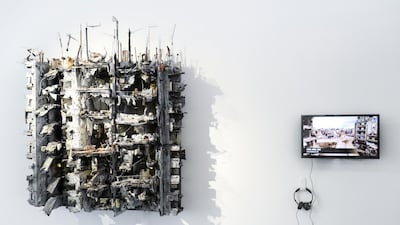
'Collateral damage' by Mohamad Hafez. Credit: Rodney Nelson -
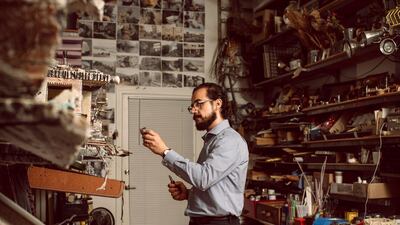
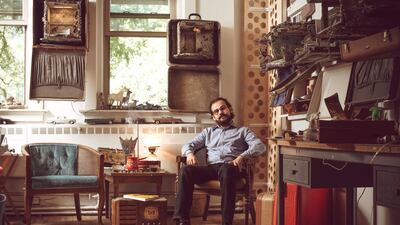
Mohamed Hafez’s New Haven studio is lined with stainless steel shelves housing buckets full of bits of junk, which he describes as his “ingredients of the day”. Credit: Cole Wilson -

'We have won!' by Mohamed Hafez. Credit: Rodney Nelson -

Unpacked Refugee Baggage' by Mohamed Hafez. Credit: Rodney Nelson -

“I’ve been making these models for 15 years now, but for the first 10 years, my practice was completely confidential and for me only,” he says. “It’s not until relatively recently that people have said to me that I need to exhibit these works," says Mohamed Hafez. Credit: Rodney Nelson -
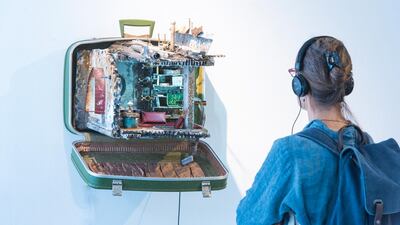
'Unpacked Refugee Baggage' by Mohamad Hafez. Credit: Rodney Nelson -
Making these miniature models – many of which are based on images Hafez has seen in newspapers and magazines – is no longer the cathartic experience it once was for Hafez, however. “If you are trying to remodel the ruins of Aleppo, I feel devastated after completing the work,” he says, “particularly when I incorporate the sound effects. You’re hearing children playing in the street and the call to prayer and church bells ringing. Anyone who has been to that region will recognise these noises as representations of a peace that no longer exists.” Credit: Rodney Nelson -
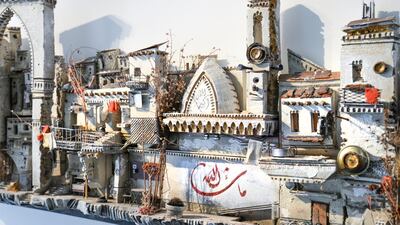
'Unsettled Nostalgia' by Mohamed Hafez. Credit: Rodney Nelson


But all that changed when rebels led by the extremist group Hayat Tahrir Al Shams stormed Syria’s second largest city Aleppo, piercing Bashar Al Assad’s air of, if not invincibility, inevitably. Then the rebels took Hama and Homs and finally Damascus.
In a span of just days, the Assad family's decades of power came crashing down and suddenly Mr Hafez could entertain an entirely new future.
“Had you called me literally five days ago I would have told you I'm very desperate and very down, and I was 100 per cent sure I would not see Damascus in my lifetime and I was about 70 per cent sure my son would not see Damascus in his lifetime,” he said. “As of 72 hours ago, the dream of possibly going back to Damascus is for once a viable solution.”
Now, as he tries to process everything that has transpired, Mr Hafez described himself as a frozen computer with a spinning rainbow wheel going around and around.
For nearly the whole of Syria’s 13-year civil war, he has helped to tell his people's story to the world through his art. Part of his desire to give it to institutions is because in his mind a chapter has closed.
“There is no argument that this era has finished," he said. “People are saying: 'We are afraid of what is coming next.' What is worse than what we have seen? Nothing, nothing is worse than what we've seen.
"So we as creatives in the Syrian diaspora, we need to first realise the era has ended, and that we were fortunate enough to create work that reflected that era.”
Mr Hafez said he is not sure exactly how it will work and who will be interested in his art, but that he is determined to see it through.
He estimates that he has done about 100 pieces, some of which are just sketches, others much more elaborate.
“I am invested in the new generation,” he said. “So what is the best thing for me to give them? It is this way of emotionally connecting to what had happened through art. They connect, they understand, they hopefully invest, they grow the love and we move forward.”

