

At the age of 11, in 1969, Michael Lopez-Alegria stood on a beach, embracing family and strangers as he heard the news that man had just landed on the Moon. That moment would change his life forever.
In the years to come, Madrid-born Mr Lopez-Alegria tirelessly pursued his great hope of exploring space, carrying out 5,700 flight hours as a test pilot before finally achieving his dream of becoming an astronaut.
For Mr Lopez-Alegria, now 66, “the wonder of being in space is something that never gets old” – and that passion for discovery and adventure continues.
From his record-setting spacewalks to leading the first all-private crewed mission to the International Space Station, the career of the first Spanish-American astronaut to travel to space has been marked by impressive achievements and groundbreaking missions.
Mr Lopez-Alegria has 10 spacewalks and the second-longest time spent outside space vessels among Nasa astronauts.
He also spent 215 days on the ISS – from September 18, 2006, to April 21, 2007 – contributing to research and operations on the space station.

Private space flight
Two years ago, Mr Lopez-Alegria took on a new challenge: becoming the commander of Axiom-1, the first all-private astronaut mission to the ISS.
This historic mission, launched on April 8, marked a significant milestone in the evolution and future of commercial human space flight.
He also led the Axiom-3 mission this year, with the team spending 18 days on the ISS and completing 346 orbits around the Earth, covering 14.6 million kilometres of space flight.
“The experience was beautiful – again. It's always a privilege to fly to space, and really an honour to be able to do it and sort of continue to expand the frontier of commercial human space flight,” Mr Lopez-Alegria told The National.
This mission further solidified his role as a trailblazer in the new era of space exploration.
“With commercial human space flight still in its infancy, it’s critical for the Axiom space missions to produce meaningful research with tangible results that have real-world applications,” he said.
“I’m encouraged by what Ax-1 and Ax-2 have accomplished and look forward to continuing to push the boundaries of human space exploration.”
One of the benefits of the evolving nature of space flight is the ability to better connect with those back on Earth.
“Astronauts can take cell phones to space but they don’t work like they do on the ground,” Mr Lopez-Alegria said.
“We don’t get cell service but we can check our emails, conduct video calls, take photos and listen to music.”
A notable highlight of the Ax-3 mission was the inclusion of Alper Gezeravci, who was the first Turkish astronaut to visit the ISS.
His participation marked a significant achievement for Turkey and expanded international collaboration in space exploration, reflecting a shared human aspiration to explore and understand the cosmos.
“He told me that he was only a child when he looked up and the sky was the limit of his dreaming, because Turkish people had never been to space,” Mr Lopez-Alegria said of his teammate.
“So he became a pilot and now he's saying that children … can look not only to the sky, but to space and dream even bigger than they did when he was a boy.”
Throughout his career, Mr Lopez-Alegria has often spoken about the profound impact of space travel on his perspective.
“No degree of education or preparation can get you ready for what it’s really like to look down at your home planet,” he said.
This sentiment has been echoed by many astronauts who have experienced the “Overview Effect” – a cognitive shift in awareness caused by seeing the Earth from orbit.
'The future is bright'
As commercial space flight continues to advance, Mr Lopez-Alegria envisions a future in which “space is becoming more and more accessible”.
Part of it, he said, “is because of the revolution in information technology, which makes you know things faster and more repeatable and it just allows more participation from more corners of the population”.
But he acknowledges that the democratisation of space travel is still in its early stages.
“The democratisation is a slow process because we don't fly very often and, when we do, it's still very expensive," Mr Lopez-Alegria said.
"But I think in the future prices will reduce, and more and more people will be able to do it, and it will become more and more part of the daily life of people.”
He is excited to embark on this brand new chapter of exploration of private space flight.
“It's a very privileged and important role that I'm very proud of,” Mr Lopez-Alegria said.
He said there is a great sense of responsibility and expectations that come with being an astronaut.
James Webb space images – in pictures
-
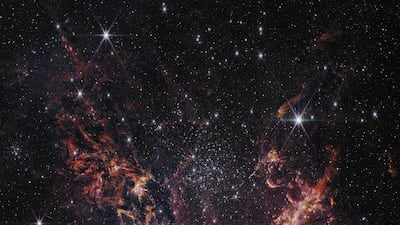
A cluster of stars in the Small Magellanic Cloud in an image taken by the James Webb Space Telescope. PA -

A colour composite image of the Messier 74 galaxy. Photo: Gabriel Brammer (Cosmic Dawn Center, Niels Bohr Institute, University of Copenhagen) / James Webb Space Telescope -
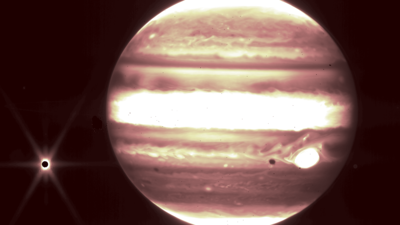
Jupiter and its moon Europa, left, are seen through the James Webb Space Telescope. Photo: Nasa -
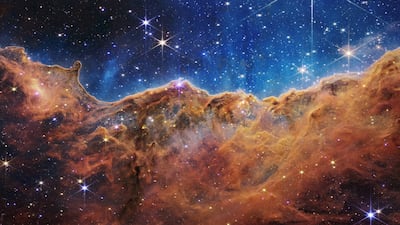
Captured in infrared light by Nasa's new James Webb Space Telescope, this image reveals areas of star birth in Carina Nebula. All photos: James Webb Space Telescope -

Known as Webb's First Deep Field, the picture showcases a galaxy cluster called SMACS 0723 as it appeared 4.6 billion years ago. The image was revealed by US President Joe Biden on July 11 during an event at the White House. -
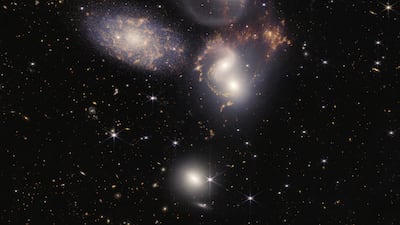
An image of Stephan's Quintet, an area in space with a group of five galaxies. -
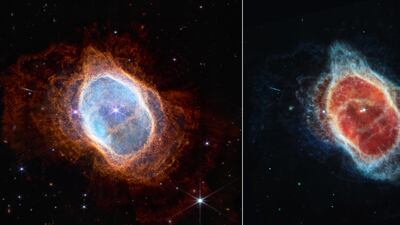
Side-by-side comparison shows observations of the Southern Ring Nebula in near-infrared light (left) and mid-infrared light. -

The telescope has captured the distinct signature of water, along with evidence for clouds and haze, in the atmosphere surrounding a hot, puffy gas giant planet orbiting a distant Sun-like star, called WASP-96 b. Photo: James Webb Space Telescope


“I think astronauts, especially in the United States, are sort of expected to be role models," Mr Lopez-Alegria said.
"And it's not really something that they necessarily want to be, but you realise that it's an important responsibility."
He said that “travelling into space forces you to recognise your strengths and accept your weaknesses as both an individual and a human”, with each mission allowing astronauts to engage in a journey of self-discovery and personal growth.
Mr Lopez-Alegria has high hopes for humanity's future.
“I think the future is bright,” he said. "We will see the retirement of the ISS probably by the end of this decade.
"At that point, we'll have at least one commercial space station in orbit where countries, pupils, researchers, entities beyond just the people that can use the ISS today, can use that platform.
“And again, this is a step towards democratising the experience.”
What's next for Mr Lopez-Alegria? Not even the sky is the limit.
“My dream is now: never stop dreaming,” he said
“I would love to be able to walk on the Moon in one of those spacesuits or at least check out an orbital spacesuit on the commercial Axiom Space Station some day.
"That would be a nice dream to come true.”


