
Washington has confirmed that Russia recently launched a weaponised satellite and placed it into the same orbit as a US government reconnaissance satellite, reigniting debate over the importance of keeping space neutral.
Pentagon spokesman Maj Gen Pat Ryder told reporters last week that the satellite was assessed to be “a counter-space weapon, presumably capable of attacking other satellites in low-Earth orbit”.
At the UN Security Council, the US accused Russia of developing satellites that have the potential to carry nuclear weapons.
Robert Wood, the deputy US ambassador to the UN, said the recent launch follows previous attempts to position counterspace systems – most recently in 2022 when a Russian satellite was observed releasing a projectile in the direction of another craft.
Kremlin spokesman Dmitry Peskov said Russia continues to “act absolutely in accordance with international law”.
There appears to be growing unease internationally about the potential weaponisation of space.
The Outer Space Treaty of 1967, to which the US and Russia are both signatories, banned the placement of weapons of mass destruction in Earth’s orbit, but many say the treaty needs to be updated as capabilities further develop and more countries become involved in space travel and exploration.
“It's kind of been acknowledged for quite some time now that maybe the Outer Space Treaty needs to be modernised, so to speak, to address the concerns that we're facing right now,” Krista Langeland, deputy director of Rand's Space Enterprise Initiative, told The National, adding that international working groups have been developed to define the need for norms and regulation.

“But it's been a really difficult process to get everybody on board with that … this [space weaponisation] has just been such a long-standing disagreement.”
This was most recently illustrated by tit-for-tat vetoes on the UN Security Council that highlighted the deepening rift over how to keep space neutral.
Rising geopolitical tension doesn't help, with the US, Russia and China - home to some of the world's biggest space programmes - often at loggerheads over a host of global issues, leading some to fear that the golden years of space co-operation following the Cold War that led to feats including the launch of the International Space Station may now be in the past.
Ms Langeland said that polarisation over the issue of weaponising space is not new and a major question lies in the definition of the term “weapon”.
“Trying to get a UN resolution that can get at space weapons when it's not entirely clear what space weapons are – certainly there's disagreement among UN participants, China and Russia on one side versus the US and its allies on the other,” she told The National.
There is not only the possibility of conventional weapons being put into space but about how seemingly benign objects or activities could be weaponised.
Ms Langeland gave the example of the increasingly important activity of debris removal, or clearing unusable satellites and other detritus from Earth's orbit to maintain a safe environment for satellites and spacecraft.
“That same capability can be used to drag other satellites or displace other satellites,” she said.
James Webb space images – in pictures
-
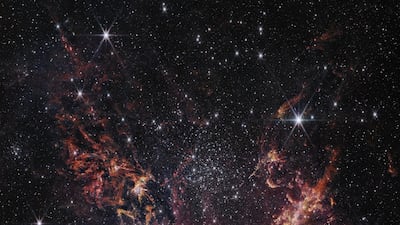
A cluster of stars in the Small Magellanic Cloud in an image taken by the James Webb Space Telescope. PA -
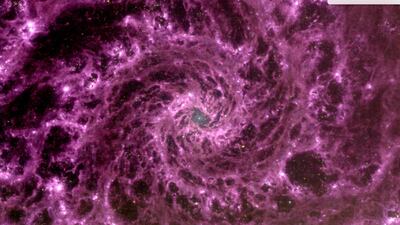
A colour composite image of the Messier 74 galaxy. Photo: Gabriel Brammer (Cosmic Dawn Center, Niels Bohr Institute, University of Copenhagen) / James Webb Space Telescope -
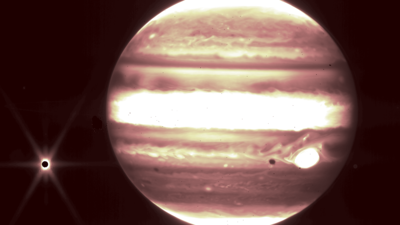
Jupiter and its moon Europa, left, are seen through the James Webb Space Telescope. Photo: Nasa -
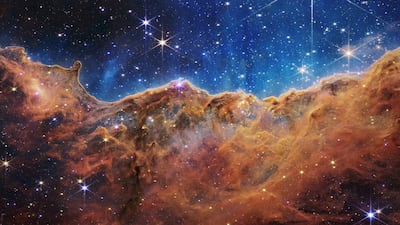
Captured in infrared light by Nasa's new James Webb Space Telescope, this image reveals areas of star birth in Carina Nebula. All photos: James Webb Space Telescope -

Known as Webb's First Deep Field, the picture showcases a galaxy cluster called SMACS 0723 as it appeared 4.6 billion years ago. The image was revealed by US President Joe Biden on July 11 during an event at the White House. -
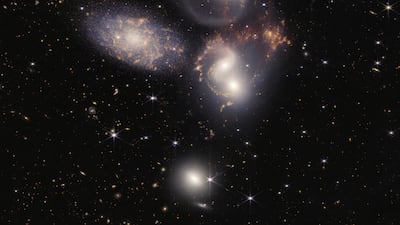
An image of Stephan's Quintet, an area in space with a group of five galaxies. -
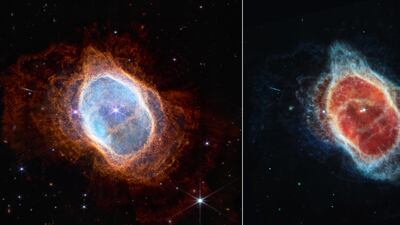
Side-by-side comparison shows observations of the Southern Ring Nebula in near-infrared light (left) and mid-infrared light. -

The telescope has captured the distinct signature of water, along with evidence for clouds and haze, in the atmosphere surrounding a hot, puffy gas giant planet orbiting a distant Sun-like star, called WASP-96 b. Photo: James Webb Space Telescope


“This is really at the heart of what is a very interesting problem: nobody can agree on what space weapons are.”
Something else nobody appears able to agree on is where deterrence stops and aggression begins.
US officials have repeatedly stressed that while Russia and China aim to turn space into a battlefield, Washington only wants to deter malign activity.
The Pentagon's Maj Gen Ryder said following the satellite launch by Russia that the US has “a responsibility to be ready to protect and defend the … space domain”.
Deputy defence secretary Kathleen Hicks said in January that the US was “committed to preventing conflict through deterrence by making clear to our competitors that the costs of aggression would far outweigh any conceivable benefits”.
Deterrence, however, often necessitates the development of weapons.
The Defence Advanced Research Projects Agency (Darpa) in September reached out to the private sector for “new methods and technologies that may provide warfighters with disruptive options for protecting and defending space systems across the competition continuum”.
“There's a lot of unknown unknowns about how we're going to use space and how space is going to, in the future, play into our daily lives and into our military capabilities,” Ms Langeland said.
“But it is increasingly recognised that space is a war-fighting domain – and not just that, but it's been acknowledged … that it is our most essential war-fighting domain.”

