The US should urgently provide Pakistan with additional military equipment as it counters a surge in attacks by the Pakistani Taliban, Islamabad’s envoy to Washington has said.
Ambassador Masood Khan also told The National that his country requires some $100 billion to adapt to the effects of climate change, which is wreaking havoc on the South Asian nation through deadly floods and heatwaves, and he called for the implementation of a “time-bound” two-state solution to end the Israeli-Palestinian conflict.
Pakistan has seen a sharp rise in attacks from the Pakistani Taliban, formally called the Tehreek-e-Taliban Pakistan (TTP), since the US left Afghanistan in 2021.
Islamabad says many of the assaults are launched from Afghan territory, something Kabul and the TTP deny.
“Our immediate need is equipment that would be helpful in fighting terrorism, the asymmetric threat from the Tehreek-e-Taliban Pakistan or other terrorists,” Mr Khan said in an interview at the Pakistan embassy in Washington.
“The TTP are using Afghan soil to mount attacks against Pakistan. In order to stop that, we need sniper rifles, night vision goggles, communication equipment. This has been part of our conversations with the United States, that in this area we should be helped.”
Tensions on the Afghanistan-Pakistan border have further increased since a ceasefire between the TTP and Islamabad unravelled in 2022, and Mr Khan considers the TTP the primary threat to Pakistan’s security.
According to the country's Institute for Conflict and Security Studies, Pakistan suffered 409 militant attacks in the first five months of 2024, an 83 per cent increase compared to the same period a year before.
Most of the attacks are happening in Khyber Pakhtunkhwa in the north-west and Balochistan in the south-west. While the TTP and the Afghan Taliban are ideologically similar, the TTP are seeking to purge Pakistan government control from Pashtun tribal lands and push an ultraconservative interpretation of Islam across Pakistan.
“The Afghan leadership has assured us that they would deter TTP from mounting these attacks against Pakistan,” Mr Khan said.
“They haven't succeeded yet, and we've had several rounds of conversations with them. And hopefully they would put the political will and operational arm behind their promises.”
Despite decades of security co-operation, the US-Pakistan relationship has seldom been straightforward, especially during the 20-year war in Afghanistan, when Washington accused Islamabad of playing a double game by supporting the Afghan Taliban while also benefiting from billions of dollars in US security assistance.
Relations hit a low point when, in 2018, then-president Donald Trump cut $1.3 billion in security assistance to Pakistan. Under the Biden administration, ties have improved slightly and in 2022 Congress authorised a $450 million sales package to sustain Pakistan’s fleet of F-16s.
“We welcomed that, and that was a very big signal. And we were hoping that there would be another sustainment package too. But that hasn't materialised yet,” Mr Khan said.
“Over the decades we bought many US defence platforms. For the army, for navy for air force, they need to be sustained therefore, we need spares. But we also need new equipment and new platforms, we need aircraft, we need helicopters, we need C-130s”.
Since the Taliban took power in 2021, Pakistan has argued that the security situation in Afghanistan has improved to the point that it is safe for Afghan refugees living along the Pakistan border region should return.
Last October, Pakistan announced the Illegal Foreigners’ Repatriation Plan that aims to expel 1.7 million refugees. Rights groups have said many of those being deported could face persecution in Afghanistan.
Mr Khan said members of the US Congress ask him about the plan. He said of the 4 million undocumented people living in Pakistan, 1.7 million “had to be sent back to Afghanistan”.
“The bulk of the Afghans who were in Pakistan, they went back to their homeland voluntarily, some 98 per cent. We didn't have to force them,” said Mr Khan, a Pakistani diplomat who previously served as ambassador to the UN.
“These are undocumented refugees who just would walk into Pakistan without any papers, without any registration in Pakistan. … We've been talking about this and explaining to the people here [in the US]“.
Climate change abatement and Pakistan's views on the Israel-Gaza war
Pakistan has been very vocal on Gaza, saying Israel should be held to account for any war crimes that it may have committed.
Mr Khan reiterated his country’s calls for a permanent ceasefire and for the establishment of multiple aid corridors to help Gazans.
He also called for a “time-bound formula” to guarantee progress towards a two-state solution.
“The United States can lead that effort to ensure the establishment of a Palestinian state and to make a two-state solution a reality,” he said.
Mr Khan said recent weather events in Pakistan illustrate the urgent need for nations to contribute to the Loss and Damage Fund that went into operation in 2022. The fund was established to help people in vulnerable communities recover from the effects of climate change.
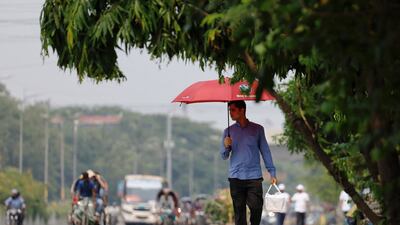
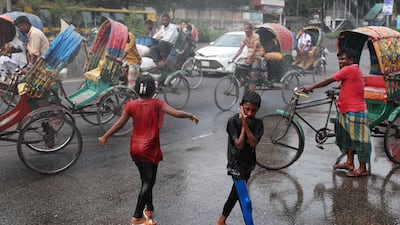
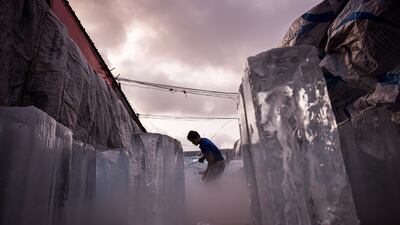
Jacobabad, in Sindh province, is one of the hottest cities on Earth, with temperatures last year touching 51°C. A deadly heatwave across South-east Asia has hit Pakistan hard, just two years after floods across the country caused more than $30 billion of damage.
“There are many ways in which we can mitigate these devastations over time. We need money,” he said.
“We need for this kind of transformation to a climate-resilient economy. We need at least $100 billion for renewables, for afforestation and so on.”
On the broader Pakistani economy, Mr Khan pointed to several sectors Islamabad is focusing on in terms of drawing greater foreign investment, including IT, mining, agriculture and energy.
Pakistan is on track to secure a new loan from the International Monetary Fund and macroeconomic factors are shifting in its favour as it works to boost its economy, the country's finance minister told The National in April.
Pakistan's stock market has been on a tear after reforms agreed to with the IMF, almost doubling in the past year to become the world’s top performer in dollar terms.
Islamabad is still finalising terms of a new loan from the IMF that reportedly could be as much $8 billion.
South Asia region battles unprecedented heatwaves – in pictures
Dengue%20fever%20symptoms
%3Cp%3EHigh%20fever%20(40%C2%B0C%2F104%C2%B0F)%3Cbr%3ESevere%20headache%3Cbr%3EPain%20behind%20the%20eyes%3Cbr%3EMuscle%20and%20joint%20pains%3Cbr%3ENausea%3Cbr%3EVomiting%3Cbr%3ESwollen%20glands%3Cbr%3ERash%26nbsp%3B%3C%2Fp%3E%0A
Who was Alfred Nobel?
The Nobel Prize was created by wealthy Swedish chemist and entrepreneur Alfred Nobel.
- In his will he dictated that the bulk of his estate should be used to fund "prizes to those who, during the preceding year, have conferred the greatest benefit to humankind".
- Nobel is best known as the inventor of dynamite, but also wrote poetry and drama and could speak Russian, French, English and German by the age of 17. The five original prize categories reflect the interests closest to his heart.
- Nobel died in 1896 but it took until 1901, following a legal battle over his will, before the first prizes were awarded.
Qosty Byogaani
Starring: Hani Razmzi, Maya Nasir and Hassan Hosny
Four stars
The years Ramadan fell in May
Who's who in Yemen conflict
Houthis: Iran-backed rebels who occupy Sanaa and run unrecognised government
Yemeni government: Exiled government in Aden led by eight-member Presidential Leadership Council
Southern Transitional Council: Faction in Yemeni government that seeks autonomy for the south
Habrish 'rebels': Tribal-backed forces feuding with STC over control of oil in government territory
The specs: 2019 Subaru Forester
Price, base: Dh105,900 (Premium); Dh115,900 (Sport)
Engine: 2.5-litre four-cylinder
Transmission: Continuously variable transmission
Power: 182hp @ 5,800rpm
Torque: 239Nm @ 4,400rpm
Fuel economy, combined: 8.1L / 100km (estimated)
Army of the Dead
Director: Zack Snyder
Stars: Dave Bautista, Ella Purnell, Omari Hardwick, Ana de la Reguera
Three stars
The five pillars of Islam
Timeline
2012-2015
The company offers payments/bribes to win key contracts in the Middle East
May 2017
The UK SFO officially opens investigation into Petrofac’s use of agents, corruption, and potential bribery to secure contracts
September 2021
Petrofac pleads guilty to seven counts of failing to prevent bribery under the UK Bribery Act
October 2021
Court fines Petrofac £77 million for bribery. Former executive receives a two-year suspended sentence
December 2024
Petrofac enters into comprehensive restructuring to strengthen the financial position of the group
May 2025
The High Court of England and Wales approves the company’s restructuring plan
July 2025
The Court of Appeal issues a judgment challenging parts of the restructuring plan
August 2025
Petrofac issues a business update to execute the restructuring and confirms it will appeal the Court of Appeal decision
October 2025
Petrofac loses a major TenneT offshore wind contract worth €13 billion. Holding company files for administration in the UK. Petrofac delisted from the London Stock Exchange
November 2025
180 Petrofac employees laid off in the UAE
Mercer, the investment consulting arm of US services company Marsh & McLennan, expects its wealth division to at least double its assets under management (AUM) in the Middle East as wealth in the region continues to grow despite economic headwinds, a company official said.
Mercer Wealth, which globally has $160 billion in AUM, plans to boost its AUM in the region to $2-$3bn in the next 2-3 years from the present $1bn, said Yasir AbuShaban, a Dubai-based principal with Mercer Wealth.
“Within the next two to three years, we are looking at reaching $2 to $3 billion as a conservative estimate and we do see an opportunity to do so,” said Mr AbuShaban.
Mercer does not directly make investments, but allocates clients’ money they have discretion to, to professional asset managers. They also provide advice to clients.
“We have buying power. We can negotiate on their (client’s) behalf with asset managers to provide them lower fees than they otherwise would have to get on their own,” he added.
Mercer Wealth’s clients include sovereign wealth funds, family offices, and insurance companies among others.
From its office in Dubai, Mercer also looks after Africa, India and Turkey, where they also see opportunity for growth.
Wealth creation in Middle East and Africa (MEA) grew 8.5 per cent to $8.1 trillion last year from $7.5tn in 2015, higher than last year’s global average of 6 per cent and the second-highest growth in a region after Asia-Pacific which grew 9.9 per cent, according to consultancy Boston Consulting Group (BCG). In the region, where wealth grew just 1.9 per cent in 2015 compared with 2014, a pickup in oil prices has helped in wealth generation.
BCG is forecasting MEA wealth will rise to $12tn by 2021, growing at an annual average of 8 per cent.
Drivers of wealth generation in the region will be split evenly between new wealth creation and growth of performance of existing assets, according to BCG.
Another general trend in the region is clients’ looking for a comprehensive approach to investing, according to Mr AbuShaban.
“Institutional investors or some of the families are seeing a slowdown in the available capital they have to invest and in that sense they are looking at optimizing the way they manage their portfolios and making sure they are not investing haphazardly and different parts of their investment are working together,” said Mr AbuShaban.
Some clients also have a higher appetite for risk, given the low interest-rate environment that does not provide enough yield for some institutional investors. These clients are keen to invest in illiquid assets, such as private equity and infrastructure.
“What we have seen is a desire for higher returns in what has been a low-return environment specifically in various fixed income or bonds,” he said.
“In this environment, we have seen a de facto increase in the risk that clients are taking in things like illiquid investments, private equity investments, infrastructure and private debt, those kind of investments were higher illiquidity results in incrementally higher returns.”
The Abu Dhabi Investment Authority, one of the largest sovereign wealth funds, said in its 2016 report that has gradually increased its exposure in direct private equity and private credit transactions, mainly in Asian markets and especially in China and India. The authority’s private equity department focused on structured equities owing to “their defensive characteristics.”
Company profile
Company: Verity
Date started: May 2021
Founders: Kamal Al-Samarrai, Dina Shoman and Omar Al Sharif
Based: Dubai
Sector: FinTech
Size: four team members
Stage: Intially bootstrapped but recently closed its first pre-seed round of $800,000
Investors: Wamda, VentureSouq, Beyond Capital and regional angel investors
Jetour T1 specs
Engine: 2-litre turbocharged
Power: 254hp
Torque: 390Nm
Price: From Dh126,000
Available: Now
Specs%3A%202024%20McLaren%20Artura%20Spider
%3Cp%3E%3Cstrong%3EEngine%3A%3C%2Fstrong%3E%203.0-litre%20twin-turbo%20V6%20and%20electric%20motor%3Cbr%3E%3Cstrong%3EMax%20power%3A%3C%2Fstrong%3E%20700hp%20at%207%2C500rpm%3Cbr%3E%3Cstrong%3EMax%20torque%3A%3C%2Fstrong%3E%20720Nm%20at%202%2C250rpm%3Cbr%3E%3Cstrong%3ETransmission%3A%3C%2Fstrong%3E%20Eight-speed%20dual-clutch%20auto%3Cbr%3E%3Cstrong%3E0-100km%2Fh%3A%3C%2Fstrong%3E%203.0sec%3Cbr%3E%3Cstrong%3ETop%20speed%3A%20%3C%2Fstrong%3E330kph%3Cbr%3E%3Cstrong%3EPrice%3A%3C%2Fstrong%3E%20From%20Dh1.14%20million%20(%24311%2C000)%3Cbr%3E%3Cstrong%3EOn%20sale%3A%3C%2Fstrong%3E%20Now%3C%2Fp%3E%0A
CABINET%20OF%20CURIOSITIES%20EPISODE%201%3A%20LOT%2036
%3Cp%3E%3Cstrong%3EDirector%3A%20%3C%2Fstrong%3EGuillermo%20del%20Toro%3Cbr%3E%3Cstrong%3EStars%3A%3C%2Fstrong%3E%20Tim%20Blake%20Nelson%2C%20Sebastian%20Roche%2C%20Elpidia%20Carrillo%3Cbr%3ERating%3A%204%2F5%3C%2Fp%3E%0A
Will the pound fall to parity with the dollar?
The idea of pound parity now seems less far-fetched as the risk grows that Britain may split away from the European Union without a deal.
Rupert Harrison, a fund manager at BlackRock, sees the risk of it falling to trade level with the dollar on a no-deal Brexit. The view echoes Morgan Stanley’s recent forecast that the currency can plunge toward $1 (Dh3.67) on such an outcome. That isn’t the majority view yet – a Bloomberg survey this month estimated the pound will slide to $1.10 should the UK exit the bloc without an agreement.
New Prime Minister Boris Johnson has repeatedly said that Britain will leave the EU on the October 31 deadline with or without an agreement, fuelling concern the nation is headed for a disorderly departure and fanning pessimism toward the pound. Sterling has fallen more than 7 per cent in the past three months, the worst performance among major developed-market currencies.
“The pound is at a much lower level now but I still think a no-deal exit would lead to significant volatility and we could be testing parity on a really bad outcome,” said Mr Harrison, who manages more than $10 billion in assets at BlackRock. “We will see this game of chicken continue through August and that’s likely negative for sterling,” he said about the deadlocked Brexit talks.
The pound fell 0.8 per cent to $1.2033 on Friday, its weakest closing level since the 1980s, after a report on the second quarter showed the UK economy shrank for the first time in six years. The data means it is likely the Bank of England will cut interest rates, according to Mizuho Bank.
The BOE said in November that the currency could fall even below $1 in an analysis on possible worst-case Brexit scenarios. Options-based calculations showed around a 6.4 per cent chance of pound-dollar parity in the next one year, markedly higher than 0.2 per cent in early March when prospects of a no-deal outcome were seemingly off the table.
Bloomberg