US President Joe Biden steps off Marine One in Chicago, Illinois. AFP

US will stop sending weapons to Israel if it launches Rafah invasion, Biden says


  • English
  • Arabic

Live updates: Follow the latest on Israel-Gaza

President Joe Biden said on Wednesday that he would stop shipments of US weapons to Israel if Prime Minister Benjamin Netanyahu orders a major invasion of the southern Gaza city of Rafah.

The decision comes after Mr Biden and members of his administration spent months trying to persuade Israel to do more to reduce civilian casualties in Gaza, where about 35,000 people have been killed since the October 7 Hamas-led attacks triggered the war.

Israel has seemed to shrug off any US pressure, insisting it must use maximum force to wipe out Hamas, while Mr Biden has faced domestic fury from critics who have accused him of supporting what they call Israel's "genocide" in Gaza.

So Mr Biden is now using the most powerful leverage he has by threatening to stop the supply of American weapons.

“I made it clear that if they go into Rafah – they haven’t gone in Rafah yet – if they go into Rafah, I’m not supplying the weapons that have been used historically to deal with Rafah, to deal with the cities,” Mr Biden told CNN.

The decision could be historic moment in the war in Gaza and in America's longstanding security relationship with Israel, which benefits from about $3.8 billion in annual military funding, with much more on the way.

It also signals Mr Biden's most public break with Mr Netanyahu, though the President stressed that other aspects of US military support for Israel would continue, such as replenishing the Iron Dome anti-missile system.

Israel this week said it was conducting a limited military operation to gain control of the Rafah border crossing on the Gaza side, much to the anger of the international humanitarian community, which says this would block aid deliveries aimed at curbing the risk of famine.

Mr Biden has faced growing criticism for his support of Israel by many in the US, including members of his own Democratic Party, the Arab-American community and students, posing a threat to his bid for re-election this November.

He also said that US weapons have killed civilians in Gaza.

“Civilians have been killed in Gaza as a consequence of those bombs and other ways in which they go after population centres,” Mr Biden said, referring to the 2,000-pound bombs that the US paused shipments of last week.

The Pentagon said earlier on Wednesday that a shipment of “high-payload munitions” to Israel had been delayed, demanding it do more to protect civilians as it increases combat operations around Rafah.

Washington last month passed a foreign aid package that allocated about $26 billion for Israel.

Mr BIden also touched on the nationwide protests on campuses against the war in Gaza, with students calling for their universities to divest from Israel's actions in the Palestinian territories.

“There's a legitimate right to free speech and protest,” Mr Biden said.

“As always, you have a right to do that.”

But he repeated his administration's warning that anti-Semitism and hate speech should not be allowed on campus.

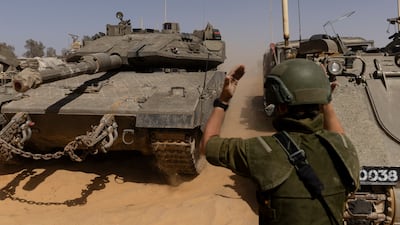
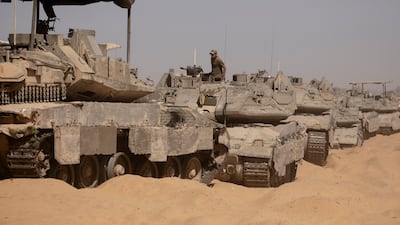
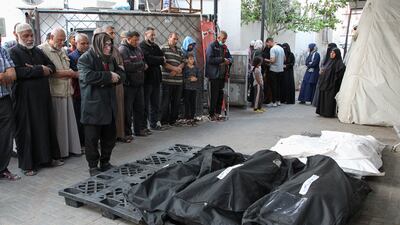
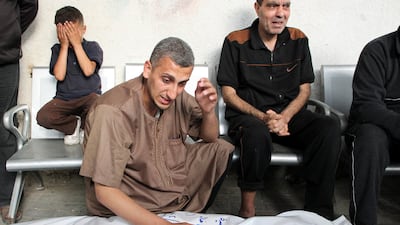
Civilians ordered to flee eastern Rafah as Israel begins invasion - in pictures

  • An Israeli soldier directs a tank near Israel's border with southern Gaza. Getty Images
    An Israeli soldier directs a tank near Israel's border with southern Gaza. Getty Images
  • An Israeli soldier stands on a tank in southern Israel. Getty Images
    An Israeli soldier stands on a tank in southern Israel. Getty Images
  • People flee the eastern parts of Rafah ahead of a threatened Israeli incursion. Reuters
    People flee the eastern parts of Rafah ahead of a threatened Israeli incursion. Reuters
  • Palestinians leave ahead of a threatened assault on Rafah. Reuters
    Palestinians leave ahead of a threatened assault on Rafah. Reuters
  • Palestinians search for casualties in the rubble of a house destroyed in an Israeli strike in Rafah. AFP
    Palestinians search for casualties in the rubble of a house destroyed in an Israeli strike in Rafah. AFP
  • Palestinians carry an injured man who was pulled from the rubble of a house destroyed in an Israeli strike in Rafah. AFP
    Palestinians carry an injured man who was pulled from the rubble of a house destroyed in an Israeli strike in Rafah. AFP
  • Mourners next to the bodies of Palestinians killed in an Israeli strike in southern Gaza. Reuters
    Mourners next to the bodies of Palestinians killed in an Israeli strike in southern Gaza. Reuters
  • Mourners at Abu Yousef El-Najjar Hospital in Rafah. Reuters
    Mourners at Abu Yousef El-Najjar Hospital in Rafah. Reuters
What can victims do?

Always use only regulated platforms

Stop all transactions and communication on suspicion

Save all evidence (screenshots, chat logs, transaction IDs)

Report to local authorities

Warn others to prevent further harm

Courtesy: Crystal Intelligence

RESULT

Manchester United 1 Brighton and Hove Albion 0
Man United: Dunk (66' og)

Man of the Match: Shane Duffy (Brighton)

Like a Fading Shadow

Antonio Muñoz Molina

Translated from the Spanish by Camilo A. Ramirez

Tuskar Rock Press (pp. 310)

Nick's journey in numbers

Countries so far: 85

Flights: 149

Steps: 3.78 million

Calories: 220,000

Floors climbed: 2,000

Donations: GPB37,300

Prostate checks: 5

Blisters: 15

Bumps on the head: 2

Dog bites: 1

Springtime in a Broken Mirror,
Mario Benedetti, Penguin Modern Classics


Our Time Has Come
Alyssa Ayres, Oxford University Press

Dubai Bling season three

Cast: Loujain Adada, Zeina Khoury, Farhana Bodi, Ebraheem Al Samadi, Mona Kattan, and couples Safa & Fahad Siddiqui and DJ Bliss & Danya Mohammed 

Rating: 1/5

Sam Smith

Where: du Arena, Abu Dhabi

When: Saturday November 24

Rating: 4/5

Ten tax points to be aware of in 2026

1. Domestic VAT refund amendments: request your refund within five years

If a business does not apply for the refund on time, they lose their credit.

2. E-invoicing in the UAE

Businesses should continue preparing for the implementation of e-invoicing in the UAE, with 2026 a preparation and transition period ahead of phased mandatory adoption. 

3. More tax audits

Tax authorities are increasingly using data already available across multiple filings to identify audit risks. 

4. More beneficial VAT and excise tax penalty regime

Tax disputes are expected to become more frequent and more structured, with clearer administrative objection and appeal processes. The UAE has adopted a new penalty regime for VAT and excise disputes, which now mirrors the penalty regime for corporate tax.

5. Greater emphasis on statutory audit

There is a greater need for the accuracy of financial statements. The International Financial Reporting Standards standards need to be strictly adhered to and, as a result, the quality of the audits will need to increase.

6. Further transfer pricing enforcement

Transfer pricing enforcement, which refers to the practice of establishing prices for internal transactions between related entities, is expected to broaden in scope. The UAE will shortly open the possibility to negotiate advance pricing agreements, or essentially rulings for transfer pricing purposes. 

7. Limited time periods for audits

Recent amendments also introduce a default five-year limitation period for tax audits and assessments, subject to specific statutory exceptions. While the standard audit and assessment period is five years, this may be extended to up to 15 years in cases involving fraud or tax evasion. 

8. Pillar 2 implementation 

Many multinational groups will begin to feel the practical effect of the Domestic Minimum Top-Up Tax (DMTT), the UAE's implementation of the OECD’s global minimum tax under Pillar 2. While the rules apply for financial years starting on or after January 1, 2025, it is 2026 that marks the transition to an operational phase.

9. Reduced compliance obligations for imported goods and services

Businesses that apply the reverse-charge mechanism for VAT purposes in the UAE may benefit from reduced compliance obligations. 

10. Substance and CbC reporting focus

Tax authorities are expected to continue strengthening the enforcement of economic substance and Country-by-Country (CbC) reporting frameworks. In the UAE, these regimes are increasingly being used as risk-assessment tools, providing tax authorities with a comprehensive view of multinational groups’ global footprints and enabling them to assess whether profits are aligned with real economic activity. 

Contributed by Thomas Vanhee and Hend Rashwan, Aurifer

Updated: May 09, 2024, 6:50 AM