


Live updates: Follow the latest on Israel-Gaza
After participating in a pro-Palestine protest at Columbia University in New York, Lebanese-American student Yasmine was detained by police — the first mass arrest on a US campus that has since ignited a student anti-war movement.
"What got me to protest was the disappointment with everything that was happening in the last six months [in Gaza] and feeling extremely helpless," Yasmine, who asked to be identified only by her first name, told The National.
With only two months left until graduation, Yasmine was suspended and is unsure whether she will be able to complete her degree in time.
She has to appear in court on May 8 for a 'violation' charge.
More than 100 students at Columbia were arrested last week for refusing to dismantle a protest encampment on the university’s main campus.
Part of a larger group advocating Palestinian rights, the students set up the camp on the central lawn of the school's upper Manhattan campus as a form of peaceful protest against what they describe as Israel's unjust actions against Palestinians.
The students have declared their intention to stay until the university agrees to divest from companies linked to Israel, ensure financial transparency and grant amnesty for faculty members connected to protests.
“We don't actually know what Colombia invests in and that's part of our tuition,” Yasmine said.
She added that the images of Palestinian suffering amid the siege of Gaza, as well as in the occupied West Bank, had left many students feeling powerless and the encampment was a response to the administration ignoring their demands.
“We are heart-broken by what's happening in Palestine every day,” she said.
“The essential goal is to divest funding from Israeli apartheid and to shed light on what's happening in Palestine.
Pro-Palestine protests at US universities – in pictures
-

Activists and students take part in an encampment protest at George Washington University, in Washington. AFP -
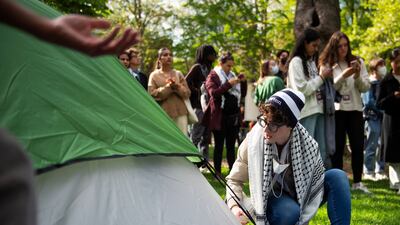
Students and faculty of Drexel University and University of Pennsylvania erect an encapment to protest against the war in Gaza, at the University of Pennsylvania campus, in Philadelphia. AFP -
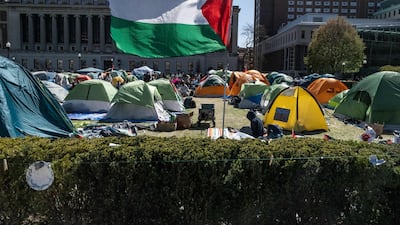
Columbia University students continue their demonstration on campus afterlast week's arrest of more than 100 protesters, in New York City. Getty Images -
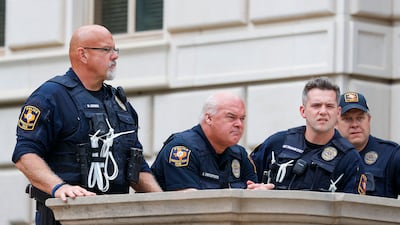
Police watch as students and faculty show support at a Protect Palestine Rally at the University of Texas, in Austin. EPA -
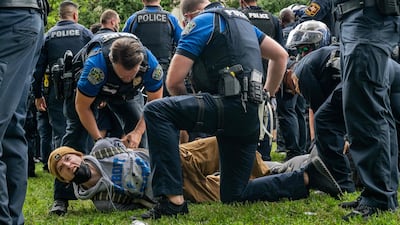
A student is arrested during a pro-Palestine demonstration at the University of Texas at Austin. Getty Images -
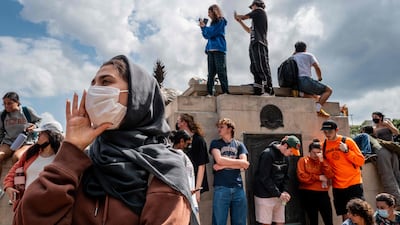
Students rally at the University of Texas at Austin, where police arrested scores of protesters. Getty images -
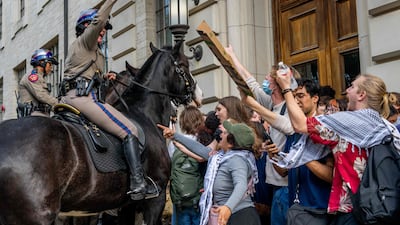
Mounted police confront students protesting against the war in Gaza, at the University of Texas at Austin. Getty Images -
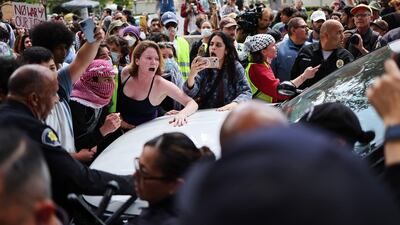
Pro-Palestine demonstrators argue with University of Southern California officials, who attempted to take down an encampment set up in support of Gaza, at the institution in Los Angeles. Getty images -
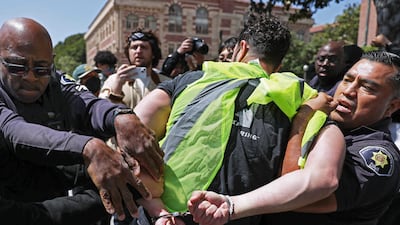
University of Southern California police officers detain a pro-Palestine demonstrator. Getty Images -
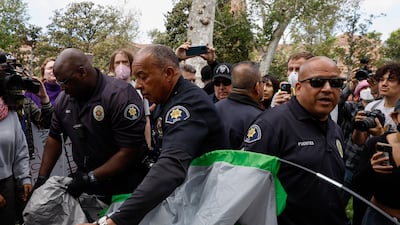
University of Southern California officers dismantle protesters' tents. EPA -
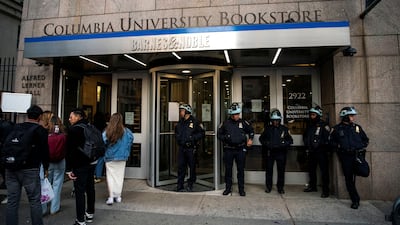
Police stand guard at an entrance to Columbia University, in New York City, where students continue to protest in support of Palestinians, amid the war in Gaza. Reuters -
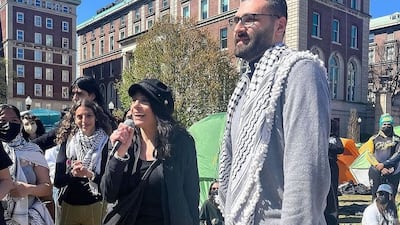
Najla Said, daughter of Palestinian-American academic and literary critic Edward Said, and Motaz Azaiza, a Palestinian photojournalist from Gaza, join the Gaza solidarity encampment at Columbia University. Photo: Columbia Students for Justice in Palestine -
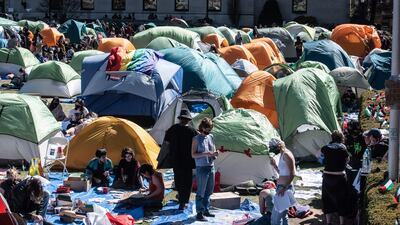
As the campus protests continue, Columbia has moved its classes online. AFP -
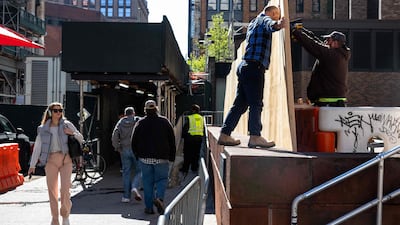
Workers erect a wooden barrier at New York University Stern School of Business after an encampment set up by students was cleared out on Monday night. Getty Images -
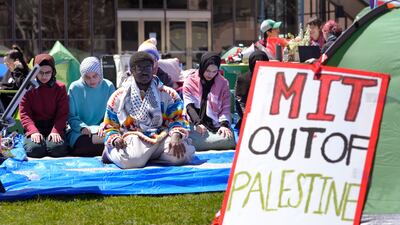
Massachusetts Institute of Technology student Isa Liggans, front left, takes part in Muslim prayer with others, at an encampment of tents at the college, in Cambridge, Massachusetts. AP -
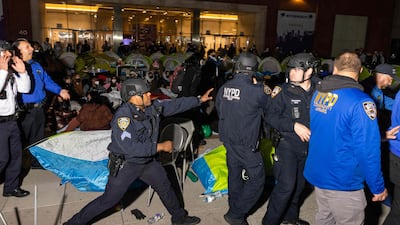
Police officers disperse pro-Palestinian students and protesters who set up an encampment on the campus of New York University. AFP -
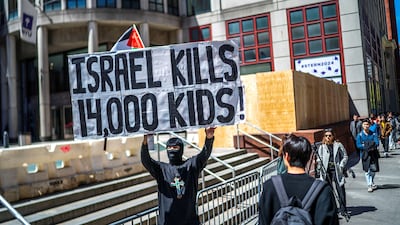
A protester outside New York University. Reuters -
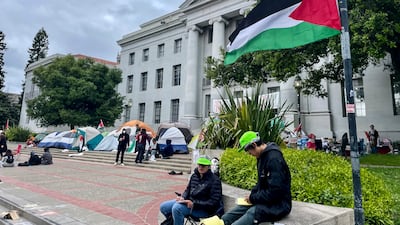
Pro-Palestinian protesters gather in front of Sproul Hall on the campus of the University of California, Berkeley. AP -
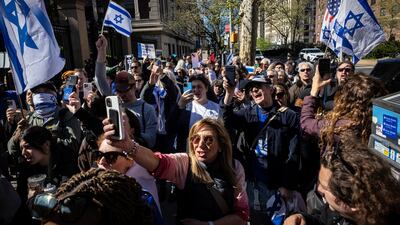
Pro-Israeli demonstrators chant 'shame' after Columbia University assistant professor Shai Davidai was denied access to the main campus. AP -
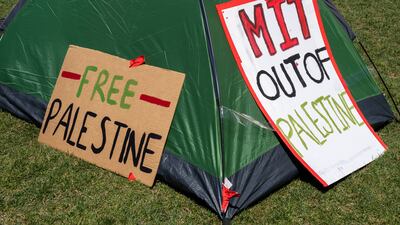
A tent used by pro-Palestinian demonstrators at MIT. Bloomberg -
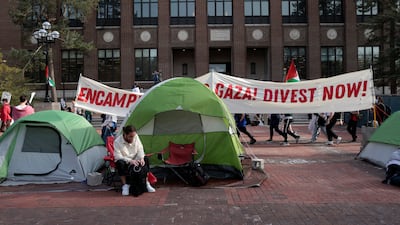
A coalition of University of Michigan students rally to pressure the university to divest its endowment from companies that support Israel. Reuters -
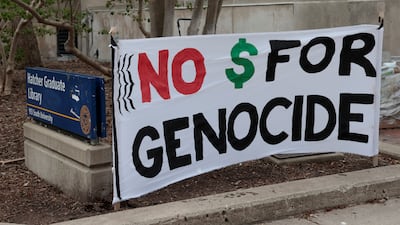
A sign at the University of Michigan. Reuters -
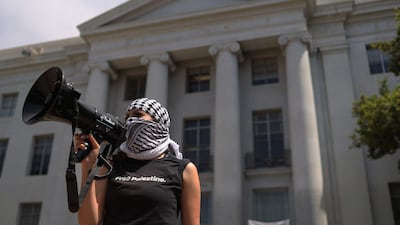
A pro-Palestinian protester in front of Sproul Hall in Berkeley, California. Getty Images / AP -
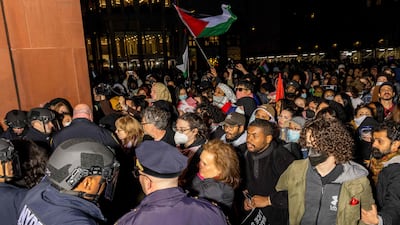
Police officers detain pro-Palestinian students and protesters at New York University. AFP -
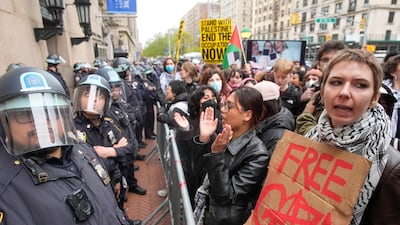
Police in Riot gear stand guard as demonstrators chant slogans outside the Columbia University campus. AP -
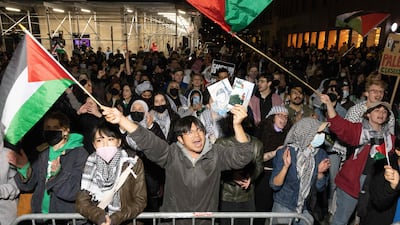
Pro-Palestinian students and activists protest against the Israel-Gaza war on the campus of New York University. AFP


“Especially coming from, like, in America, which is Israel's number-one supporter, and gives it a carte blanche to do whatever it wants and break as many international laws as it wants.”
A resident fellow at Yale Law School, who asked to remain anonymous, told The National “divesting from weapons manufacturers is actually a low bar – that's what makes these protests so potentially explosive”.
In November, Columbia suspended the groups Students for Justice in Palestine and Jewish Voice for Peace, which had organised the protest, for the rest of the autumn term, citing repeated breaches of school policies.
“They are still barred this term,” said Yasmine.
“Even though at every protest, there had been counter-protesters with students who stand with Israel, and who faced no backlash for also being there.
“It's a bit of a double standard in terms of how the institution has actually dealt with this.”
The protest at Columbia coincided with university president Nemat Shafik's appearance before Congress, during which she was grilled on Columbia's approach to fighting on-campus anti-Semitism.
During the Republican-led House committee hearing, Ms Shafik promised to address unauthorised protests more rigorously.
Protests continue at Columbia University after pro-Palestine encampment arrests – video
The protest, which began peacefully, escalated when participants refused to comply with university officials' orders to vacate the premises.
The next day, Ms Shafik enlisted the New York Police Department to remove the encampment, leading to more than 100 arrests and numerous student suspensions.
The incident has raised concerns in the Columbia community over the suppression of free debate, which is fundamental to the US educational ethos.
According to Mohamad Bazzi, director of the Kevorkian Centre for Near Eastern Studies at New York University, Columbia and Barnard College have been the most extreme examples where dozens of protesting students are facing disciplinary action.
“Students have lost their housing; they've been denied access to student housing. They might not be allowed to finish the term,” he told The National.
He added that the pillars of freedom of speech and liberty to protest are “definitely under assault” at these institutions.
“America's campuses and universities, especially for pro-Palestine speech … that’s been the dividing line that we've seen in the past few months.”
When asked if the protests were making life unsafe for Jewish students on campuses, Yasmine strongly disagreed.
“Most of the people who were with me in my jail cell were Jewish. The people on the encampment are from so many different backgrounds, like Arab, Jewish, Muslim, Christian, Black, South-East Asian … it's very diverse.”

Helga Tawil-Srouri, associate fellow at NYU who has been at the school's encampment since it was set up on Monday morning, told The National administrators are “not holding up” their promises of academic freedom, freedom of assembly and freedom of speech.
“They're also being obviously very, very duplicitous and hypocritical about who can have such freedoms and who can't, and it kind of portrays very deep, fundamental kinds of problems about how university administrations deal with their own people,” she said.
“The students are really quite amazing in their own way. I think they're very politically aware, very politically astute. They're very … uncompromising, if I can say that, and they're willing to take a stand.”
Mr Bazzi noted that high-ranking staff within US universities are increasingly apprehensive over a potential backlash from Congress.
Only a few months before Ms Shafik appeared at the hearing, two university presidents who had also come under the congressional microscope over on-campus anti-Semitism resigned.
The resident fellow at Yale Law School said that when it comes to Israel, “there are sensitivities that are highly problematic”.
“Not only the establishment leaders in universities and key positions tend to not be representative of the broader public opinion, much less than a university student bodies opinion,” he said.
“But also, you have the entire donor class that is uniquely invested in the idea of Israel and the continuation of Israel's role of dominance, oppression in the region.
“What makes these protests really interesting is because they hold the potential to move the needle on some on this issue that is very, very intractable.”
He said it has become obvious that the “injustices” experienced by Palestinians are “irreconcilable with the stated values of western society”.
Despite the challenges, Yasmine has no regrets.
“It's created such a huge movement across campuses around the US,” she said.
“I feel it's kind of brought some inspiration and hope for a lot of people. And that's 100 per cent worth it for me.”

