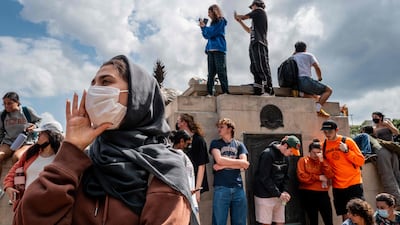
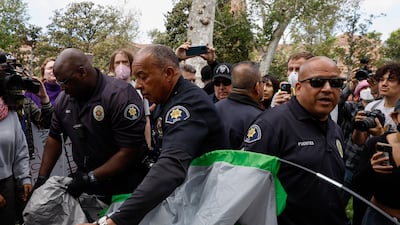
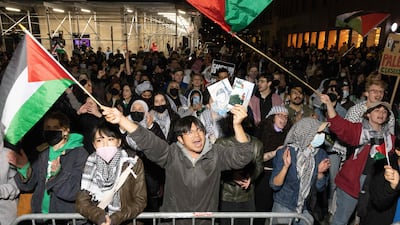
US House Speaker Mike Johnson near the pro-Palestinian student gathering at Columbia University in New York City on Wednesday. AFP

Palestine protesters at Columbia University face National Guard threats


Patrick deHahn
  • English
  • Arabic

Live updates: Follow the latest on Israel-Gaza

US House Speaker Mike Johnson visited Columbia University on Wednesday and suggested the National Guard should be called in to clear what he called anti-Semitic protests against Israel's war in Gaza.

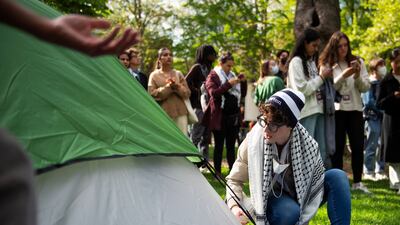
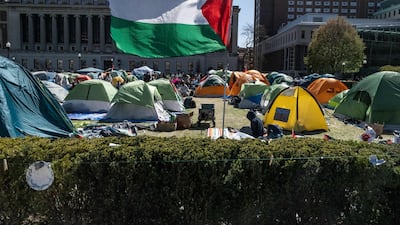
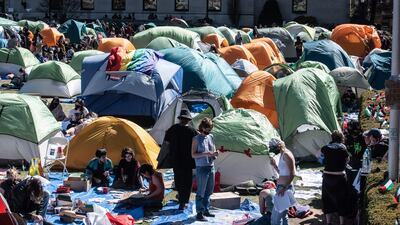
“There is an appropriate time for the National Guard,” Mr Johnson said in remarks just steps from a pro-Palestine protest camp, which has been a focal point for a fast-growing anti-war movement at universities across the US.

His comments echo those of Tom Cotton and Josh Hawley, two far-right Republican senators who this week advocated for the National Guard to be sent.

Republicans and protest critics say demonstrators, many of whom are Jewish, are being anti-Semitic by criticising Israel's actions in the Gaza Strip, where health authorities say more than 34,200 people have been killed.

“We just can't allow this kind of hatred and anti-Semitism to flourish on our campuses,” Mr Johnson said.

“It must be stopped in its tracks. Those who are perpetrating this violence should be arrested.”

He was joined by fellow Republican representatives Nicole Malliotakis, Mike Lawler and Virginia Foxx, all of whom were met with loud boos from protesters.

They said they spoke to Jewish students who told them they are “in fear” and have dealt with bullying.

“This simple truth is neither Israel nor these Jewish students on this campus will ever stand alone,” Mr Johnson said.

The Republican House leader also said they met Columbia University President Nemat Shafik and other school administrators.

Mr Johnson suggested that she should resign “if she cannot immediately bring order to this chaos”.

On Tuesday evening, Ms Shafik said in a statement that “a small group of faculty, administrators, and University Senators … [were] in dialogue with student organisers to discuss the basis for dismantling the encampment, dispersing and following university policies going forward”.

She said the university would “have to consider alternative options for clearing the West Lawn and restoring calm” if an agreement is not reached.

Student protest organisers claimed that university leaders “threatened … to call both the National Guard and NYPD if we do not acquiesce to their demands”, and negotiators left discussions as a result.

Columbia said the claim was “untrue” and “unsubstantiated”.

A university cannot request the National Guard be brought in. Only a state governor has that authority.

Organisers referred to the Kent State shootings, an indelible moment in US protest history when National Guard troops shot into an anti-Vietnam War campus protest in Ohio in 1970 and killed four students.

Organisers later issued a new statement saying they had received a “written commitment and concession not to call the NYPD or the National Guard”, calling it an “important victory”.

Columbia said discussions will continue for at least 48 hours.

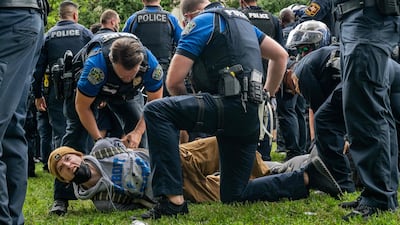
Columbia's protest – and the university-ordered police arrests of more than 100 people last week – have inspired student protest camps and pro-Palestine demonstrations at university campuses across the US.

“This is a deeply painful, painful moment for many communities,” White House press secretary Karine Jean-Pierre said.

Most of the student protests have called for their schools to divest from companies working with Israel, shut down academic relations with Israeli institutions and a ceasefire in Gaza.

“The President believes that free-speech debate and non-discrimination on college campuses are important – they're important American values,” Ms Jean-Pierre said.

The new movement has drawn the attention of Israeli Prime Minister Benjamin Netanyahu.

“What’s happening in America’s college campuses is horrific. Anti-Semitic mobs have taken over leading universities,” he said in a video on Wednesday.

“It’s unconscionable. It has to be stopped. It has to be condemned and condemned unequivocally.”

Universities have seen anti-Semitic and Islamophobic incidents since Israel launched its war in Gaza in response to the October 7 Hamas-led attacks. which Israel says killed about 1,200 people.

Pro-Israel supporters say that criticism of the country is an attack on Jewish people.

But many pro-Palestine campus gatherings have Jewish students taking part, and others are led by Jewish Voice for Peace affiliates.

“I think that it's a really clear, repressive tactic meant to attempt to silence and chill us,” New York University graduate student Alana told The National.

She said she was Jewish and took part in similar anti-war protests calling for divestment at New York University.

“They can use various forms of anti-hatred, anti-Semitic law, different modes of legalised attack on our movement by calling it anti-Semitic, even though a large percentage of every single Palestine protest is Jewish and young Jews,” Alana said.

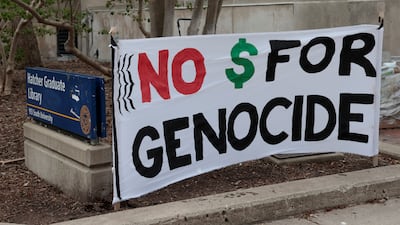
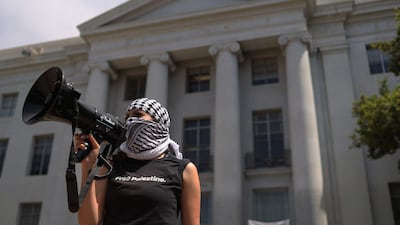
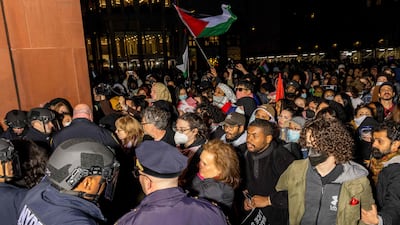
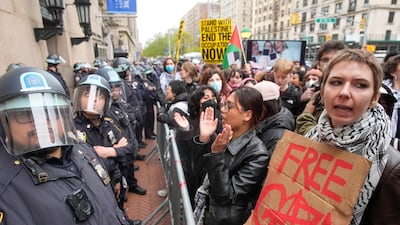
Pro-Palestine protests at US universities – in pictures

  • Activists and students take part in an encampment protest at George Washington University, in Washington. AFP
    Activists and students take part in an encampment protest at George Washington University, in Washington. AFP
  • Students and faculty of Drexel University and University of Pennsylvania erect an encapment to protest against the war in Gaza, at the University of Pennsylvania campus, in Philadelphia. AFP
    Students and faculty of Drexel University and University of Pennsylvania erect an encapment to protest against the war in Gaza, at the University of Pennsylvania campus, in Philadelphia. AFP
  • Columbia University students continue their demonstration on campus afterlast week's arrest of more than 100 protesters, in New York City. Getty Images
    Columbia University students continue their demonstration on campus afterlast week's arrest of more than 100 protesters, in New York City. Getty Images
  • Police watch as students and faculty show support at a Protect Palestine Rally at the University of Texas, in Austin. EPA
    Police watch as students and faculty show support at a Protect Palestine Rally at the University of Texas, in Austin. EPA
  • A student is arrested during a pro-Palestine demonstration at the University of Texas at Austin. Getty Images
    A student is arrested during a pro-Palestine demonstration at the University of Texas at Austin. Getty Images
  • Students rally at the University of Texas at Austin, where police arrested scores of protesters. Getty images
    Students rally at the University of Texas at Austin, where police arrested scores of protesters. Getty images
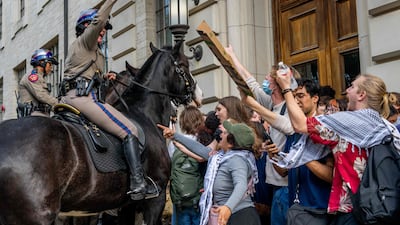
  • Mounted police confront students protesting against the war in Gaza, at the University of Texas at Austin. Getty Images
    Mounted police confront students protesting against the war in Gaza, at the University of Texas at Austin. Getty Images
  • Pro-Palestine demonstrators argue with University of Southern California officials, who attempted to take down an encampment set up in support of Gaza, at the institution in Los Angeles. Getty images
    Pro-Palestine demonstrators argue with University of Southern California officials, who attempted to take down an encampment set up in support of Gaza, at the institution in Los Angeles. Getty images
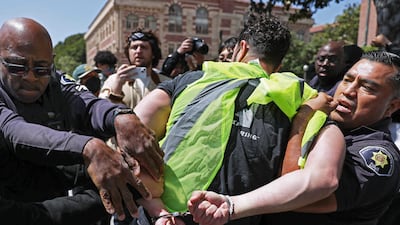
  • University of Southern California police officers detain a pro-Palestine demonstrator. Getty Images
    University of Southern California police officers detain a pro-Palestine demonstrator. Getty Images
  • University of Southern California officers dismantle protesters' tents. EPA
    University of Southern California officers dismantle protesters' tents. EPA
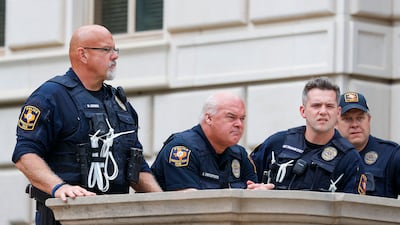
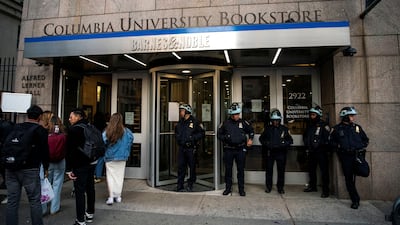
  • Police stand guard at an entrance to Columbia University, in New York City, where students continue to protest in support of Palestinians, amid the war in Gaza. Reuters
    Police stand guard at an entrance to Columbia University, in New York City, where students continue to protest in support of Palestinians, amid the war in Gaza. Reuters
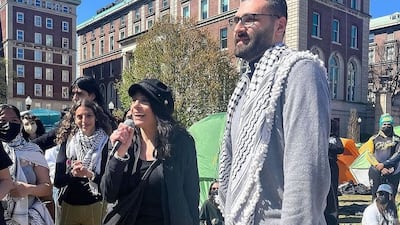
  • Najla Said, daughter of Palestinian-American academic and literary critic Edward Said, and Motaz Azaiza, a Palestinian photojournalist from Gaza, join the Gaza solidarity encampment at Columbia University. Photo: Columbia Students for Justice in Palestine
    Najla Said, daughter of Palestinian-American academic and literary critic Edward Said, and Motaz Azaiza, a Palestinian photojournalist from Gaza, join the Gaza solidarity encampment at Columbia University. Photo: Columbia Students for Justice in Palestine
  • As the campus protests continue, Columbia has moved its classes online. AFP
    As the campus protests continue, Columbia has moved its classes online. AFP
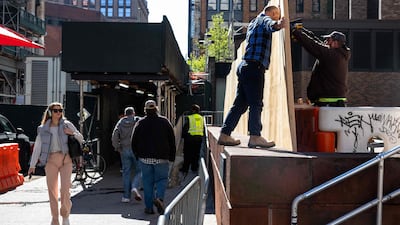
  • Workers erect a wooden barrier at New York University Stern School of Business after an encampment set up by students was cleared out on Monday night. Getty Images
    Workers erect a wooden barrier at New York University Stern School of Business after an encampment set up by students was cleared out on Monday night. Getty Images
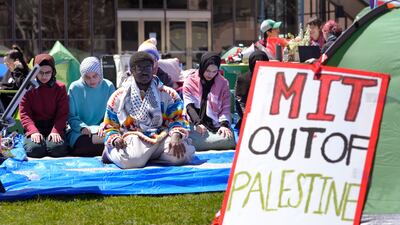
  • Massachusetts Institute of Technology student Isa Liggans, front left, takes part in Muslim prayer with others, at an encampment of tents at the college, in Cambridge, Massachusetts. AP
    Massachusetts Institute of Technology student Isa Liggans, front left, takes part in Muslim prayer with others, at an encampment of tents at the college, in Cambridge, Massachusetts. AP
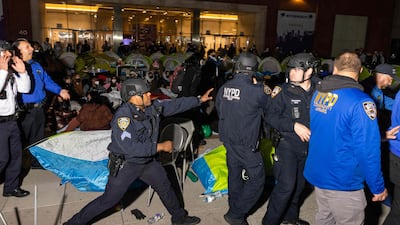
  • Police officers disperse pro-Palestinian students and protesters who set up an encampment on the campus of New York University. AFP
    Police officers disperse pro-Palestinian students and protesters who set up an encampment on the campus of New York University. AFP
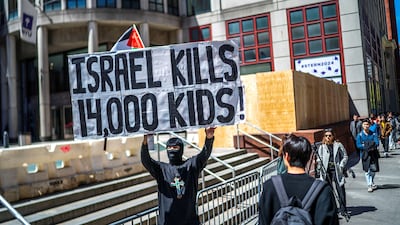
  • A protester outside New York University. Reuters
    A protester outside New York University. Reuters
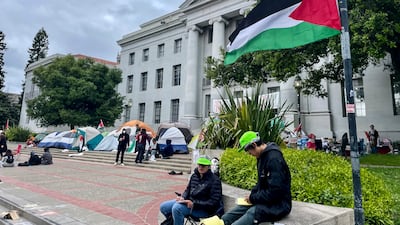
  • Pro-Palestinian protesters gather in front of Sproul Hall on the campus of the University of California, Berkeley. AP
    Pro-Palestinian protesters gather in front of Sproul Hall on the campus of the University of California, Berkeley. AP
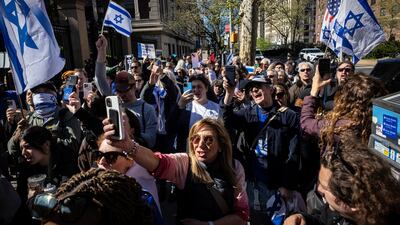
  • Pro-Israeli demonstrators chant 'shame' after Columbia University assistant professor Shai Davidai was denied access to the main campus. AP
    Pro-Israeli demonstrators chant 'shame' after Columbia University assistant professor Shai Davidai was denied access to the main campus. AP
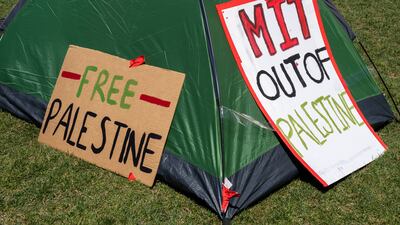
  • A tent used by pro-Palestinian demonstrators at MIT. Bloomberg
    A tent used by pro-Palestinian demonstrators at MIT. Bloomberg
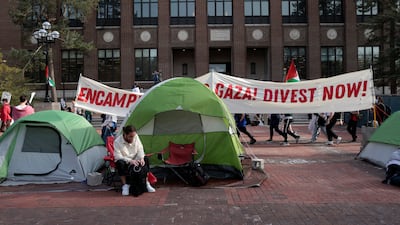
  • A coalition of University of Michigan students rally to pressure the university to divest its endowment from companies that support Israel. Reuters
    A coalition of University of Michigan students rally to pressure the university to divest its endowment from companies that support Israel. Reuters
  • A sign at the University of Michigan. Reuters
    A sign at the University of Michigan. Reuters
  • A pro-Palestinian protester in front of Sproul Hall in Berkeley, California. Getty Images / AP
    A pro-Palestinian protester in front of Sproul Hall in Berkeley, California. Getty Images / AP
  • Police officers detain pro-Palestinian students and protesters at New York University. AFP
    Police officers detain pro-Palestinian students and protesters at New York University. AFP
  • Police in Riot gear stand guard as demonstrators chant slogans outside the Columbia University campus. AP
    Police in Riot gear stand guard as demonstrators chant slogans outside the Columbia University campus. AP
  • Pro-Palestinian students and activists protest against the Israel-Gaza war on the campus of New York University. AFP
    Pro-Palestinian students and activists protest against the Israel-Gaza war on the campus of New York University. AFP
The Buckingham Murders

Starring: Kareena Kapoor Khan, Ash Tandon, Prabhleen Sandhu

Director: Hansal Mehta

Rating: 4 / 5

Monster Hunter: World

Capcom

PlayStation 4, Xbox One

Infiniti QX80 specs

Engine: twin-turbocharged 3.5-liter V6

Power: 450hp

Torque: 700Nm

Price: From Dh450,000, Autograph model from Dh510,000

Available: Now

Afro%20salons
%3Cp%3E%3Cstrong%3EFor%20women%3A%3C%2Fstrong%3E%3Cbr%3ESisu%20Hair%20Salon%2C%20Jumeirah%201%2C%20Dubai%3Cbr%3EBoho%20Salon%2C%20Al%20Barsha%20South%2C%20Dubai%3Cbr%3EMoonlight%2C%20Al%20Falah%20Street%2C%20Abu%20Dhabi%3Cbr%3E%3Cstrong%3EFor%20men%3A%3C%2Fstrong%3E%3Cbr%3EMK%20Barbershop%2C%20Dar%20Al%20Wasl%20Mall%2C%20Dubai%3Cbr%3ERegency%20Saloon%2C%20Al%20Zahiyah%2C%20Abu%20Dhabi%3Cbr%3EUptown%20Barbershop%2C%20Al%20Nasseriya%2C%20Sharjah%3C%2Fp%3E%0A
Game Changer

Director: Shankar 

Stars: Ram Charan, Kiara Advani, Anjali, S J Suryah, Jayaram

Rating: 2/5

Heavily-sugared soft drinks slip through the tax net

Some popular drinks with high levels of sugar and caffeine have slipped through the fizz drink tax loophole, as they are not carbonated or classed as an energy drink.

Arizona Iced Tea with lemon is one of those beverages, with one 240 millilitre serving offering up 23 grams of sugar - about six teaspoons.

A 680ml can of Arizona Iced Tea costs just Dh6.

Most sports drinks sold in supermarkets were found to contain, on average, five teaspoons of sugar in a 500ml bottle.

While you're here
Benefits of first-time home buyers' scheme
  • Priority access to new homes from participating developers
  • Discounts on sales price of off-plan units
  • Flexible payment plans from developers
  • Mortgages with better interest rates, faster approval times and reduced fees
  • DLD registration fee can be paid through banks or credit cards at zero interest rates
Our legal consultant

Name: Dr Hassan Mohsen Elhais

Position: legal consultant with Al Rowaad Advocates and Legal Consultants.

How green is the expo nursery?

Some 400,000 shrubs and 13,000 trees in the on-site nursery

An additional 450,000 shrubs and 4,000 trees to be delivered in the months leading up to the expo

Ghaf, date palm, acacia arabica, acacia tortilis, vitex or sage, techoma and the salvadora are just some heat tolerant native plants in the nursery

Approximately 340 species of shrubs and trees selected for diverse landscape

The nursery team works exclusively with organic fertilisers and pesticides

All shrubs and trees supplied by Dubai Municipality

Most sourced from farms, nurseries across the country

Plants and trees are re-potted when they arrive at nursery to give them room to grow

Some mature trees are in open areas or planted within the expo site

Green waste is recycled as compost

Treated sewage effluent supplied by Dubai Municipality is used to meet the majority of the nursery’s irrigation needs

Construction workforce peaked at 40,000 workers

About 65,000 people have signed up to volunteer

Main themes of expo is  ‘Connecting Minds, Creating the Future’ and three subthemes of opportunity, mobility and sustainability.

Expo 2020 Dubai to open in October 2020 and run for six months

Some of Darwish's last words

"They see their tomorrows slipping out of their reach. And though it seems to them that everything outside this reality is heaven, yet they do not want to go to that heaven. They stay, because they are afflicted with hope." - Mahmoud Darwish, to attendees of the Palestine Festival of Literature, 2008

His life in brief: Born in a village near Galilee, he lived in exile for most of his life and started writing poetry after high school. He was arrested several times by Israel for what were deemed to be inciteful poems. Most of his work focused on the love and yearning for his homeland, and he was regarded the Palestinian poet of resistance. Over the course of his life, he published more than 30 poetry collections and books of prose, with his work translated into more than 20 languages. Many of his poems were set to music by Arab composers, most significantly Marcel Khalife. Darwish died on August 9, 2008 after undergoing heart surgery in the United States. He was later buried in Ramallah where a shrine was erected in his honour.

TICKETS

Tickets start at Dh100 for adults, while children can enter free on the opening day. For more information, visit www.mubadalawtc.com.

It's up to you to go green

Nils El Accad, chief executive and owner of Organic Foods and Café, says going green is about “lifestyle and attitude” rather than a “money change”; people need to plan ahead to fill water bottles in advance and take their own bags to the supermarket, he says.

“People always want someone else to do the work; it doesn’t work like that,” he adds. “The first step: you have to consciously make that decision and change.”

When he gets a takeaway, says Mr El Accad, he takes his own glass jars instead of accepting disposable aluminium containers, paper napkins and plastic tubs, cutlery and bags from restaurants.

He also plants his own crops and herbs at home and at the Sheikh Zayed store, from basil and rosemary to beans, squashes and papayas. “If you’re going to water anything, better it be tomatoes and cucumbers, something edible, than grass,” he says.

“All this throwaway plastic - cups, bottles, forks - has to go first,” says Mr El Accad, who has banned all disposable straws, whether plastic or even paper, from the café chain.

One of the latest changes he has implemented at his stores is to offer refills of liquid laundry detergent, to save plastic. The two brands Organic Foods stocks, Organic Larder and Sonnett, are both “triple-certified - you could eat the product”.  

The Organic Larder detergent will soon be delivered in 200-litre metal oil drums before being decanted into 20-litre containers in-store.

Customers can refill their bottles at least 30 times before they start to degrade, he says. Organic Larder costs Dh35.75 for one litre and Dh62 for 2.75 litres and refills will cost 15 to 20 per cent less, Mr El Accad says.

But while there are savings to be had, going green tends to come with upfront costs and extra work and planning. Are we ready to refill bottles rather than throw them away? “You have to change,” says Mr El Accad. “I can only make it available.”

The burning issue

The internal combustion engine is facing a watershed moment – major manufacturer Volvo is to stop producing petroleum-powered vehicles by 2021 and countries in Europe, including the UK, have vowed to ban their sale before 2040. The National takes a look at the story of one of the most successful technologies of the last 100 years and how it has impacted life in the UAE.

Read part three: the age of the electric vehicle begins

Read part two: how climate change drove the race for an alternative 

Read part one: how cars came to the UAE

The five pillars of Islam

1. Fasting 

2. Prayer 

3. Hajj 

4. Shahada 

5. Zakat 

Mercer, the investment consulting arm of US services company Marsh & McLennan, expects its wealth division to at least double its assets under management (AUM) in the Middle East as wealth in the region continues to grow despite economic headwinds, a company official said.

Mercer Wealth, which globally has $160 billion in AUM, plans to boost its AUM in the region to $2-$3bn in the next 2-3 years from the present $1bn, said Yasir AbuShaban, a Dubai-based principal with Mercer Wealth.

Within the next two to three years, we are looking at reaching $2 to $3 billion as a conservative estimate and we do see an opportunity to do so,” said Mr AbuShaban.

Mercer does not directly make investments, but allocates clients’ money they have discretion to, to professional asset managers. They also provide advice to clients.

“We have buying power. We can negotiate on their (client’s) behalf with asset managers to provide them lower fees than they otherwise would have to get on their own,” he added.

Mercer Wealth’s clients include sovereign wealth funds, family offices, and insurance companies among others.

From its office in Dubai, Mercer also looks after Africa, India and Turkey, where they also see opportunity for growth.

Wealth creation in Middle East and Africa (MEA) grew 8.5 per cent to $8.1 trillion last year from $7.5tn in 2015, higher than last year’s global average of 6 per cent and the second-highest growth in a region after Asia-Pacific which grew 9.9 per cent, according to consultancy Boston Consulting Group (BCG). In the region, where wealth grew just 1.9 per cent in 2015 compared with 2014, a pickup in oil prices has helped in wealth generation.

BCG is forecasting MEA wealth will rise to $12tn by 2021, growing at an annual average of 8 per cent.

Drivers of wealth generation in the region will be split evenly between new wealth creation and growth of performance of existing assets, according to BCG.

Another general trend in the region is clients’ looking for a comprehensive approach to investing, according to Mr AbuShaban.

“Institutional investors or some of the families are seeing a slowdown in the available capital they have to invest and in that sense they are looking at optimizing the way they manage their portfolios and making sure they are not investing haphazardly and different parts of their investment are working together,” said Mr AbuShaban.

Some clients also have a higher appetite for risk, given the low interest-rate environment that does not provide enough yield for some institutional investors. These clients are keen to invest in illiquid assets, such as private equity and infrastructure.

“What we have seen is a desire for higher returns in what has been a low-return environment specifically in various fixed income or bonds,” he said.

“In this environment, we have seen a de facto increase in the risk that clients are taking in things like illiquid investments, private equity investments, infrastructure and private debt, those kind of investments were higher illiquidity results in incrementally higher returns.”

The Abu Dhabi Investment Authority, one of the largest sovereign wealth funds, said in its 2016 report that has gradually increased its exposure in direct private equity and private credit transactions, mainly in Asian markets and especially in China and India. The authority’s private equity department focused on structured equities owing to “their defensive characteristics.”

Updated: April 25, 2024, 8:23 AM