

Live updates: Follow the latest on Israel-Gaza
Harvard College has suspended its Palestine Solidarity Committee chapter for the rest of the term and students who continue to take part in any of its activities will face expulsion, the university's newspaper has reported.
Amid a growing number of protest movements over the Israel-Gaza war at universities across the country, Harvard College told the pro-Palestinian student group by email on Monday that it has been temporarily suspended for failing to register a protest and breaching guidelines on the use of campus space.
“The organisation will not be recognised and will not have access to university benefits and services during this time, including but not limited to use of campus space and appropriate use of the Harvard name,” the email said.
“If the organisation continues to operate and commits additional violations during this suspension, the organisation risks permanent expulsion, as provided in the resource guide.”
The Palestine Solidarity Committee denounced the move.
“Harvard has shown us time and again that Palestine remains the exception to free speech,” the group wrote in a statement on social media.
The development comes amid increased tension at several elite US universities, where pro-Palestinian students have set up camps in protest against the Israel-Gaza war.
US universities have long been a bastion of activism and anti-war protests.
But this protest movement, which has included students from diverse backgrounds, has presented an unprecedented challenge to city officials and university leaders.

Protesters say they want to see an immediate ceasefire in Gaza, where about 34,200 Palestinians, most of them civilians, have been killed, according to local health authorities.
Much of the coastal enclave has been reduced to rubble. Most residents have been displaced, and face a lack of access to food and basic necessities.
The war erupted on October 7, after a Hamas-led attack on Israel that killed about 1,200 people, according to Israeli authorities.
Jewish student groups say the protests make them feel unsafe, and that since October 7, they have experienced a rise in harassment and anti-Semitic comments.
At least two Republican senators, Josh Hawley and Tom Cotton have called on President Joe Biden to mobilise the national guard in response to the protests on campus.
Columbia has announced that it is moving to remote learning until the end of the term, claiming security concerns.
“We're monitoring this closely,” White House deputy press secretary Andrew Bates told journalists on Tuesday.
“We know that this is a painful moment for many communities and we support every American's right to peacefully protest.”
Mr Bates said anti-Semitic comments and calls for violence are “unacceptable”.
But Jewish student organisations, including Jewish Voice for Peace, have taken part in the on-campus anti-war activism.
On Monday evening, a group of Jewish students at Columbia, several of them wearing Palestinian keffiyehs, held a makeshift Passover seder.
Last week more than 100 students who had camped out at the university to protest against Israel’s assault on Gaza, and demand that the university divest from companies that sell weapons to Israel, were arrested by police.
Videos and photos of the arrests of those taking part in the so-called Gaza Solidarity Encampment have been widely shared on social media. They also spurred camps and arrests on other US campuses.
More than 150 students were arrested at New York University on Monday night, and at Yale University, nearly 50 were detained.
More than 150 professors and faculty members at Columbia submitted an open letter in support of student protesters and against the police crackdown.
Student Gaza protests at US universities - in pictures
-

Activists and students take part in an encampment protest at George Washington University, in Washington. AFP -
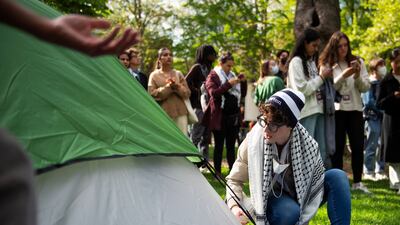
Students and faculty of Drexel University and University of Pennsylvania erect an encapment to protest against the war in Gaza, at the University of Pennsylvania campus, in Philadelphia. AFP -
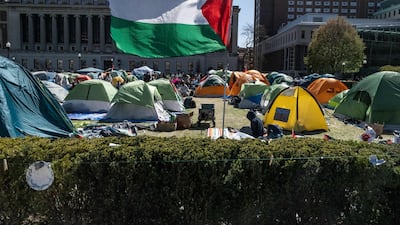
Columbia University students continue their demonstration on campus afterlast week's arrest of more than 100 protesters, in New York City. Getty Images -
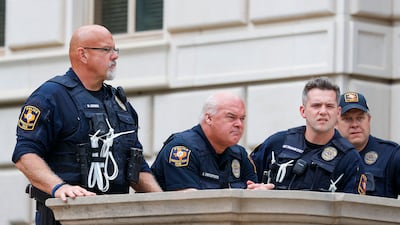
Police watch as students and faculty show support at a Protect Palestine Rally at the University of Texas, in Austin. EPA -
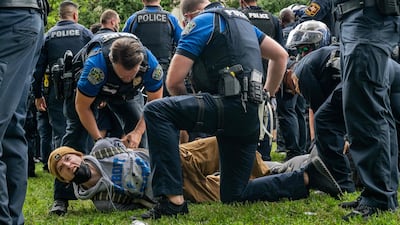
A student is arrested during a pro-Palestine demonstration at the University of Texas at Austin. Getty Images -
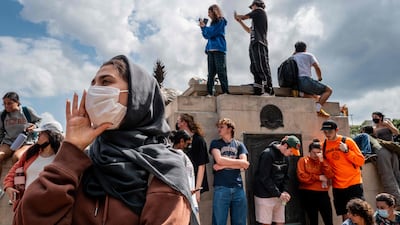
Students rally at the University of Texas at Austin, where police arrested scores of protesters. Getty images -
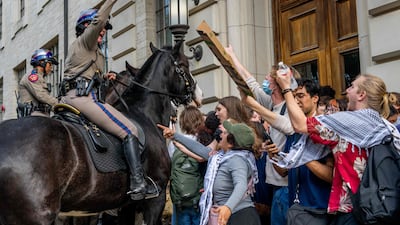
Mounted police confront students protesting against the war in Gaza, at the University of Texas at Austin. Getty Images -
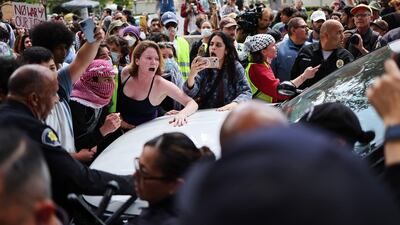
Pro-Palestine demonstrators argue with University of Southern California officials, who attempted to take down an encampment set up in support of Gaza, at the institution in Los Angeles. Getty images -
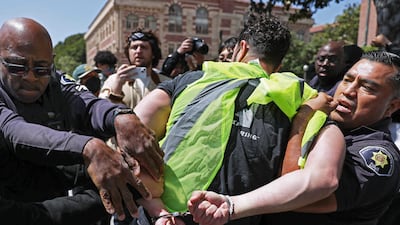
University of Southern California police officers detain a pro-Palestine demonstrator. Getty Images -
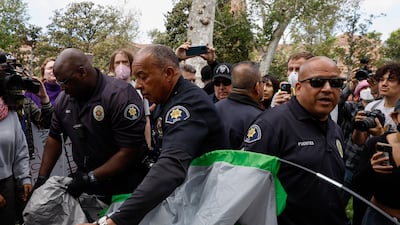
University of Southern California officers dismantle protesters' tents. EPA -
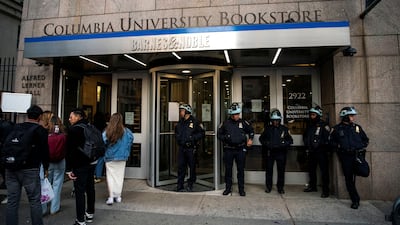
Police stand guard at an entrance to Columbia University, in New York City, where students continue to protest in support of Palestinians, amid the war in Gaza. Reuters -
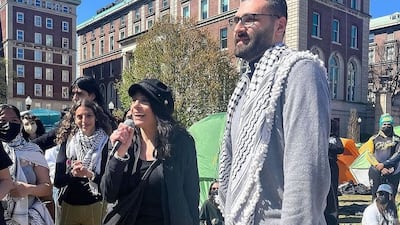
Najla Said, daughter of Palestinian-American academic and literary critic Edward Said, and Motaz Azaiza, a Palestinian photojournalist from Gaza, join the Gaza solidarity encampment at Columbia University. Photo: Columbia Students for Justice in Palestine -
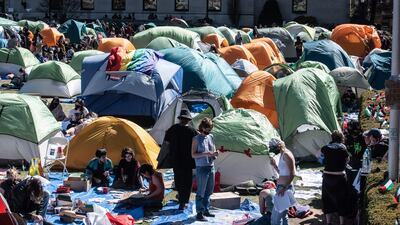
As the campus protests continue, Columbia has moved its classes online. AFP -
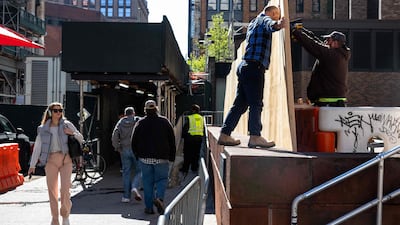
Workers erect a wooden barrier at New York University Stern School of Business after an encampment set up by students was cleared out on Monday night. Getty Images -
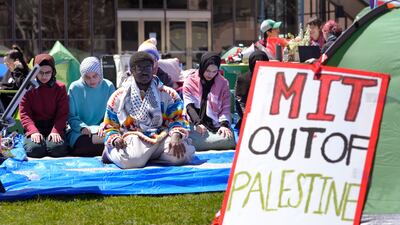
Massachusetts Institute of Technology student Isa Liggans, front left, takes part in Muslim prayer with others, at an encampment of tents at the college, in Cambridge, Massachusetts. AP -
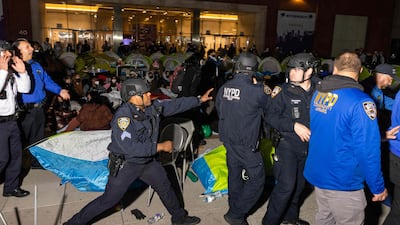
Police officers disperse pro-Palestinian students and protesters who set up an encampment on the campus of New York University. AFP -
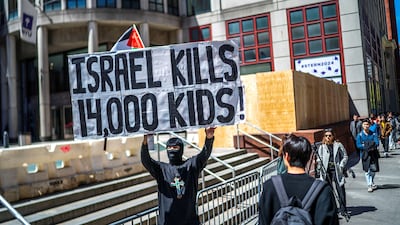
A protester outside New York University. Reuters -
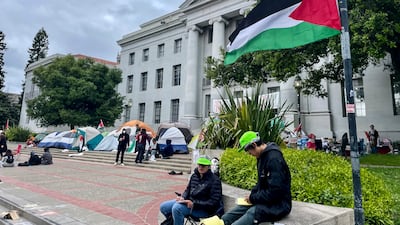
Pro-Palestinian protesters gather in front of Sproul Hall on the campus of the University of California, Berkeley. AP -
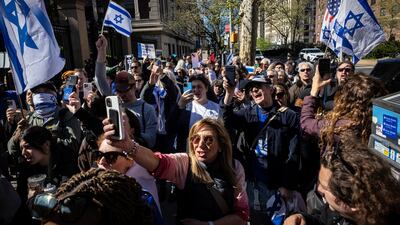
Pro-Israeli demonstrators chant 'shame' after Columbia University assistant professor Shai Davidai was denied access to the main campus. AP -
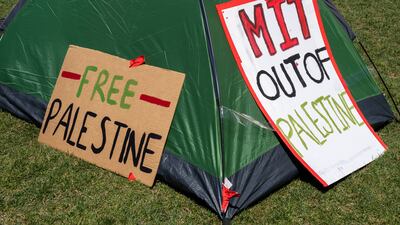
A tent used by pro-Palestinian demonstrators at MIT. Bloomberg -
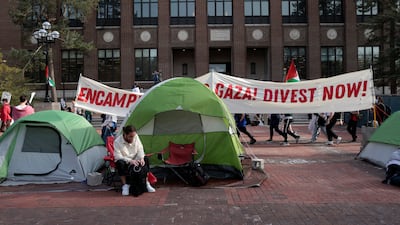
A coalition of University of Michigan students rally to pressure the university to divest its endowment from companies that support Israel. Reuters -
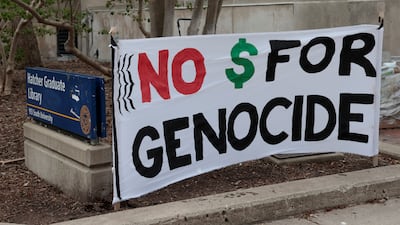
A sign at the University of Michigan. Reuters -
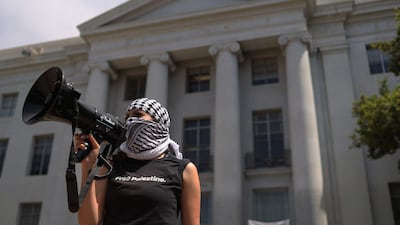
A pro-Palestinian protester in front of Sproul Hall in Berkeley, California. Getty Images / AP -
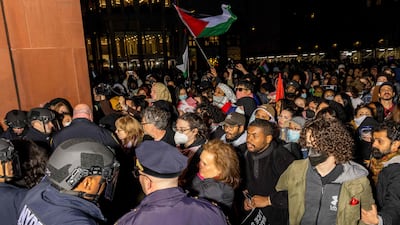
Police officers detain pro-Palestinian students and protesters at New York University. AFP -
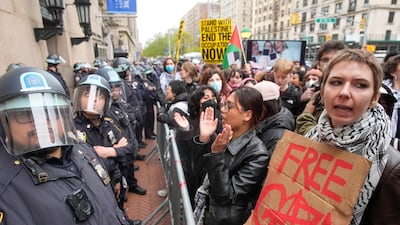
Police in Riot gear stand guard as demonstrators chant slogans outside the Columbia University campus. AP -
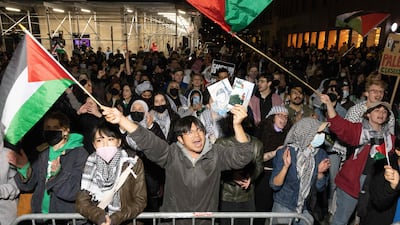
Pro-Palestinian students and activists protest against the Israel-Gaza war on the campus of New York University. AFP



