


Live updates: Follow the latest news on Israel-Gaza
As missiles and drones streaked through the skies over the Middle East, a coalition of nations led by the US rushed to Israel’s defence to thwart Iran’s attack.
For the first time, Tehran on Saturday launched missiles from its territory at Israel. In total, Iran sent more than 300 projectiles, launched from Iran, Iraq, Syria and Yemen towards Israel.
It was a huge salvo, and one that Israel, with the help of the US and a loose coalition of states including Middle East partners, was able to almost entirely stop.
The attack was in retaliation for Israel’s April 1 strike on the Iranian embassy compound in Damascus, which killed several high-ranking members of the Islamic Revolutionary Guard Corps including Brig Gen Mohammad Reza Zahedi, who led Iran's operations in Lebanon and Syria.
Israel claims its multilayered defence system and the efforts of other countries stopped 99 per cent of the missiles and drones, limiting the damage caused and preventing any fatalities.
Two US Navy destroyers took out more than 80 one-way attack drones and at least six ballistic missiles, according to the Pentagon.
The British Royal Air Force intercepted Iranian drones in Syrian and Iraqi airspace, as did France.
And the Jordanians shot down Iranian drones that had breached their airspace.
“This was an unprecedented Iranian attack,” a senior Biden administration official said.
“It was also an extraordinary feat of military prowess and co-operation with partners in defeating it.”
The US has spent years trying to develop an integrated air-defence system that could protect against just this kind of attack.
“Over the past couple decades actually, the US has tried to create this kind of regional air and missile defence umbrella particularly with the Gulf Co-operation Council, but also to kind of pull in Israel into that as well,” said Shaan Shaikh, of the Centre for Strategic and International Studies.
Quiet co-operation
In 2021, after the signing of the Abraham Accords under the Trump administration, Israel was absorbed into US Central Command's area of responsibility, which also includes many Arab states.
The move has helped to streamline communications between militaries.
“It’s clearly a sea change since Israel got integrated into the Centcom area of operations,” said Firas Maksad, of the Middle East Institute in Washington.
The loose coalition is part of Washington’s efforts to build on the Abraham Accords and better integrate Israel into the region.
Dana Stroul, who until recently was the Pentagon's top civilian official in charge of the Middle East, said the response to the Iranian attack was a “proof of concept” that showed years of diplomacy and confidence building, “as well as the agreements to share information and stitch together operational capabilities are actually bearing fruit”.
But Arab countries have been reluctant to discuss the extent to which they assisted in Saturday's operation, given tensions over Israel's continued war in Gaza, where nearly 34,000 people have been killed, according to local health authorities.
The war started in response to Hamas-led attacks in southern Israel on October 7, in which some 1,200 people were killed, according to Israeli tallies.
When asked about Baghdad's role in Saturday's operations, Iraqi Prime Minister Mohammed Shia Al Sudani told reporters he does not want his country involved in any escalation, and he declined to say whether Iraqi forces had been tracking the Iranian missiles.
“It was a very successful display of combined military force brought together against a shared enemy, even if some of the participants weren't willing to talk about it,” said Cole Bunzel, a fellow at the Hoover Institution at Stanford University.
US Secretary of Defence Lloyd Austin praised the coalition's response.
“That doesn’t happen at the 11th hour, that happens because countries are working together, making sure that we have the right procedures and processes in place to enable us to do that,” Mr Austin said.
Iran's attack on Israel – in pictures
-

Israel's air defence system intercepts projectiles amid an attack by Iran, as seen from Ramallah in the occupied West Bank. Screengrab from AFPTV / AFP -

Missiles fired from Iran towards Israel are intercepted over the northern part of the country. AFP -
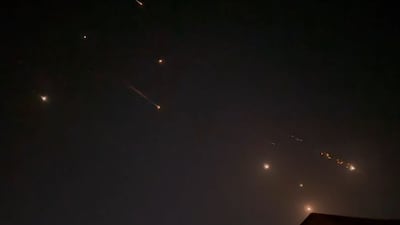
Explosions light up the sky in Hebron in the Palestinian territories during the attack. Screengrab from AFPTV / AFP -

Explosions occur over Hebron. Screengrab from AFPTV / AFP -
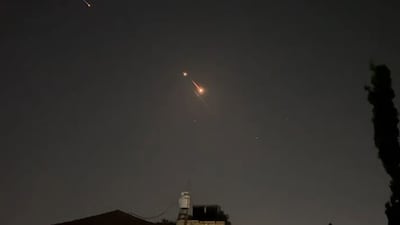
Explosions light up the skies over Jerusalem during the attack. Screengrab from AFPTV / AFP -
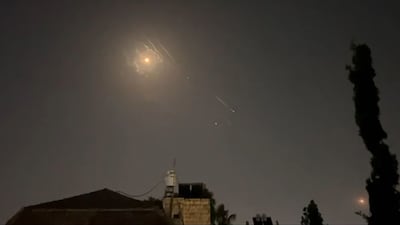
Explosions occur over Jerusalem. Screengrab from AFPTV / AFP -
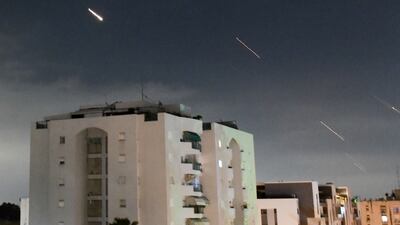
Israel's Iron Dome air defence system moves to intercept missiles fired from Iran. AP -
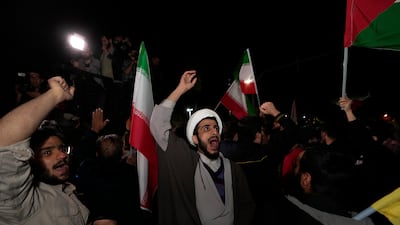
Iranian demonstrators chant slogans during an anti-Israel gathering in Tehran. AP -

People in Tehran appear to celebrate in the street after the attack on Israel. Wana (West Asia News Agency) / Reuters -
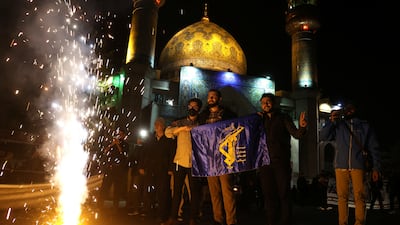
Iranians appear to celebrate in the street after the attack. Wana (West Asia News Agency) / Reuters -
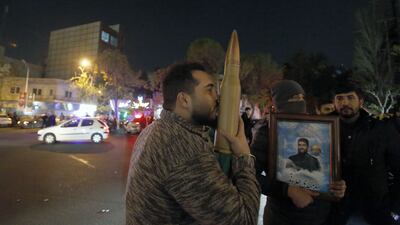
A man kisses a mock rocket during an anti-Israel rally in Tehran after Iran launched the attack. EPA -
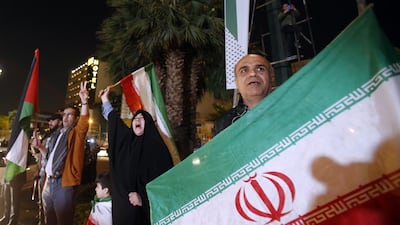
People hold Iranian and Palestinian flags at Palestine Square in Tehran. EPA -

US President Joe Biden meets members of his national security team about the attack on Israel by Iran. The White House / AP


Jake Sullivan, White House National Security Adviser, said the US is working to “expand the successful integration of air and missile defence and early warning systems across the Middle East, to further erode the effectiveness of Iran’s missile and [attack drone] capabilities”.
Immediately after Israel's strike on Damascus, the US began preparing for possible Iranian retaliation, moving military assets in the region
But despite countries co-ordinating to thwart Iran, it is unlikely this will herald a broader rapprochement between Israel and Arab countries.
“Many in the Gulf, Saudi Arabia in particular, have been very clear that there will not be much progress in terms of an overt diplomatic relationship between the Gulf and Israel, Saudi Arabia in particular here, absent significant progress on the Palestinian track,” Mr Maksad told The National.
Israel is considering its response to Iran’s retaliatory strike, and another attack could further strain its relations with the rest of the region.
“This is a fraught moment for whether or not we are able to move forward with what should be a shared priorities, integration and normalisation,” Ms Stroul told The National.
“That is why I think the Israelis are really thinking very carefully about what and how and when they respond to the Iranian attack on their territory.”
Israel is now facing an unusual scenario: the same partners that rushed to defend it against Iran are now the ones now calling for restraint.
“Every capital in the region is making it very clear that they seek de-escalation and don't want to conventional conflict,” Ms Stroul said.
“Israel is going to have to take those views into account if it also believes that its security is best protected and defended through integration and normalisation.”
Israel has long boasted of its ability to defend itself unilaterally, so the idea of working with partners is a new concept, Ms Stroul noted.
“It is not yet clear whether or not Israeli decision-making will shift to accommodate and try to strengthen what could be an emerging coalition or whether they will undertake certain unilateral actions that many will see as opening another cycle of escalation across the region,” she said.
Further compounding matters is a possible impending invasion of Rafah, the last refuge for more than one million Palestinians who have already fled from elsewhere in the densely populated enclave, that would put Israel at odds with US President Joe Biden and much of the region as well.

