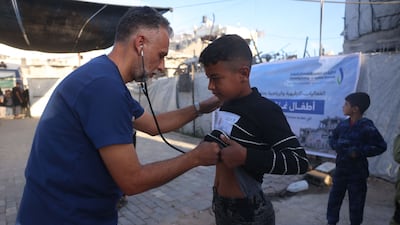

A group of critically ill and injured children from Gaza has arrived in the UK for treatment as British ministers condemned Israel for not allowing more medical supplies into the enclave.
Health Secretary Yvette Cooper said the children had “endured unimaginable hardship” and were in “desperate need” of treatment.
This is the second group of children to arrive in the country, with about 50 and their close family members evacuated last year. The names of the children and the hospitals where they are receiving treatment have been withheld to protect their privacy.

Experts on the issue have previously told The National that the cases will have been selected based on the kinds of specialist treatment available in the UK. This includes neuro-rehabilitation, treating severe burns, limb salvage surgery, trauma and conditions such as diabetes that have not been managed.

Ms Cooper thanked the “brilliant and dedicated healthcare teams” in the UK that would be caring for the children “with the compassion and expertise that our National Health Service is renowned for across the world”.
She also warned that the Israeli government had “refused to listen” to her calls to protect hospitals and let more medical supplies into the enclave.
“When I announced the first wave of medical evacuations as Foreign Secretary last November, I called for the protection of medical infrastructure and health workers in Gaza, and for a huge increase in the volume of medicines and supplies allowed in, so that young Palestinian children could get the urgent treatment they needed close to home,” she said.
“The Israeli government refused to listen to those calls, and that is why – a year on – we still see so many children in Gaza in desperate need of medical help.
“Today, we welcome some of the most severely ill children to Britain to be cared for by the NHS, and we thank all our partners in the region who have helped to enable this evacuation.”
The recent evacuation was led by a government task force working with the World Health Organisation and international partners.
The children and their families first travelled to Amman where they “underwent robust security checks” before arriving in the UK, the Department of Health and Social Care said.
More children are expecting to be evacuated to the UK by the end of the year.

The UK's efforts come after more than 18 months of campaigning from British doctors and legislators. The biggest hurdle was the slow-moving visa-process, and the requirement for patients to travel to Amman in Jordan to have their biometric details processed.
Gaza's Ministry of Health warned last week that dangerously low numbers of patients were being permitted to travel out of Gaza for medical treatment, with 21,000 patients still awaiting evacuation.
An Israeli air strike hit Nasser Hospital in November, killing at least six people, including medical staff and patients, according to the ministry.
Heavy rain last week in Gaza damaged or destroyed more than 40,000 family shelters, as well as health sites and toilets, according to the British charity Medical Aid for Palestinians.
More than 120,000 tents are needed, but only about 2,800 are available due to restrictions, MAP said last week.
About 42 per cent of all medicine had run out as of October. More than half of chemotherapy drugs and almost three quarters of supplies for open heart surgery and cardiac catherisation were also out of stock, MAP said, using data from hospital information system Health Cluster.
“Children in Gaza have endured three years of unimaginable horror,” Foreign Secretary Ed Miliband said.
“Hospitals have been devastated and, as winter draws in, desperately ill patients are still unable to get the care they need.
“We welcome these children and their families to the UK for urgent NHS treatment, and their arrival is a stark reminder of the scale of the humanitarian crisis in Gaza.”