

A senior bishop in the Church of England has said that he was “intimidated” by Israeli militias during a visit to the West Bank this year.
The Most Reverend Stephen Cottrell, the Archbishop of York, said he was stopped at checkpoints and that militias told him he could not visit Palestinian families in the occupied territory. The territory has witnessed record levels of settler violence against Palestinians this year and the expansion of settlements.
Earlier this week, Israel's security cabinet approved 19 more settlements in the West Bank, bringing the number granted permission in the past three years to 69.
The archbishop described how YMCA charity representatives in Bethlehem, who work with “persecuted Palestinian communities” in the West Bank, gave him an olive wood nativity scene carving. The piece showed a “large grey wall” blocking the three kings from getting to the stable to see Mary, Joseph and Jesus.
“It was sobering for me to see this wall for real on my visit to the Holy Land, and we were stopped at various checkpoints and intimidated by Israeli militias who told us that we couldn't visit Palestinian families in the occupied West Bank,” he said.

During his Christmas Day sermon at York Minster, he also talked about the “walls that divide and separate the Holy Land, I'm also thinking of all the walls and barriers we erect across the whole of the world and, perhaps most alarming, the ones we build around ourselves.”
“The ones we construct in our hearts and minds, and of how our fearful shielding of ourselves from strangers – the strangers we encounter in the homeless on our streets, refugees seeking asylum, young people starved of opportunity and growing up without hope for the future – means that we are in danger of failing to welcome Christ when he comes.”
The Archbishop of York visited Israel and the West Bank for four days in early November in what was described by his office as a “pilgrimage of prayer and solidarity with The Most Reverend Hosam Naoum, Anglican Archbishop in Jerusalem”.
According to a report by The Jerusalem and the Middle East Church Association, the Archbishop saw the problems being faced by farmers in the West Bank as they attempted to harvest their olive crop.
“Armed and masked settlers arrived to disrupt the visit to Um al Khair in the South Hebron Hills,” the organisation said. “They were only dispersed when police arrived and told them that the Archbishop was present.”
-
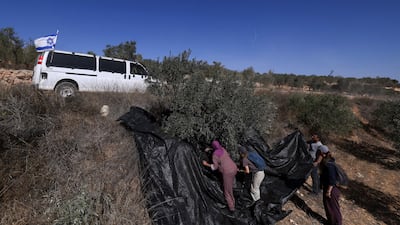
Israeli security forces drive past Palestinians harvesting olives in the village of Turmus Ayya, on the outskirts of Ramallah. The UN has documented more than 30 Israeli settler attacks on Palestinians in the occupied West Bank village in one week during the harvest. AFP -
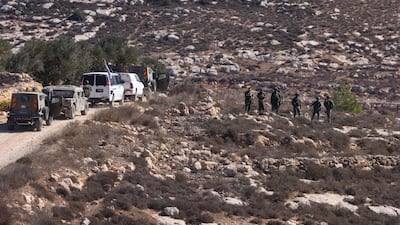
Israeli soldiers take position in Turmus Ayya, where a settler was caught on camera clubbing a 55-year-old Palestinian woman unconscious as she picked olives. AFP -
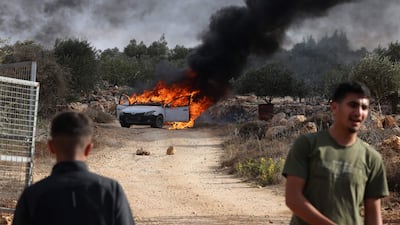
Palestinians stand near a burning car reportedly set alight by Israeli settlers trying to disrupt the olive harvest in Turmus Ayya. AFP -

Palestinians turn back after being prevented from picking olives by Israeli soldiers in the village of Farkha, near Salfit, in the occupied West Bank. Reuters -
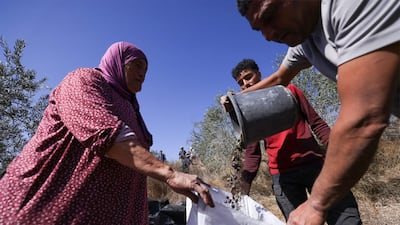
Olives being collected in Turmus Ayya. The olive harvest season is more than just an agricultural or economic activity in the West Bank. It is also an integral part of Palestinians' cultural heritage. AFP


There has been a rise in attacks on olive farmers this year, according to the UN. These include assaults on harvesters, theft of crops and harvesting equipment and vandalism of olive trees.
A video of a masked settler clubbing and knocking to the ground a 55-year-old Palestinian woman who was harvesting olives sparked outrage after it was shared widely on social media platforms.
The Archbishop’s comments come as Pope Leo XIV used his Christmas sermon to condemn conditions in Gaza, where Palestinians are living in flimsy tents in freezing conditions.
Leo, the first American Pope, said the story of Jesus being born in a stable showed that God had “pitched his fragile tent” among the people of the world. “How, then, can we not think of the tents in Gaza, exposed for weeks to rain, wind and cold?” he asked.
Most world powers deem Israeli settlements on land it captured in the 1967 Arab-Israeli War illegal, and several UN Security Council resolutions have called on Israel to halt all settlement activity. Israel disputes the view that such outposts are unlawful and claims biblical and historical ties to the land.

