



Buyers from the Gulf have driven sales of homes priced above £15 million ($19.6 million) across central London over the past four months, according to a luxury property agency.
Almost 30 per cent of the prime properties sold have been bought by Middle East purchasers, most notably from the United Arab Emirates, Saudi Arabia and Qatar, according to Beauchamp Estates.
It has reported a recent flurry of transactions as potential buyers race to get deals over the line before next week’s UK government budget, which is expected to result in significant property tax changes.
Deals have been done for off-plan luxury properties at 100 Kensington and Park Modern on Bayswater Road as well as Greybrook House in Mayfair.
Yahya Swallem, a senior sales consultant at Beauchamp Estates, told The National that London property currently represents “good value” for buyers from the Middle East, many of them from a “new younger generation”.
Gulf purchasers were followed by buyers from China, the UK itself, the US and continental Europe, but Mr Swallem said it has become increasingly apparent in recent months that the Central London property market is now significantly reliant on Gulf purchasers for the sale of “trophy homes in the best addresses”.
Research by Beauchamp Estates, based on sales data from local agents and property professional network LonRes, shows that from January to June there were 27 properties sold for more than £15 million ($19.6 million) in central London. Gulf buyers spent £105 million ($137.7 million) to purchase seven (more than 25 per cent) of them. That has risen to 30 per cent between July and October. Beauchamp Estates estimate that 30 per cent of the buyers for homes costing more than £5 million ($6.5 million) are from the Gulf.

Where’s hot?
Mr Swallem said the purchases have switched from one to two-bed investment apartments five years ago to larger properties which will be kept for 20 years or more. This favours new build developments, rather than established areas such as Knightsbridge where buildings are older and have fewer facilities, he argued.
Mr Swallem said Belgravia and Mayfair are the neighbourhoods that are thriving, with properties being overhauled or built from scratch.
What's selling?
The final apartment by developer Fenton Whelan at Greybrook House, a Grade II listed six-storey building between Claridge’s hotel and Bonhams auctioneers in Mayfair, has sold to an international buyer for £7.9 million ($10.4 million).
An Abu Dhabi businessman bought the duplex penthouse apartment in the building, as well as a neighbouring three-bed apartment for hosting guests and a separate staff apartment, for a total of £30.4 million ($39.9 million).

Fenton Whelan has also completed £75 million ($987 million) worth of sales over the past 16 weeks at Park Modern, a development of 57 one to six-bedroom homes overlooking Hyde Park. The final phase of sales includes the penthouse, a £60 million ($78.7 million) property looking directly at the Royal Albert Hall.
Two penthouses at the 29-storey Oria tower at 100 Kensington on West Cromwell Road have been sold in a £10 million ($13.1 million) deal to a buyer from the Middle East. The deal makes up part of more than £40 million ($52.4 million) worth of off-plan sales made at the tower so far.
Developers SevenCapital and MARK Capital Management said the buyers were acquiring apartments either as a pied-a-terre, or as future homes and investment for their student children while they are going to college or university in London. Many ‘lock up and leave’ properties can be rented or used as holiday homes.
-
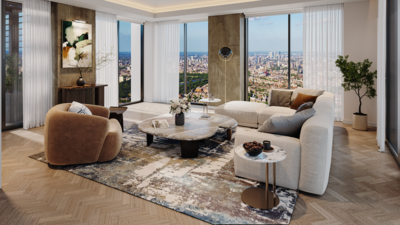
A £10 million penthouse for sale at the 100 Kensington development. All photos: Sevencapital -
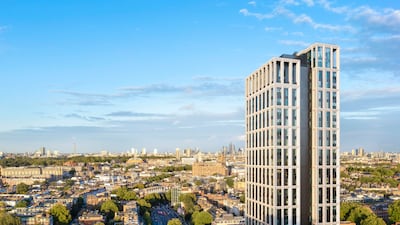
The 100 Kensington exterior -
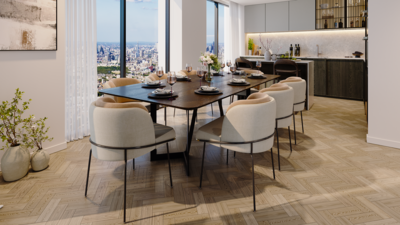
The dining area of the penthouse -
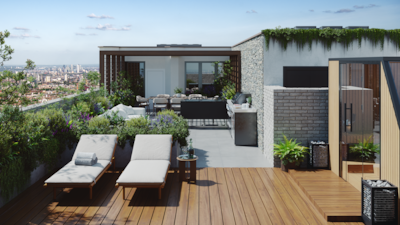
The penthouse terrace -

The gym -

A swimming pool -
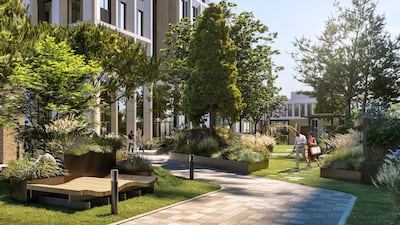
The Oria Podium Garden entrance


Who’s buying?
Sanjay Sharma, co-founding director of Fenton Whelan, told The National there has been a change over the last 12 months. “A year ago, if I went to Dubai or Riyadh, there wasn't a huge amount of interest in London,” he said. “But that has really reversed.”
He puts that down to rising property prices in the Gulf and a flatlining in London over the past decade, which means there is relative value to be found.
“People view this as an opportunity,” he said. “Some of the buyers are actually people who have owned in London for a very long time, maybe multi-generational since the 80s and 90s, and haven't bought for many years because they thought prices were at a high. Now those people are coming back and increasing their exposure after a long absence.”

Mr Swallem believes the negativity surrounding UK Chancellor Rachel Reeves’s budget has been affecting the market. Some buyers have made their move before changes are introduced; others are holding off due to the possible introduction of a mansion tax.
Mr Swallem has been “navigating in a difficult market” but he believes people are sensing value because prices have dropped significantly, pointing to a property in Cheyne Gardens in Chelsea which was marketed at £16.5 million (21.6 million) but sold for £13.5 million ($17.7 million). “Once the price is right, people will buy,” he said.
Mr Sharma, meanwhile, acknowledges that the pool of people globally who can afford such properties is relatively small, so it’s vital to “go to the places where those people are”. He is a regular at the Monaco Yacht Show and spends time in Silicon Valley, where he originally comes from, hoping to catch the eye of tech billionaires.
He is marketing Park Modern at the Cityscape exhibition in Riyadh this week, determined to prolong the trend for Middle East purchasers putting their cash into London.
He recognises that spending tens of millions of pounds on a property is “an extraordinary amount of money”, but says the amount of wealth held by the top one per cent has increased dramatically. “The amount that they can afford to spend on prime property has increased,” he said. “For people at the very highest end of the market, there hasn't been any recession for a very long time.”
While billionaires want value for money, and long-term returns, there is something more important to them. It must be “truly unique”, Mr Sharma said, explaining the emphasis buyers place on location, views and amenities.
“There are people who have sufficient wealth,” he said. “For them it is not ‘how much does it cost?’ It's ‘do I want it or not?’”

