


Hopes have been raised that the UK can play a role in building bridges between Israel and Palestine after British Prime Minister Keir Starmer gave new backing to an international peace fund, as a recovery blueprint for Gaza gains new traction, The National can reveal.
The International Fund for Israel-Palestinian Peace was launched in 2018 with the support of Labour Friends of Israel, a group in the UK Parliament, and seeks to support civil society organisations in Israel and Palestine.
The Prime Minister's officials and the Foreign Office held meetings last week with the fund's key organisers, the Alliance for Middle East Peace, a network of 160 Israeli and Palestinian organisations.
This comes amid concerns about the fragile ceasefire in Gaza, with exchanges of Israeli hostages and Palestinian detainees delayed.
Meanwhile, US President Donald Trump’s proposal to resettle Palestinians in other Arab countries, has raised fears Israel could be left to assert full control over the Palestinian territories with US-backing. This is compounded by a US freeze on foreign aid, which has left many organisations struggling.
Portland Trust
Future conference
UK Foreign Secretary David Lammy is expected to host a conference this year to bring together international funding for the project.
It follows Mr Starmer's pledge to support the fund at the annual Labour Friends of Israel event in December and host an “inaugural meeting in London to support civil society in the region”.
The support is all the more critical after Mr Trump's slashing of USAID budgets, said Wasim Al Masri, Allmep's programmes director in Ramallah, in the occupied West Bank.
“The freeze on USAID has been devastating. We're hoping [this fund] will be a large pool to co-ordinate support from multiple donor states,” Mr Al Masri said.
Mr Al Masri, who is originally from Gaza, lost family members in the war, which came to a halt with a truce on January 19.
He believes that “working to build solidarity across communities” in Israel and Palestine is the best way to build support for Palestinian statehood and justice.
“More Palestinian activists are realising that to advocate for our rights, it makes more sense to create solidarity on the other side,” he said.
But there is also scepticism about the fund from those who believe it is a “diversion” from the shaky ceasefire and destruction on the ground in Gaza.
“How can you talk about peace when there are children still trapped under the rubble?” one Arab diplomat asked.
-
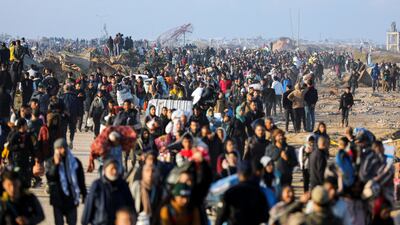
Displaced Palestinians make their way back to their homes in northern Gaza after Israel allowed them to return. Reuters -
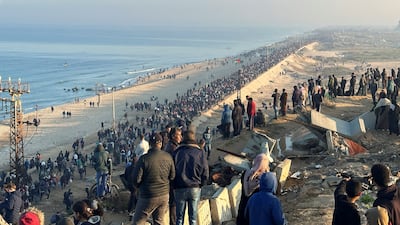
Their return had been held up by a dispute over the release of Israeli hostages held in the enclave. Reuters -
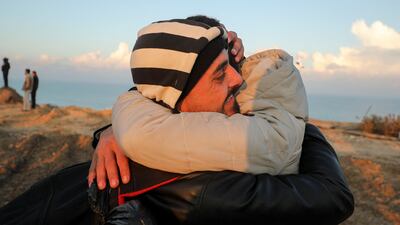
Palestinians are reunited as displaced people return to northern Gaza. Reuters -
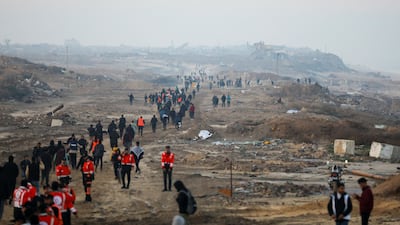
Palestinians in northern Gaza wait to welcome returnees from the south. Reuters -

A man and child make their way home, in northern Gaza. Reuters -

Palestinians on Salah Al Din Road wait to be allowed to return to their homes in northern Gaza. Reuters


Blueprints for progress
Mr Trump’s comments that Gaza is decades away from recovery is undermined by a 12-month blueprint for rebuilding the strip. Called Palestine Emerging, it launched in April last year after a meeting convened by the UK-based non-profit Portland Trust. The trust was established to promote peace and stability between Israelis and Palestinians through economic development.
Among those attending last spring's meeting were Palestinian private sector leaders and members of the US non-profit RAND Corporation think tank.
“If you’re going to look at what the West Bank and Gaza, what Palestine as a sustainable economy is going to look like, there needs to be massive things happening. And that was the basis on which we then began the work,” said Baron Frankal, chief executive of the Portland Trust.
The work is led by Palestinian engineer Shireen Shelleh, chief executive of the Centre for Engineering and Planning consulting firm in Ramallah.

It includes proposals such as repurposing an estimated 30 million tonnes of rubble from war-torn in Gaza to build an island port in the north of the strip and positioning Palestine as a test-bed for 6G technology.
It also sketches out a 12-month development plan, so that rebuilding can begin immediately after the war ends and a political solution is in place.
The project has already gathered funding and backing from major US and European institutions for its health care proposal that would see the Gaza's healthcare system move towards a hybrid insurance-based model.
Proposed measures also include a short-term corridor from the occupied West Bank to Gaza for essential supplies and patient transfers, plus mobile units for critical health care.
The proposals were developed over meetings in Washington in December, in collaboration with the World Bank, the World Health Organisation, Harvard Medical School and private Palestinian hospitals, among others.
Most Palestinians − 58.6 per cent − favoured compulsory health insurance, according to a survey by Dr Khalil Shikaki of the Palestinian Centre for Policy and Survey Research think tank.
The measures are projected to generate $1.58 billion of healthcare investment by 2050, according to Palestine Emerging.
Mr Frankal said that while the proposals were “not orthodox and may not be popular – but they might just work. These are the sorts of practical solutions that need to be out there on the table, facing reality as it is not as we may want it to be”.
Political process

Mr Frankal says a political settlement is necessary for such plans to come to fruition.
“There has to be a stable Palestinian government, unitary government, covering the territories that has to be tolerated and accepted by Israel. It has to have international guarantees,” he said.
“There has to be a strong, solid, stable political and security environment. Otherwise, nobody is going to invest serious amounts.”
The project is seen by some observers as reminiscent of the underlying philosophy behind the Oslo Accords, signed between Israel and the Palestine Liberation Organisation in the early 1990s. These included a vision of improving Palestine’s economy to create stability and a path to statehood.
Mr Frankal rejects the comparison. The new blueprint, he insists, is focused on Palestine, and could not replace a political process, which was also needed.
“It certainly has common features, but it's from the Palestinian point of view. What the Palestinian economy needs,” he said.
“If you’re looking at the Palestinian economy, one of the things you need to do is open up. You need connectivity, you need open borders, you need the free flow of goods movement.
“What's not changed is the political situation. It’s clearly worsened. No one is pretending that this is a substitute for a political framework that needs to be put in place.”

There are political incentives for Mr Starmer to back a successful peace initiative as the UK seeks to play a role in the conflict to patch up community tensions at home.
The Labour Party has struggled to convince its support base of its commitment to peace in the Israel-Palestine conflict, and lost four seats to independent candidates running on a Gaza ticket in the general election last year.
Critics of the party's stance on the conflict, including former British diplomats, have called on the government to recognise Palestine and to comply with the International Court of Justice advisory opinion, which found Israel's occupation of Palestine to be illegal.
The IFIPP will be modelled on the International Fund for Ireland, which worked by improving societal and political conditions to pave the way for the Good Friday Agreement in 1998, designed to end three decades of violence in Northern Ireland.
Former Conservative prime minister Rishi Sunak also gave cross-party backing to the IFIPP in 2022.

