


A new soft and sticky type of battery inspired by electric eels could be used in wearable tech or even implanted in the body to deliver drugs or power sensors to monitor health.
Conventional batteries use rigid metallic materials with electrons to carry a charge, while the new jelly-like batteries use ions, like electric eels.
Eels have long stacks of modified muscle cells, called electrolytes, which have both a positive and negative side, that they use to generate electricity.
The new battery, developed by researchers at the University of Cambridge, works in the same sort of way, using hydrogels, jelly-like materials with a layered structure, a bit like sticky Lego, that are capable of delivering an electric current.
Co-author of a report into the batteries, Dr Jade McCune, from the Department of Chemistry, told The National: “While normal batteries rely on chemical reactions at electrodes to generate power, the batteries in this work generate power through an ion gradient that is formed across the gel power source.

“Previous works have also mimicked the electric eel to make a hydrogel power source.
“The innovative part of this work is that we have made the power source sticky and stretchable. By making the different compartments of hydrogel stick strongly together we can stretch the materials and the hydrogel compartments do not come apart.”
The sticky substance can stretch to more than 10 times its original length without losing conductivity.
These properties make them ideal for use in biomedical implants, since they are soft and can mould to human tissue, said Dr McCune.
“For example, they could power biosensors for the detection of metabolites such as lactate and glucose, which are important for monitoring human health and disease,” she told The National.
Because the hydrogels are free of metal, soft and comfortable, their properties can match a range of human tissues.
In pictures: looking trendy in wearable technology
-
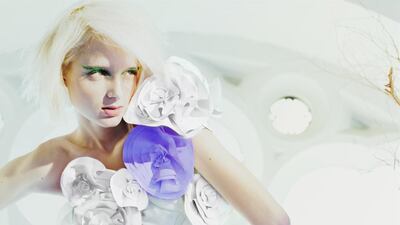
-
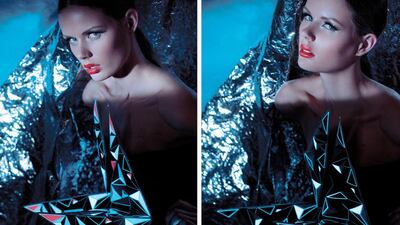
Rainbow Winters, a fashion design house founded by Amy Winters, incorporates technology into the clothes. Using sensors and smart textiles that adapt in response to sounds, stretch or sunlight and water, her designs can change colour and pattern. Courtesy Amy Winters -
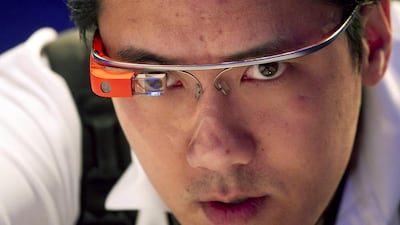
Vincent Nguyen of SlashGear wears a Google Glass while covering the introduction of the Microsoft Surface 2 in September. Mark Lennihan / AP Photo -

For aspiring health nuts and to inspire couch potatoes to get active, any of these four fitness trackers will record not only the steps taken on any given day but also sleep patterns to calorie intake, mood and progress toward exercise goals. Richard Drew / AP Photo -

Panasonic’s HX-A100, a wearable camera, on display at the 2013 International Consumer Electronics Show in Las Vegas, Nevada. David Becker / Getty Images / AFP -
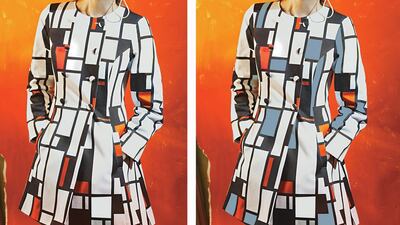
UK-based designer Amy Winters, who founded fashion design house Rainbow Winters, incorporates technology into the clothes. Using sensors and smart textiles that adapt in response to sounds, stretch or sunlight and water, her designs can change colour and pattern. Courtesy Amy Winters -
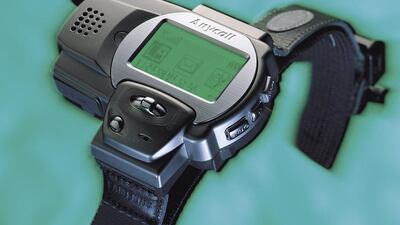
Samsung’s first watch phone, Samsung SPH-WP10, was made in 1999. Samsung Electronics / Handout via Reuters -
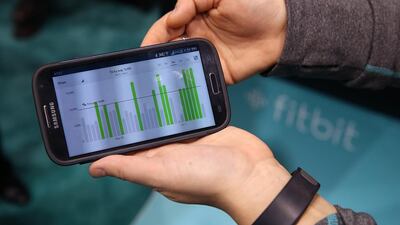
Data collected from the Fitbit Force is displayed on a smartphone at the 2014 International Consumer Electronics Show in Las Vegas, Nevada. Fitbit has issued a voluntary recall on its Force wristbands after reports began surfacing in January that the device was causing a painful skin irritation for some users. Justin Sullivan / Getty Images / AFP -
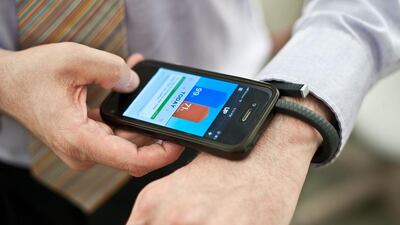
A man uses an UP fitness wristband and its smartphone application. Jawbone in 2012 released redesigned UP wristbands that combine fashion with smartphone lifestyles. UP apps tailored for Apple or Android mobile devices collect data from the bands to let people get pictures of activity, sleep, eating, and even moods on any given day or over time. Nicholas Kamm / AFP


“This avoids longstanding issues with mechanical mismatching between traditional hard metallic electronics and tissues which typically results in rejection, inflammation and other undesired responses when placed in vivo,” Dr McCune added.
The mechanical properties of the hydrogels can be customised to match human tissue, said Prof Oren Scherman, director of the Melville Laboratory for Polymer Synthesis, who led the research in collaboration with Prof George Malliaras from the Department of Engineering.
Since they contain no rigid components such as metal, they would also be less likely to cause the build-up of scar tissue. And they are surprisingly tough, being able to withstand being squashed without permanently losing their original shape, and can self-heal when damaged.
The researchers are planning future experiments to test the hydrogels in living organisms to assess their suitability for a range of medical applications.

For centuries, scientists thought there was only one species of electric eel. But in 2019, DNA analysis revealed there are actually three different species – Electrophorus voltaic, Electrophorus electricus and Electrophorus varii – all of which live in South America.
The Electrophorus voltai discharges the strongest shock of up to 860 volts, which is capable of powering seven 40-watt light bulbs.
In 2019, the Tennessee Aquarium in the US rigged its Christmas tree up to a sensor in the tank of its electric eel, Miguel Wattson, causing it to light up every time he released a jolt.
Eels emit the strongest shocks in self-defence and when trying to stun their prey, discharging smaller charges when they are communicating with other eels or trying to detect their surroundings.

