


Live updates: Follow the latest on Israel-Gaza
The Mayor of London, Sadiq Khan, summoned the Metropolitan Police Commissioner to discuss “community relations”, after a row about the force’s handling of pro-Palestinian protests.
Sir Mark Rowley met Mr Khan on Monday after an outcry over an incident in which an anti-Semitism campaigner was threatened with arrest near a demonstration on April 13.
Mr Rowley has faced calls for his resignation after the force bungled its apology for suggesting an "openly Jewish'' man's presence along the route of a pro-Palestinian march could provoke the demonstrators.
The mayor said he had confidence in his top officer, as did Prime Minister Rishi Sunak, who also called for rebuilding relations with the city's Jewish community.
"I share the shock and the anger that many are feeling," Mr Sunak said. "But what happened was clearly wrong. And it's right that they've apologised for that.
"And yes, I do have confidence in him, but that's on the basis that he works to rebuild the confidence and trust of not just the Jewish community, but the wider public, particularly people in London but more broadly."

London police are struggling to manage tension sparked by the Israel-Hamas war, with some Jewish residents saying they feel threatened by repeated pro-Palestinian marches.
“We remain focused on doing everything possible to ensure Jewish Londoners feel safe in this city,” the Metropolitan Police Service said in a statement Sunday.
“We know recent events and some of our recent actions have contributed to concerns felt by many.”
The marches have been largely peaceful.
But many demonstrators accuse Israel of genocide and a small number have shown support for Hamas, the group that led the October 7 attack on Israel and which has been banned by the UK government as a terrorist organisation.
The Metropolitan Police force has posted thousands of officers during each of the dozen major marches as it seeks to protect the rights of the pro-Palestinian protesters and prevent clashes with counter-demonstrators and Jewish residents.
It has met leaders of the Jewish community, and senior police officers wrote to the man at the centre of the latest controversy, offering to meet him to apologise and discuss what more could be done to “ensure Jewish Londoners feel safe".
Gideon Falter, chief executive of the Campaign Against Anti-Semitism, was wearing a traditional Jewish yarmulke when he was stopped by police while trying to cross a street in central London as demonstrators filed past on April 13.
One officer told Mr Falter he was worried that the man’s “quite openly Jewish” appearance could provoke a reaction from the protesters, according to video posted on social media by the campaign group.
A second officer then told him he would be arrested if he refused to be escorted out of the area, because he would be “causing a breach of the peace".
Metropolitan Police initially apologised for the language the officer used in describing Mr Falter’s appearance, but said counter-demonstrators had to be aware “that their presence is provocative".
The department later deleted that apology from its social media accounts and issued a second statement.
“In an effort to make a point about the policing of protest we caused further offence,” the force said on Friday.
“This was never our intention ... Being Jewish is not a provocation. Jewish Londoners must be able to feel safe in the city.”
Latest Gaza protests in the UK – in pictures
-

A woman leads a chant as Pro-Palestinian protesters gather in Parliament Square in London to call for an end to arms support to Israel. Getty Images -
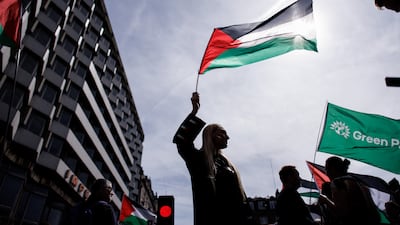
Pro-Palestinian protesters march from Russell Square to Parliament Square as part of a national day of action for Palestine, in London. EPA -
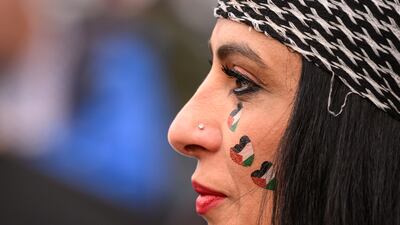
A woman in Parliament Square in London. Getty Images -
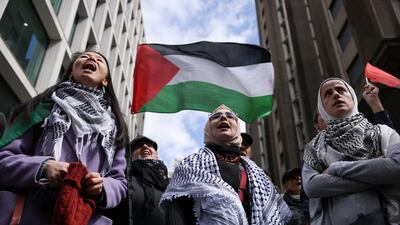
Protesters at a pro-Palestinian demonstration outside Barclays bank in London. Reuters -
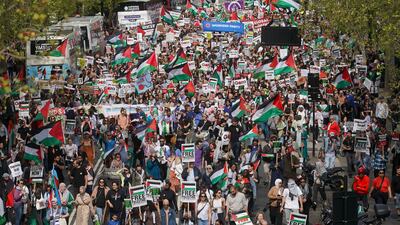
People take part in a pro-Palestine march in central London. PA -
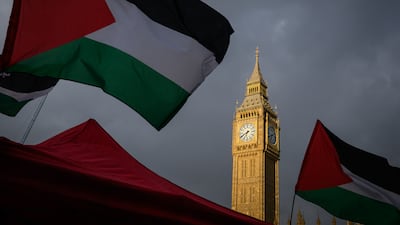
Flags fly near Big Ben as protesters gather in Parliament Square. Getty Images -
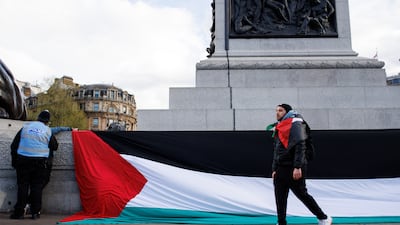
Protesters place a large Palestinian flag in Trafalgar Square during a vigil in London. EPA -

Police prevent protesters from blocking the entrance to One Curzon, a building owned by London Metric, who also rent buildings to weapons manufacturers Elbit, Boeing and BAE Systems. Getty Images



