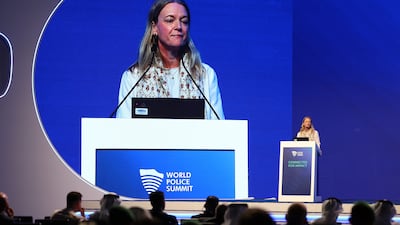

Methamphetamine is taking hold across the Middle East as drug gangs move to fill the gap left by the collapse of Syria's Captagon trade, a senior UN official has warned.
The end of the war in Syria ruined production of Captagon and broke up the smuggling networks that had flooded the region with the illegal pills, said Siri Bjune of the UN Office on Drugs and Crime (UNODC). But crime gangs have been quick to switch products.
“The end of the conflict in Syria has disrupted Captagon production and weakened the networks that sustained the market, while methamphetamine is increasingly becoming entrenched in the Near and Middle East,” Ms Bjune told the World Police Summit in Dubai on Tuesday.

Syria was the world's biggest source of Captagon under Bashar Al Assad, whose regime fell in December 2024. Much of the trade was aimed at consumers in the Gulf.
Ms Bjune, chief of UNODC's border management branch, said the shift demonstrated how quickly criminal groups can react to pressure from police and changes in the market.
Record drug use
Ms Bjune was presenting the UN's World Drug Report 2026, which found that 331 million people worldwide used drugs in 2024, a rise of 34 per cent from a decade earlier. “Drug use has reached historically high levels,” she told those gathered at Dubai World Trade Centre.
Methamphetamine remains the world's largest synthetic drug market. North America, East Asia and South-East Asia are still its biggest markets but smugglers are increasingly pushing it into new regions, including the Middle East.
“Traffickers are diversifying their routes, exploiting smaller ports, new transit corridors and sophisticated technologies to move drugs across borders,” Ms Bjune said.
She also warned that the Taliban's ban on opium production in Afghanistan appeared to be weakening. Cultivation has risen more than fourfold in a year, from about 10,000 hectares in 2025 to more than 43,000 hectares this year, though figures remain below pre-prohibition levels.
Opium has generated an estimated $525 million for traffickers in Afghanistan so far in 2026, she said.
The report also raised concerns over fentanyl in North America, the misuse of the painkiller tramadol in parts of Africa and the spread of nitazenes, a group of highly potent synthetic opioids.
Ketamine in green tea packets
Stephen Fry, executive director for investigation support at Interpol, told the summit how a single bag washed up on a beach in South Korea exposed a trafficking network spanning nine countries.

A beach cleaner on Jeju Island found the plastic package, which appeared to contain green tea. “Inside was ketamine,” said Mr Fry. By comparing images and intelligence from earlier seizures shared by member countries, Interpol linked what had previously looked like unrelated cases.
“Across nine countries, 24 tonnes of ketamine [were found], all concealed in the same distinctive green tea package,” he said. “For these networks, a seized shipment is simply the cost of doing business.”
He urged police to treat every seizure as a lead to trace routes, money flows, middlemen and suppliers.
Ketamine is now the fastest-growing drug on Interpol's radar, driven by illicit production in increasingly industrial-scale laboratories, Mr Fry said.
During Interpol's Operation Lionfish-Mayag, ketamine seizures overtook methamphetamine for the first time. The same operation seized enough fentanyl for an estimated 63 million potentially fatal doses.
Traffickers are concealing drugs in everyday goods such as leather, paprika and paint, and using doctored customs papers to avoid detection, Mr Fry said. “It is a pressing concern with AI making convincing fakes much easier to produce,” he added.
He called on countries to share intelligence more readily. “Each time you pick up that phone, exchange an email with an international counterpart, or say 'yes' to an information request from another country, the investigation becomes bigger than one country,” he said.
'Target the business'
Gabor Sztankovics, a regional adviser at UNODC, said police must pursue the business models behind organised crime rather than focusing only on seizures and arrests.
“A middleman, a driver, a transporter or a smuggler can easily be replaced,” Mr Sztankovics said. “We have to target the business, the market and the supply chain.”
Drawing on his work with Europol on cases involving encrypted messaging, he said gangs relied on hard-to-replace specialists who handle encrypted communications, cryptocurrency and money laundering.
Taking out that expertise could do more lasting damage to criminal groups than shutting down individual supply routes, he said.

