Abu Dhabi has teamed up with global tech company OpenAI on a series of landmark deals aimed at harnessing artificial intelligence across sectors including the government, investment, food and education.
The agreements were signed after a meeting between Sheikh Khaled bin Mohamed, Crown Prince of Abu Dhabi and Chairman of the Abu Dhabi Executive Council, and OpenAI chief executive Sam Altman.
Mr Altman hailed the UAE for setting a "bold, global standard" for the integration of AI across both the public and private sectors.

"We are proud to support the UAE’s ambition, anchored in a shared commitment to safety, accessibility and responsible innovation,” he said.
AI-powered plans
The Abu Dhabi government and OpenAI will launch the world's first AI-native Machine-Readable Government initiative, which is being heralded as a key step in the emirate's goal to become the world's first AI-native government.
The high-tech project will translate a defined set of government policies and regulations into machine-readable form, enabling AI-powered systems to assist officials with routine regulatory compliance assessments, including those related to issuing permits and certificates.
-
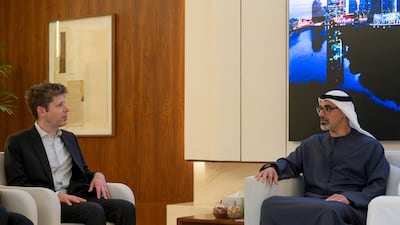
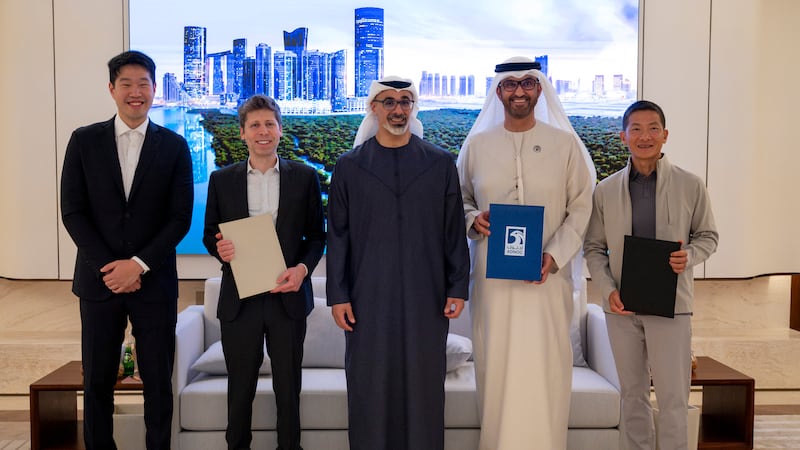
Sheikh Khaled bin Mohamed, Crown Prince of Abu Dhabi and Chairman of the Abu Dhabi Executive Council, meets OpenAI chief executive Sam Altman. All photos: Abu Dhabi Media Office -
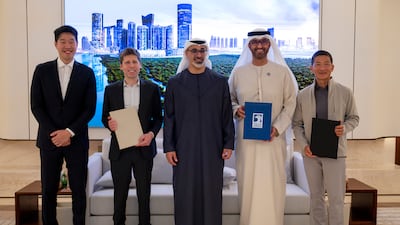
Sheikh Khaled and Mr Altman held talks before Adnoc signed an agreement with OpenAI and G42 to become the first energy company to deploy OpenAI’s Frontier technology -
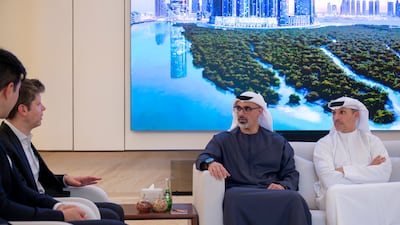
Mr Altman said 'Abu Dhabi and the UAE are setting a bold, global standard for AI integration' -
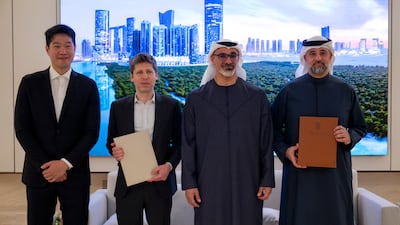
Sheikh Khaled witnessed the signing of the agreement, signed by G42 through its subsidiary Inception42 -
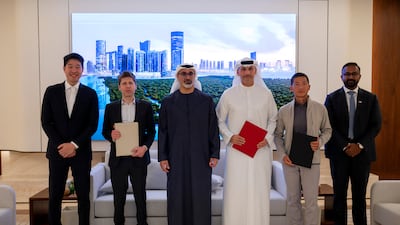
Sheikh Khaled with Mr Altman and other officials -
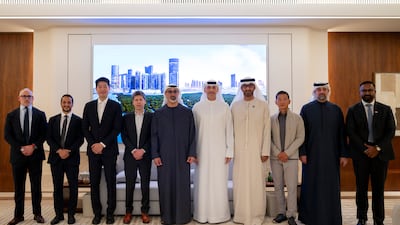
Sheikh Khaled with Mr Altman and other officials



Each assessment is traceable to the governing rule, while government officials retain oversight and accountability for final decisions.
Led and governed by the Department of Government Enablement – Abu Dhabi (DGE), MRG’s first pilot is already in production with the Abu Dhabi Agriculture and Food Safety Authority (Adafsa), focused on food imports.
The technology will run on OpenAI’s GPT models using inference infrastructure based in the UAE.
Investing in the future
Under the plans, Abu Dhabi's Mubadala and Inception42 signed an agreement with OpenAI to deploy advanced AI capabilities to support investment analysis, opportunity identification and risk assessment, with the goal of ensuring more informed investment decisions.
In addition, Inception42 and OpenAI signed a five-year agreement to enable the adoption of Open AI's Frontier platform across government, enterprise and education.
They will collaborate to deliver enterprise solutions for large UAE organisations, pairing OpenAI’s Frontier platform and AI engineering expertise with Inception42’s applied AI capabilities and consultancy-led professional services programmes.
The UAE has taken significant steps in recent years to promote the use of AI within its education sector, to ensure teachers and pupils alike can keep pace with the rapidly-evolving technology.
In September, the UAE Cabinet approved an AI curriculum to be used across all public and private schools.
The curriculum will focus on “providing students with the technical requirements of AI, instilling an awareness of its ethical applications, and enhancing their understanding of AI data, algorithms, applications, and risks”, state news agency Wam reported.
Sheikh Mohammed bin Rashid, Vice President, Prime Minister and Ruler of Dubai, who chaired the ministerial meeting, said the UAE planned to train 22,000 teaching staff to utilise AI.
Growing partnership
Earlier this month, Abu Dhabi partnered with OpenAI and Microsoft to launch the AiNative training programme, aimed at equipping 20,000 government employees and the wider public with AI skills.
Under the initiative, employees will be given help to build up expertise with ChatGPT, Codex and Microsoft 365 Copilot. Specialised, function-specific certifications, including areas such as coding and data, will follow in later phases of the project.
Citizens and residents will be able to access the training programme via Tomouh, DGE's AI-driven learning app, which can be accessed through the UAE Pass government app.
The scheme will cover practical applications of AI in everyday life, including managing personal finances, running a small business, finding a job, studying and creating content responsibly online, and will be delivered through the free version of ChatGPT.
DGE owns the curriculum, which has been developed with OpenAI, Microsoft and MBZUAI.
AI ambitions
Abu Dhabi last year set out its mission to be the world's first AI-powered government, as part of its Digital Strategy 2025-2027.
Led by the DGE, the programme will allocate Dh13 billion ($3.5 billion) to boost digital infrastructure, automate 100 per cent of government processes, and integrate sovereign cloud computing across all operations.
The strategy is expected to contribute more than Dh24 billion to Abu Dhabi’s economy by 2027 and create more than 5,000 employment opportunities supporting Emiratisation efforts.

