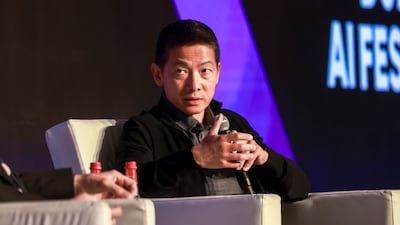
AI provides the UAE with a unique chance to reposition itself as a global exporter of intelligence rather than energy, the group chief executive of Abu Dhabi's technology conglomerate G42 has said.
The UAE’s energy resources could be transformed into computing power that could supply AI services far beyond its borders, said Peng Xiao.
He spoke during the Dubai AI Festival on Monday.

“I think our ambition is to go from an energy exporter to become an intelligence exporter,” Mr Xiao said.
Mr Xiao said the UAE’s access to reliable energy and its speed in delivering computing infrastructure could help it meet international demand for AI services.
G42 is developing a five-gigawatt AI campus in Abu Dhabi, including the one-gigawatt Stargate UAE project with partners including OpenAI, Oracle, Nvidia, Cisco and SoftBank.
“Many of our American partners are actually coming to our region, coming to our country to get access to compute capacity, because we are able to deliver now,” he said.
The UAE’s connectivity could allow services from its planned infrastructure to reach a potential user base of about four billion people, he added.
Humans should fundamentally rethink what they value, including the ability to think and to use tools, because AI can now do that better than humanity, Mr Xiao said. He also strongly suggested that AI has distilled all of humanity’s knowledge.
"AI can already out-think us,” he said.
Because of this, he said, people should instead value aspects such as human connection and creativity.
“We need to think fundamentally about our lifestyle and how to coexist and also even thrive in the age where very likely AI will be doing most of the thinking for us," he said.
Disruption

Omar Al Olama, Minister of State for AI, Digital Economy and Remote Work Applications, addressed the forum in Dubai on Monday.
He said the government must ensure every worker sees AI as “an enabler and a force multiplier, rather than a displacer for them in the workplace".
“We understand that there is going to be disruption on the horizon, disruption to the private sector, disruption to governments," said the minister.
He added that the UAE leadership was reviewing its AI plans every six months, when previously it did so annually.
Over the years, the focus has shifted, from computer vision and self-driving cars in 2017, to large language models in 2022, followed by agents capable of carrying out tasks on a user’s behalf.
“What we understood from that as a nation is that we need to be agile,” Mr Al Olama said.
The aim is to improve quality of llife, allowing people and organisations to increase their output with a corresponding rise in population.
“So, a nation like the UAE, with a population of around 10 million people can have the impact of a nation of 50 million people or 100 million people, and that's our ambition,” he said. “To ensure that every single person that works here, every single person that lives here, and every single person that visits the UAE is able to multiply their output through this technology.”
In April, Sheikh Mohammed bin Rashid, Vice President and Ruler of Dubai, launched a plan to introduce agentic AI across 50 per cent of federal government sectors, from services to operations, within two years. It includes training government employees to use AI tools.
“He expected us to re-engineer government processes and services from scratch to allow for that transformation to happen,” Mr Al Olama said.
He cautioned that success would depend on how effectively organisations used AI rather than simply how much computing power they consumed.
Businesses needed to identify advantages competitors could not easily copy. Those relying on public models and cloud services risked being displaced, replaced or driven to extinction, he warned.
“My advice to all of you is try to understand what this technology can do for you and what it can do to you.
"Many people ask me what Dubai stands for, and I always say Dubai stands for Dubai Understands Business and Artificial Intelligence."

