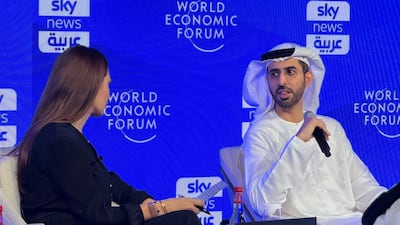

The UAE's artificial intelligence minister has said there must be worldwide consensus on the use of AI in controlling weapon systems.
Omar Al Olama, Minister of State for AI, Digital Economy and Remote Work Applications, said there was an urgent need for countries such as the US, Russia and China to agree whether AI should be used when it comes to the deployment of autonomous weapons.
“If you're going to talk about AI deploying a rocket or a bomb or sending a fighter jet to destroy a school or do certain things, we haven't been able to come to a global consensus to stop that,” he said.

“There are certain fronts of AI that need to be regulated and globally everyone's calling for it again, autonomous systems that are being used in the military to kill people. That's something that we should all agree [needs to be regulated].”
Mr Al Olama was speaking at the Annual Meeting of Global Future Leaders, hosted by the World Economic Forum (WEF) and the government of Dubai. He said it is important that AI companies are accountable for ensuring sufficient guardrails are in place to prevent the military misuse of the technology.
“It's important for us to put the right systems, to invest in understanding what could possibly go wrong,” he said. “We won't get everything right, but we need to make sure that we minimise the catastrophic events and we try to work with each other to ensure that we know exactly what's going to come out of this.”
In July, The National reported that UK foreign secretary at the time, Yvette Cooper, said AI could become the “greatest security challenge of the next decade” and called for international co-operation to stamp out the risks. Her call was backed by UN Secretary General Antonio Guterres.

Ms Cooper drew parallels between AI and efforts around nuclear safety in the wake of the Second World War and the atomic bombing of the Japanese cities of Hiroshima and Nagasaki.
Trust is paramount
Referring to sentiments shared in a new book by Sheikh Mohammed bin Rashid, Vice President and Ruler of Dubai, Mr Al Olama said trust is the backbone and true currency of the UAE – and should be the same for AI.
“The challenge that we have is it's going to be extremely easy for us to lose trust, but very hard for us to gain it back when it comes to agentic systems,” Mr Al Olama said.
“If the government takes one wrong decision, you lose a lot of that currency – you lose a lot of that trust. Once we have one breakthrough event where AI exits the sandbox and goes and harms people, I think it's going to take a long time for us to regain that trust.”
He said the UAE is doing what it can to maintain public trust in its use of AI, for example through a government-wide control tower.
“We have an agentic control tower on the federal UAE side and every agent [in the country] needs to log in and plug into the control tower,” he said.
This provides oversight of agentic AI used in government bodies and constantly assesses the value of the service.

Time for action
The UAE has participated in high-level discussions such as the G20, the G7 and the UN General Assembly but the conversations about AI have yet to lead to any conclusive global action on applying guardrails, said Mr Al Olama.
"We haven't invested enough, as governments collectively, to create a global system of consensus that ensures that we all agree to put guardrails. There needs to be action."
Countries have been working on securing their own AI infrastructure to be self-reliant, building local data centres and servers. Mr Al Olama sees countries building their own models in the future.
“Governments are not going to be at the mercy of a company or at the mercy of a specific group of people,” he said.
“The challenge is if everyone can deploy AI on their own infrastructure in their own way, that would create a lot more avenues of things going off the rails and harming people. But it also means that they're going to understand exactly what they can and cannot do with these tools, and they are responsible for it.”

