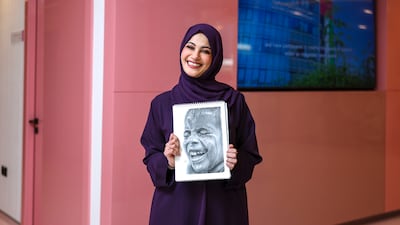
Breast cancer survivors in the UAE have delivered a message of hope to others as crucial screening drives are expanded to help save lives and transform "awareness into action".
To mark Breast Cancer Awareness Month, two Emirati women have shared their stories of battling back from adversity and refusing to allow the disease to define their lives.
Sara Al Sheebani and Meera Al Ameri underwent operations and gruelling chemotherapy sessions on their road to recovery – but were determined not to be ruled by fear, even in the toughest of times. They have now highlighted the importance of regular check-ups to ensure any issues are detected early.

Breast cancer remains the most common form of the disease to affect women around the world. It is the leading cause of premature death among women, with annual cases expected to rise from 2.3 million in 2023 to more than 3.5 million by 2050.
In October last year, breast cancer screenings in Abu Dhabi surged by 377.5 per cent compared with the same month in 2024. The exact numbers of screenings was not made available.
The Abu Dhabi Public Health Centre is seeking to build on that momentum by offering free mammograms around the emirate throughout October.
'I wasn't frightened'

For Ms Al Sheebani, now 47, a pain in her chest led her to seek medical advice. She was 34 when doctors diagnosed her with stage two breast cancer. She had no skin changes and could not feel a lump.
“I accepted the news. I wasn’t frightened,” she said. “I kept praying that they would be able to operate and that it hadn’t spread elsewhere in my body.”
She underwent surgery, chemotherapy and about 20 sessions of radiotherapy. She also had hormone treatment for more than seven years. At times, she was in so much pain that she could barely raise herself up.
“Sometimes I would open my eyes, see the sun and say, ‘Thank God, I’m alive,’” she said. “There were moments when I wondered if I might die. But I knew God was with me, and I had to keep lifting myself up.”
Ms Al Sheebani was determined to live life to the fullest and attended a family wedding during her treatment, despite her mother pleading with her to rest at home. Her feet were so swollen from treatment that she wore the largest men’s slippers she could find and asked a make-up artist to apply false eyelashes as she dealt with hair loss.
“I’m still going,” she told her parents. “Why should I hide? Why should cancer patients continue to hide in their homes? Why should I be ashamed of something I wasn’t responsible for? It is an illness like any other. So what if I lost my hair? Why should I be judged?”
Ms Al Sheebani recovered and has since had a son through IVF. She now advocates early cancer screening and encourages other patients to share their experiences. “Cancer has changed me in so many ways. I won’t deny it was hard, but it is also manageable and you get through it,” she said.
'Cancer can happen to anyone'
Meera Al Ameri, a marathon runner, weightlifter and mother of five, thought that paying close attention to her health would protect her from the disease. Her diagnosis in 2024 came as a shock.
“I ate healthily, lifted heavy weights and participated in marathons,” she said. “You think that because you are healthy, it cannot happen to you. But cancer can happen to anyone.”
She underwent chemotherapy and a double mastectomy, but continued to exercise during her treatment. “After chemotherapy, I would go and lift weights,” she said. “I treated myself as a message for others. Why should we be shy? Why should we be embarrassed?”
Ms Al Ameri also drew strength from art, which offered her an opportunity to express her emotions on paper during her cancer fight.
She chose not to hide the physical effects of treatment. “I loved myself bald,” she said. “I would actually stand in front of the mirror and admire myself. I enjoyed the wigs, too.”
Early diagnosis is key

Dr Rashed Alsuwaidi, director general of Abu Dhabi Public Health Centre, emphasised the importance of Breast Cancer Awareness month, but wants efforts to catch the disease early to be in sharp focus all year round.
“The increase we saw in breast cancer screenings last October shows what can happen when awareness turns into action,” he said. “Our priority, not just in October but for the rest of this year, is to build on that progress and make preventive screening a sustained part of how people look after their health.”
Dr Mouza Al Ameri, assistant professor at the United Arab Emirates University’s College of Medicine and Health Sciences and a consultant breast surgeon, said fear can hold women back from seeking out help.
“Fear can make the disease feel bigger than it is,” she said. “Once it is diagnosed, it becomes something we can deal with. That is why courage is the first step towards taking action.”
Dr Aala Al Nuaimi, consultant psychiatrist at Sakina, Abu Dhabi's mental health network, said support from others could help women manage the fear and anxiety surrounding screenings and diagnosis. “Awareness is about providing information, psychological safety helps them act and human connection helps them sustain the journey,” she said.

Dr Stephen Grobmyer, head of Cleveland Clinic Abu Dhabi's Cancer Institute, said screening remained crucial to catching cancer early and improving patient outcomes.
Studies at Cleveland Clinic found that about a quarter of breast cancer patients were under 40 when they had the disease diagnosed – a younger patient profile than in the US or much of Europe. Researchers are investigating why and how screening might be improved for younger women.
Advancing cancer care
Abu Dhabi's Department of Health has awarded Centre of Excellence status to specialist breast cancer services at the Burjeel Breast Centre at Burjeel Cancer Institute, as well as Cleveland Clinic Abu Dhabi. The designation matters for patients because a team of specialists is often required to assess, diagnose and plan treatment together, Dr Grobmyer said.
“A Centre of Excellence really brings all of those things together into one place and improves communication between doctors and patients, and doctors and doctors,” he said. “It makes care safer, more efficient and we think it leads to happier patients and safer care.”
Dr Dima Abdul Jabbar, consultant medical oncologist and director of the Burjeel Breast Centre, said care is "not one size fits all".
“Genetics is also only one part of the picture," she added. "We need to look at clinical, lifestyle, social and population data to develop a more complete understanding of each patient.”

Dr Grobmyer said advances in understanding breast cancer and the results of clinical trials had helped doctors reduce treatment for some patients while improving outcomes.
He also said artificial intelligence was being used to support radiologists assessing mammograms, help estimate risk and improve the analysis of pathology samples.
“In the early days, back in the mid-90s, we pretty much treated all patients the same,” he said. “At that time, we didn’t know who needed chemotherapy and who didn’t.”