
Direct flights between Abu Dhabi and Berlin will be launched on October 15 under an agreement between Etihad and the German airline Condor.
The start date of the new route – which was previously announced in December – was confirmed in Munich on Friday.
Condor planes will be used to transport passengers to and from Zayed International Airport to Berlin's Brandenburg Airport.

Dr Nadia Bastaki, Etihad’s chief people, government and corporate affairs officer, said the start of the route was a significant step.
“We are really proud to be here today because this marks a very important milestone for the UAE and Germany,” she said. “As we heard today, there are significant partnerships happening across all sectors, especially in transport and aviation.”
The route was unveiled a day after Germany announced it would open access to Berlin Brandenburg Airport to UAE airlines.
Landmark state visit
-
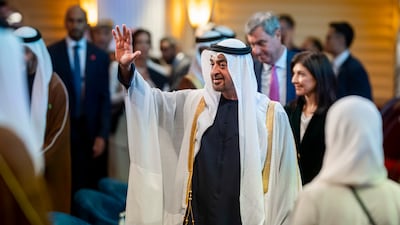
President Sheikh Mohamed arrives at the German Emirati State Visit Business Forum at Bayerischer Hof Hotel. All photos: UAE Presidential Court -
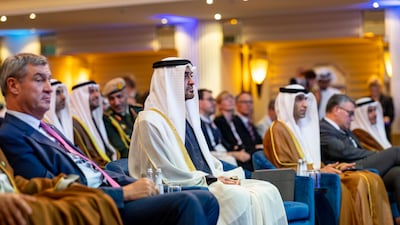
President Sheikh Mohamed at Bayerischer Hof Hotel -
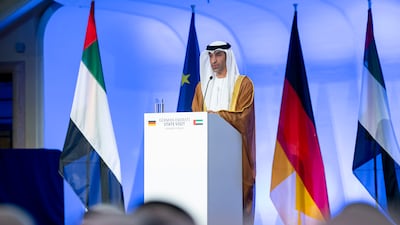
Dr Thani Al Zeyoudi, UAE Minister of State for Foreign Trade, speaks at the Bayerischer Hof Hotel -
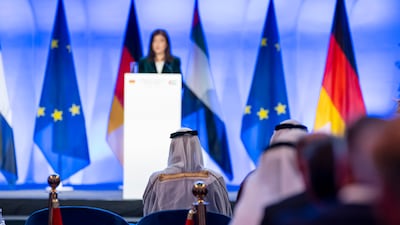
The business forum at Bayerischer Hof Hotel -
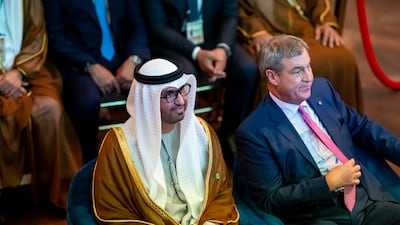
Dr Markus Soder, Minister-President of Bavaria, with Dr Sultan Al Jaber, UAE Minister of Industry and Advanced Technology -

President Sheikh Mohamed meets former chancellor Angela Merkel as part of his state visit to Germany. The meeting was also attended by Dr Sultan Al Jaber, Minister of Industry and Advanced Technology, right. -

Sheikh Mohamed meets Emirati students studying in Germany -

Sheikh Mohamed stands for a photograph with the Emirati students -

Sheikh Mohamed meets representatives of German companies at a reception in Berlin -

President Sheikh Mohamed and Bavaria's state premier Markus Soder, left, inspect a police honour guard during a reception at the Munich Residenz. All photos: UAE Presidential Court -

Sheikh Mohamed is received by Mr Soder at the Bavarian palace -

The UAE President is presented with a gift from a young girl dressed in traditional Bavarian costume -

Sheikh Mohamed signs the guest book at the Munich Residenz, watched by Mr Soder -

Sheikh Mohamed and Mr Soder during a reception at the Munich Residenz -

President Sheikh Mohamed is received by Friedrich Merz, Chancellor of Germany. -

Sheikh Mohamed and Mr Merz at the Federal Chancellery in Berlin -

Sheikh Mohamed delivers a speech during a state dinner at the Bundesprasidialamt -

Sheikh Mohamed at the dinner reception hosted by German President Frank-Walter Steinmeier -

Sheikh Mohamed lays a wreath at the Neue Wache Memorial for victims of war and dictatorship, in Berlin -

German honour guards hold a wreath during a ceremony at the Neue Wache Memorial in Berlin -

Sheikh Mohamed speaks with Kai Wegner, Mayor of Berlin, and Karin Marschall, head of protocol at the Federal Foreign Office of Germany, at the Red City Hall -

Sheikh Mohamed and Mr Wegner view a Lego model at the Red City Hall, along with Dr Sultan Al Jaber, Minister of Industry and Advanced Technology, and managing director and Group chief executive of Adnoc -

Sheikh Mohamed is received by Julia Kloeckner, President of the German Bundestag, at the Reichstag -

Sheikh Mohamed attends a reception hosted by Mr Steinmeier at Villa Borsig in Berlin -

Sheikh Mohamed and Mr Steinmeier stand while their national anthems are played at Villa Borsig -

From left, Lana Nusseibeh, Minister of State; Faisal Al Bannai, Adviser to the UAE President for Strategic Research and Advanced Technology Affairs; Ahmed Alattar, UAE ambassador to Germany; and Staff Maj Gen Musallam Al Rashidi, Director of the Office of the Supreme Commander of the Armed Forces, stand for the national anthem -

From left, Sheikh Abdullah bin Zayed, Deputy Prime Minister and Minister of Foreign Affairs; Ahmed Al Mazrouei, Chairman of the President’s Office for Strategic Affairs and Chairman of the Abu Dhabi Executive Office; Ali Al Shamsi, Secretary General of the Supreme Council for National Security; Dr Sultan Al Jaber, Minister of Industry and Advanced Technology; and Dr Thani Al Zeyoudi, Minister of Foreign Trade -

From left, Mohammed Al Mazrouei, Minister of State for Defence Affairs; Sheikh Hamdan bin Mohamed, Deputy Chairman of the Presidential Court for Special Affairs; Sheikh Mohammed bin Hamad, Adviser to the UAE President; Noura Al Kaabi, Minister of State; and Lana Nusseibeh, Minister of State -

German honour guards at the reception for Sheikh Mohamed at Villa Borsig


It was one of a raft of announcements made on Thursday as part of President Sheikh Mohamed's state visit to Germany.
Etihad’s presence in Germany stretches back 22 years, with the airline launching its first service to the country in 2004. The Abu Dhabi carrier now operates 35 flights a week to destinations in Germany. Its partnership with Condor is expected to add between 12 and 14 weekly services in different phases.
“Our first flight with Condor will start on October 1 from Berlin to Abu Dhabi,” Dr Bastaki said. “That marks a really important partnership. Condor will be able to use Abu Dhabi as a destination, but also use our network of more than 100 destinations, enabling people to fly from Germany to the east or elsewhere.”
Condor's partnership with Etihad also includes flights between Frankfurt and Abu Dhabi and connections through the UAE capital to destinations including Bangkok.
Dr Bastaki said strong demand on Etihad’s German routes supported the case for further expansion. The airline’s current services are operating at a load factor of about 90 per cent, meaning nine out of every 10 available seats are occupied.
“Our flights today are operating at a 90 per cent load factor,” she said. “That means the demand is there and people want to travel and use Etihad as part of their journey.”
She said the new services would give passengers more choice and help build stronger links between the two countries. “There is a direct market between Berlin and Abu Dhabi, but it also helps to build bridges,” she said.
Asked about Etihad’s longer-term plans for Germany, she said the airline wanted to increase frequencies at the four points covered by the bilateral air services agreement.
“We want to increase frequency across all four points in the bilateral,” she said. “If that allows us to go into different cities in Germany, that will also be part of our future plans.”
Germany is one of Etihad’s most important European markets and the airline expects stronger air links to support growing commercial and tourism ties. About 2,000 German companies have offices in the UAE, with many using the country as a base from which to serve markets across the Middle East, Africa and Asia.
“Germany is very important for us within the European sector,” Dr Bastaki said. “It is one of the main markets, not only for the airline but also for Abu Dhabi. The capitals need to be connected, and that is why the national airline, together with other airlines coming into Abu Dhabi and the UAE, can help support that partnership.”
Dr Bastaki said Etihad was also investing in efforts to address aviation’s environmental impact. “Carbon footprint is on the agenda of every airline,” she said. “We are invested in it, we offset our carbon footprint and we recognise that everybody in the aviation sector has a responsibility.”

