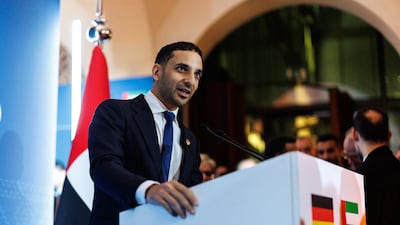
The UAE's emphasis on diplomacy to resolve conflicts means the nation is playing an increasingly important role on the global stage, said the country’s ambassador to Germany.
Ahmed Alattar spoke to The National in Berlin before President Sheikh Mohamed’s state visit to Germany, which begins on Wednesday. The UAE leader is to meet German President Frank-Walter Steinmeier and Chancellor Friedrich Merz to explore efforts to deepen co-operation, with a focus on economic and development sectors.
The visit is a rare opportunity to take relations between the two countries to a new level, said Mr Alattar. He highlighted the UAE's role in the conflict between Russia and Ukraine as an example of the diplomatic work by the Emirates.

Almost 8,000 prisoners have been exchanged by Russia and Ukraine as a result of mediation by the UAE. Since the war in Ukraine broke out in 2022, the UAE has carried out 26 mediations between the two sides.
“It is the neutral third place, and that is a very important place to have. In this day and age, it is more important than ever to have stable, reliable partners to deal with the challenges of tomorrow.
“The prisoner exchanges organised by the UAE for Russian and Ukrainian prisoners are very important,” he said. “The humanitarian support we have provided to Ukraine in several different fields is very important.”
The UAE’s relationship with both countries allowed it to provide a place where communication could continue despite the breakdown in relations between Russia, Ukraine and Nato.
Peace talks between Russia, Ukraine and the US were held in Abu Dhabi in February as part of efforts to end a war which has raged for more than four years.
-
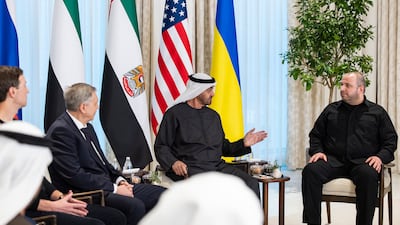
President Sheikh Mohamed receives the heads of delegations taking part in the UAE-hosted trilateral talks between Russia, Ukraine and the US at Al Shati Palace. Delegates include Jared Kushner, left, Igor Kostyukov, Chief of the Main Directorate of the General Staff of the Russian Armed Forces, second left, and Rustem Umerov, Secretary of the National Security and Defence Council of Ukraine, right. All images: UAE Presidential Court -

Sheikh Khaled bin Mohamed, Crown Prince of Abu Dhabi and Chairman of Abu Dhabi Executive Council, and Sheikh Theyab bin Mohamed, Chairman of the Office of Development and Martyrs Families Affairs at the Presidential Court, attend the Al Shati meeting with Steve Witkoff, US special envoy, and Kirill Budanov, Director of the Office of the President of Ukraine -
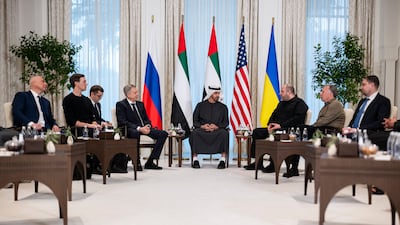
President Sheikh Mohamed receives the heads of delegations participating in the UAE-hosted trilateral talks between Russia, Ukraine and the US at Al Shati Palace. Delegates include Kirill Budanov, Director of the Office of the President of Ukraine, Steve Witkoff, US special envoy, Rustem Umerov, Secretary of the National Security and Defence Council of Ukraine, Igor Kostyukov, Chief of the Main Directorate of the General Staff of the Russian Armed Forces and Jared Kushner -

Rustem Umerov, Secretary of the National Security and Defense Council of Ukraine, left, and Steve Witkoff, US Special Envoy, at Al Shati Palace -
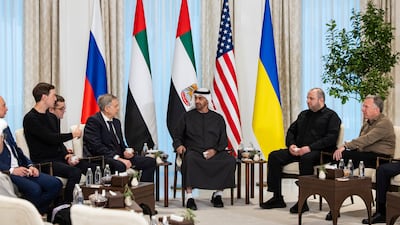
President Sheikh Mohamed receives the heads of delegations participating in the UAE-hosted trilateral talks between Russia, Ukraine and the US at Al Shati Palace. Delegates include Jared Kushner, Igor Kostyukov, Chief of the Main Directorate of the General Staff of the Russian Armed Forces, Rustem Umerov, Secretary of the National Security and Defence Council of Ukraine, and Steve Witkoff, US special envoy -
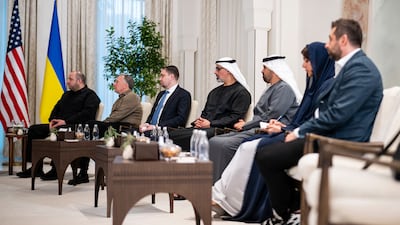
Sheikh Khaled bin Mohamed, Crown Prince of Abu Dhabi and Chairman of Abu Dhabi Executive Council, and Sheikh Theyab bin Mohamed, Chairman of the Office of Development and Martyrs Families Affairs at the Presidential Court, attend the Al Shati meeting. Also present were Kirill Budanov, Director of the Office of the President of Ukraine, Steve Witkoff, US Special Envoy, and Rustem Umerov, Secretary of the National Security and Defence Council of Ukraine


“We continue to play an important role as a nodal point of communication and as a country where people from all sides can visit and still have some degree of communication between them,” said Mr Alattar.
The UAE’s approach to international conflicts remained grounded in non-interference and self-defence, he said.
“We definitely do not want to be seen as a party to any conflict,” he said.
At the same time, the UAE’s growing defence industry meant it was becoming an exporter rather than simply an importer of security.
“The UAE has one of the largest arms-export capabilities in the world, increasingly with a footprint in Europe and a global presence,” he said. “This trend will continue in the future, with the UAE becoming an exporter of security, not just an importer of security.”
That role included the export of defence equipment as well as involvement in international stabilisation efforts, he said.
Asked how the UAE could continue dealing with opposing powers without being seen to take sides, Mr Alattar said the country acted according to its interests.
“We take the UAE’s side,” he said. “That means playing as large a role as possible, to the maximum of our capabilities.”
Mutual benefits
The ambassador said Germany had much to gain from closer relations with the UAE. He rejected the suggestion that the partnership had historically benefited the Emirates more because of Germany’s industrial and technological strengths.
“We need to give the UAE more credit here as an international player,” he said. “The UAE has come a long way in the 50 years since we established relations. It is seen as an important international player and an important partner to many countries.”
While the Emirates remained an important energy supplier, its value to Germany went far beyond oil and gas, he said.
It was also a source of investment capital, a global logistics and aviation centre and, increasingly, a base for German manufacturing.
“It is an important country in the Middle East that you can talk to, an important country that will open new possibilities for you in the region, a power broker and a strategic partner,” Mr Alattar said.
“It is also one that you can rely on – one that will do what it says. I think that is a rare thing to find in this day and age.”
Offering support
Germany’s response when the UAE came under attack from Iran showed the value of that relationship, he said.
It was among the first European countries to condemn the attacks and Mr Merz contacted Sheikh Mohamed to express his country’s solidarity. The call came only weeks after Mr Merz visited Abu Dhabi in February.
“His visit and the partnership obviously left a strong impression on him, which is why visits are important,” Mr Alattar said.