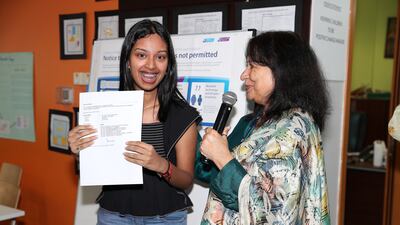
Pupils in the UAE and across the world are receiving their IB results today.
The International Baccalaureate is studied in 163 countries, including the UAE.
There are an estimated 6,200 schools offering an IB education in three regions: Africa, Europe and the Middle East; Asia-Pacific; and the Americas.

IB schools have been in the UAE since 1992, with 65 currently operating in the Emirates.
Pupils from primary school age onwards can avail themselves of an IB education. Instead of A-Levels, which are the most common exams sat by teenagers at UK curriculum schools, pupils can take an IB Diploma Programme (IBDP), open to those aged 16 to 19.
The main similarity with A-Level exams is that IB offers the same level of education; they are both university entry qualifications.
For the IB Diploma, pupils take six subjects including two languages, mathematics, sciences, humanities and, if they wish, an arts subject.
Pupils also take three core units: writing a 4,500-word extended essay, studying the theory of knowledge, and taking part in creativity, activity and service.
Both the A-Level and IB are highly rigorous and have straightforward scoring systems.
The IB subjects are scored on a 1-7 scale. Pupils gain a maximum of three points for the core units giving a maximum score of 45. A-Levels are marked on an A*-E scale.
A-Levels require pupils to study three or four subjects. Although not part of the A-Level courses, extensive extracurricular activities and study programmes are offered by many British schools.
The IB Diploma Programme is recognised and respected by the world’s leading universities and, according to the IB website, evidence suggests that higher rates of IBDP students go on to university to pursue higher education than non-IB students.