

Artificial intelligence will play a major role in helping the UAE to address issues caused by the increasing amount of extreme weather, newly appointed minister Dr Abdulla Al Mandous has declared.
Dr Al Mandous, director general of the National Centre of Meteorology, said his ministerial appointment reflects how deeply climate issues are embedded in the UAE's “long-term strategic priorities” at a time when the pace and complexity of climate change are creating “significant challenges”.
He told The National the UAE is investing in advanced forecasting systems and pledged to integrate meteorology more closely across critical sectors including aviation, water resources, food security and disaster risk management.

“This appointment represents both a great honour and a profound responsibility, reflecting the continued trust of the UAE’s leadership in advancing a science-driven vision for meteorology and climate resilience,” said Dr Al Mandous, who was granted the rank of minister by President Sheikh Mohamed in April.

“My immediate priorities will focus on further strengthening national capabilities through advanced infrastructure, data systems and talent development, while accelerating innovation and the adoption of emerging technologies – particularly artificial intelligence in weather forecasting and climate services,” he said.
“Equally important is ensuring that our services directly contribute to public safety, climate adaptation and mitigation efforts and sustainable development, while supporting national resilience.”
Countries step up risk planning
The appointment comes as the country faces increasingly unpredictable weather patterns that scientists believe are linked to man-made climate change.
Although the UAE has an arid climate with limited rainfall, scientists say this could be changing, with weather events becoming more frequent and intense. In 2024, a major storm brought parts of the country to a standstill.
Globally, it is a similar picture of intense weather. In January the World Meteorological Organisation said 2025 was among the three hottest years on record and countries are increasing investment in emergency planning to manage these risks.
Dr Al Mandous said the pace and complexity of climate change are creating significant challenges, “from the increasing frequency of extreme weather events to the growing demand for accurate, real-time data and effective early warning systems”.
“Global assessments such as the World Economic Forum’s global risks reports consistently highlight extreme weather and climate-related risks as among the most significant long-term threats to the global economy. This underscores that climate change is not only an environmental issue but a strategic economic and security priority,” he said.
“The UAE’s approach ensures that climate intelligence is fully integrated into national decision-making at the highest levels. This enables more informed policies, protects critical infrastructure, strengthens economic resilience and enhances the country’s ability to contribute meaningfully and credibly in global forums.”

Decades of weather expertise
Dr Al Mandous, who has more than three decades of experience in meteorology and climate science, has overseen a major modernisation of the national weather centre.
During his time there, the bureau has established the UAE Research Programme for Rain Enhancement Science, expanded its cloud seeding drive and participated in the development of the Arabian Peninsula radar system.
Dr Al Mandous said one of the most important outcomes had been transforming the NCM into an organisation delivering “precise, real-time forecasting and early warnings” to support the National Emergency, Crisis and Disaster Management system, helping protect lives, infrastructure and economic activity.
Now the task is to scale this up. The role does not entail a Cabinet seat, the NCM said, but signals the importance the UAE places on climate and weather data. Dr Al Mandous said his objective is for the country to become a “leading epicentre for meteorology and climate innovation”, driven by greater integration of advanced technologies, particularly AI.
“We will also focus on advancing data-driven services, enhancing early-warning systems and supporting climate adaptation and mitigation efforts,” he said, along with “contributing to capacity-building efforts in vulnerable regions”.
Dr Al Mandous also serves as president of the World Meteorological Organisation, a position he assumed in 2023 for a four-year term.
He said engagement with the WMO had brought benefits to the UAE, including opportunities to contribute to polar research, showcase technologies such as cloud seeding and step up AI use.
It also allowed the UAE to contribute to major UN initiatives such as Early Warnings for All, which aims to ensure that everyone is protected from hazardous weather, water, or climate events through such systems by the end of 2027.
-

People from all around the world, including the small island nation of Tuvalu, descend on Cop28 in Dubai. Chris Whiteoak / The National -

Performance artist Marius Diaconu leads a Unity Dance on the opening day at Expo City. Chris Whiteoak / The National -

British Foreign Secretary David Cameron at the second day of the summit. Chris Whiteoak / The National -

Visitors from Ecuador at the event. Chris Whiteoak / The National -

The Saudi pavilion turned heads. Chris Whiteoak / The National -

Protesters held flags reading: 'No climate justice without human rights.' Chris Whiteoak / The National -

Global cultures on full display on day three. Chris Whiteoak / The National -
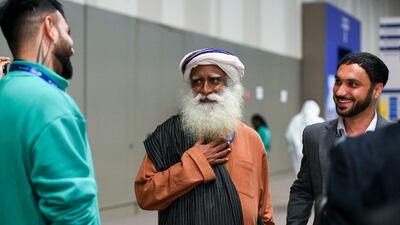
Sadhguru, founder and head of India's Isha Foundation, on day three. Khushnum Bhandari / The National -
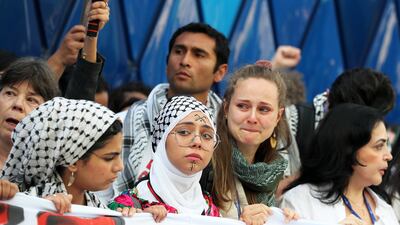
Cop28 demonstrators call for a ceasefire in Gaza. Pawan Singh / The National -

Brazil's popular pavilion. Chris Whiteoak / The National -

Expo City's impressive dome at night. Chris Whiteoak / The National -

Commissioned artwork titled The Choice by Tristan Eaton at Expo City. Chris Whiteoak / The National -
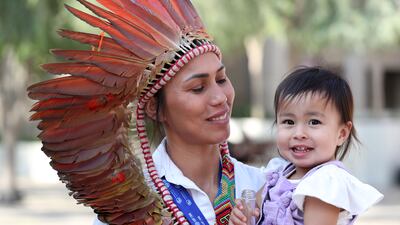
Visitors young and old at the site. Chris Whiteoak / The National -
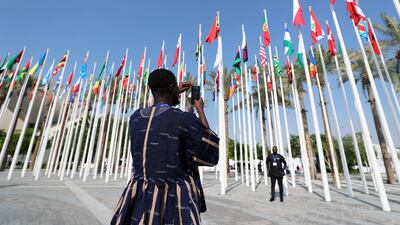
The summit is a global affair. Chris Whiteoak / The National -

Activists air their hopes at the site. Chris Whiteoak / The National -

Local and international communities are working together to secure a greener future. Chris Whiteoak / The National -

Visitors arrive for day six of the summit. Chris Whiteoak / The National -

Young activists from Engajamundo protest about smog being created from deforestation in the Amazon. Chris Whiteoak / The National -

Colours on display on day six. Chris Whiteoak / The National -

Members of a Sikh human rights group in attendence. Chris Whiteoak / The National -

Egyptian comic Bassem Youssef attends a talk on the sixth day. Chris Whiteoak / The National -

The Wake up experience with Sadhguru. Chris Whiteoak / The National -

The Wake up experience with Sadhguru. Chris Whiteoak / The National -

The first week of talks finished on a high, with hard negotiations planned for the second one. Khushnum Bhandari / The National -

Protestors call for a ban on fossil fuels. Khushnum Bhandari / The National -

Day seven's Sustainable Fashion show. Pawan Singh / The National -

Talks resumed on day nine, after a one-day break. Chris Whiteoak / The National -

Friends for Future protest to phase out fossil fuels on day nine. Chris Whiteoak / The National -

Global Campaign to Demand Climate Justice also demonstrate. Chris Whiteoak / The National -

International visitors at the site on day 11. Chris Whiteoak / The National -

People protest about 'no climate justice without human rights'. Chris Whiteoak / The National -

Mariam Almheiri, minister of Climate Change and Environment, speaks at the launch ceremony of the environmental identity. Chris Whiteoak / The National -

Visitors watch the protests. Chris Whiteoak / The National -

Day 11 at Cop28. Chris Whiteoak / The National -

Day 11 at Cop28. Chris Whiteoak / The National -

Indonesian dancers perform on day 12. Chris Whiteoak / The National -

Day 12 at Cop28. Chris Whiteoak / The National -

Negotiations remain under way on day 12. Chris Whiteoak / The National -

Messages left at the Indonesian pavilion. Chris Whiteoak / The National -

Protestors call for climate action to extend to food systems. Chris Whiteoak / The National -

Nuclear for Climate demonstrators. Chris Whiteoak / The National -
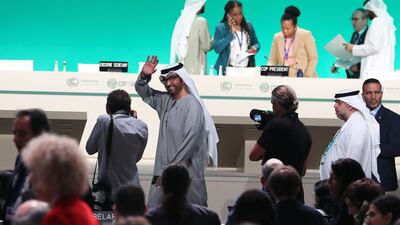
Dr Sultan Al Jaber, Cop28 President, arriving for the plenary session on day 14. Pawan Singh / The National


Lasting legacy of Cop28
His WMO appointment was in the same year the UAE hosted the Cop28 UN climate summit. That resulted in a historic agreement for countries to “transition away” from fossil fuels. Dr Al Mandous said this demonstrated the UAE’s ability to translate ambition into “tangible global impact”.
The UAE continues to play an active role in global climate discussions. Major delegations were sent to Cop29 and Cop30. Later this year the Emirates will again welcome the world for the 2026 UN Water Conference, co-hosted with Senegal.
Dr Al Mandous says his appointment highlights the UAE’s role as a “credible global convener capable of bridging perspectives between developed and developing nations”.
He adds that it “reinforces its commitment to advancing practical, science-based and impactful solutions to one of the world’s most pressing challenges”.

