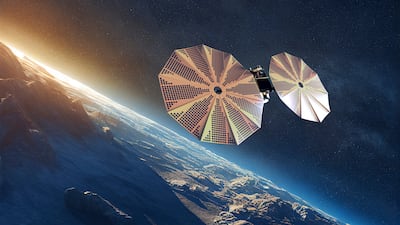
The UAE's voyage to the asteroid belt between Mars and Jupiter has taken a significant step closer to lift-off with system tests now under way.
Dr Ahmed Al Falasi, Minister of Sports and chairman of the UAE Space Agency, hailed the progress on the country's "most complex mission” to date after meeting the team working on the project in the US.
The MBR Explorer spacecraft – named in honour of Sheikh Mohammed bin Rashid, Vice President and Ruler of Dubai – is scheduled for launch in 2028 on a five-billion-kilometre journey that will take eight years.

It is to perform flybys of six asteroids and then send a lander to the surface of a seventh, in what will be a historic moment for the UAE's space sector.
Mr Al Falasi met the Emirates Mission to the Asteroid Belt team at the Space Symposium 2026, in mountainous Colorado Springs, Colorado.
“What we are witnessing today is the result of a journey that began years ago,” said the minister.
"A unified national team from across multiple entities is working together to deliver what is, to date, the most complex mission in the UAE’s space programme.
Following the successful completion of a critical design review last year, the mission has now moved into the assembly, integration and testing under space-like conditions to ensure readiness for launch in the first quarter of 2028.
During the meeting, Mr Al Felasi praised the efforts of the mission team, which brings together Emirati expertise from entities including the UAE Space Agency, the Mohammed bin Rashid Space Centre, the Technology Innovation Institute, the Sharjah Space and Astronomy Hub, Khalifa University and New York University Abu Dhabi.
He concluded the visit by raising the flag of the UAE to represent the UAE Space Agency delegation and the team of scientific experts working on EMA.
Unravelling mysteries of space
Scientists are interested in the asteroid belt because it contains remnants of the solar system and could give clues into how Earth and other planets were formed.
The spacecraft will use gravitational forces from Venus, Earth and Mars to change its velocity to reach the asteroid belt.
The MBR Explorer will perform fly-bys of up to 150km from its seven target asteroids, at speeds of up to 33,000kph.

